Showing posts with label Campaign Design. Show all posts

Monday, May 3, 2021

Buckets of Disadvantages?

We had "session zero" of Undercity Noir, which mostly involved discussing characters and getting a little additional prep-time for me, but part of the discussion turned to Templars and a perennial problem that faces them: fitting their disadvantages into a disadvantage point limit.  Templars are mystic warriors of a secret society, so that gives them a lot of disadvnatages! A Templar has a Secret that could get them killed: that they are Templars, which is a good -20 points.  And they have a Duty to their Templar Chapter, which is extremely hazardous, so it can easily clock in at another -15 to -20. They also tend to have Disciplines of Faith which will clock in easily at -10 points, which is required for them to access Communion, which is the whole point of being a Templar.  So we're already sitting at around -45 to -50 points.  That gives you at most -5 points to define whatever unique negative traits you have, and your quirks, and that's it.

"Why not use buckets of disadvantages?" Shinanoki suggested.  Well, he didn't use that term exactly, but that's exactly what I got from his suggestion.

Monday, March 15, 2021

Musings on Scale Escalation


I'm an anime fan.  It's an on-again-off-again affair: usually I'll lose interest at some point, or something else will catch my eye, and then I'll go in other directions for awhile, and then someone will recommend an anime, and before I know it, I'm buying DVDs and eating ramen, muttering that subs are better than dubs, and otherwise pretending I'm in college again.


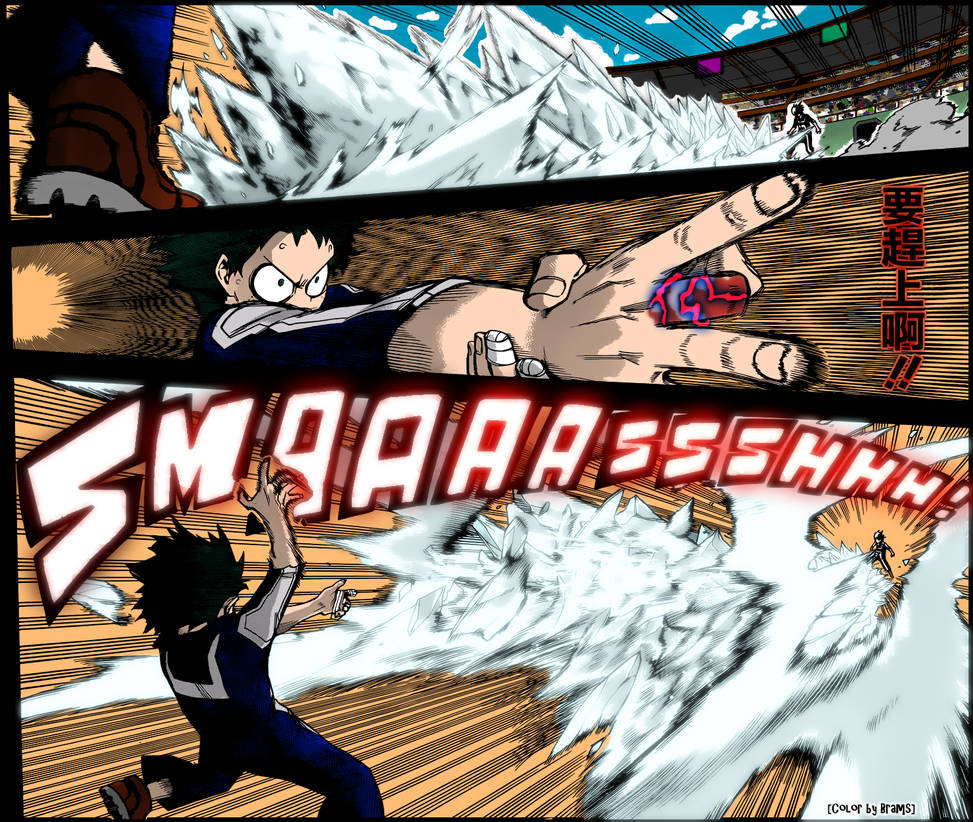
The core anime (there are a few) that has caught my interest right now is My Hero Academia, which is a very well-done, if a bit by-the-numbers, shonen anime about super-heroes.  But what has struck me is how well it engages in scale escalation, though it should be noted it's hardly the only one, and in many ways, scale-mismatch is the driving tension behind One Punch Man.

Let me explain what I mean: nearly everyone in the world has super-powers, but most of the super-powers are lame: one guy might have stretchy, elastic fingers, or they might be able to light a candle.  Even the cooler ones might be pretty subtle and "mystery-men esque" like they might shoot a strong tape out of their elbows, or they might be able to stick to things and that's it.  But some characters have truly devastating amounts of power, like the ability to freeze an entire building solid, or create massive explosions with their hands. Most fights between supers tend to be low-scale, the sort of fights one might expect between characters on the 250-500 point level in GURPS: cool, but not mind-blowing.  Like two skilled fighters could be contained in a room in a building in a city.  Then suddenly a fight will erupt between higher level characters, or a high level character will unbridle their full power and the fight escalates to a new scale. You can't contain it in a small room in a single building in one city.  Instead, it spills out, begins to destroy the area, or it would if it was in a city. It's no longer an "n-scale" fight, but a "d-scale" or "c-scale" where stray damage from this fight would seriously injure or kill a bystander.

We like this sort of scale escalation.  It rapidly ups the stakes, and makes the fight more dynamic.  The story sets the rules for us to understand. Once we have a grasp of it and the stakes, it kicks us out of that comfort zone like a mamma bird kicking the young out of its nest screaming "FLY!" The rules haven't changed so much as greatly expanded, the tensions much higher, and a few variables, which should be obvious extrapolations of the existing rules, and we watch the characters grapple with this sudden expansion.  Ideally, a well-written story should make the solution to the new problem obvious in retrospect, but watching the heroes solve this new, higher-scale crisis with their smaller-scale skills drives a lot of the tension of the story.

Of course, what works in an RPG and what works in television show or movie aren't the same.  Nonetheless, it's the sort of thing I've seen many a GM hunger to replicate, but it usually fails. Why?

Saturday, March 21, 2020

How to run an RPG VII: Narrative Flourishes Part II - Bisociation, Twists and Symbolism

Last time, we talked about alternative narrative structures. This time, I want to talk about diving deeper into your narrative, and allowing your players to extract more meaning from it. These tricks can spice up any sort of narrative!


Sunday, March 15, 2020

How to run an RPG VI: Narrative Flourishes part 1 - Alternate Narrative Structures

We've discussed a lot about narrative structures and the basics of storytelling, but "narrative" is a topic we could explore forever, as there are literally countless stories out there, all with different structures and motifs. This is an art, after all, not a science, so I wanted to expose you to a few different ideas to explore when spicing up your RPG narratives.


Wednesday, January 8, 2020

Review: Power-Ups 9: Attributes

Recently SJGames released GURPS Power-Ups 9: Attributes and my Patrons asked me to review it, so here's my review: Never have I seen a bigger mea culpa from a company, except perhaps White Wolf republishing their old versions of the World of Darkness.  But this should not be a mark of shame on SJGames; instead, the fact that this book exists should make you proud of SJGames. They have heard your endless complaining about attributes, listened, and offered up an entire smorgasbord of options you can use to fix them.

That might seem like an odd review, but upon reading it, that was the unshakeable feeling I had.  It felt like reading someone's commentary on a collection of threads about the problems with attributes.  "IQ is underpriced once you buy back Per and Will," "Nobody would ever buy a 15 point talent when an attribute is so much better," "There are too many skills!" "It doesn't even make sense that Basic Speed would be attached to HT!" "I liked how HP was handled back in 3e better" and so on.  In the past these sorts of things would have been addressed, typically by GURPS fans, as "Well, it makes sense because X" or "You're not allowed to buy that back because there's a hard disad limit" and other such defenses.  This offers no such defenses, though it does sometimes offer the context as to why a decision was made.  Instead, if anyone ever even thought of an objection to an attribute, this book attempts to address it, and other issues beside.  It rips open the entire foundation beneath attributes and exposes them, sometimes more than I would have ever thought necessary.

This gave me mixed feelings about the book.  On the one hand, kudos to Sean Punch. Seriously.  In my experience, the RPG world is full of egotistical authors that bristle at anyone questioning their genius, while Punch says "Oh, YOU DON'T LIKE HOW WE HANDLED ATTRIBUTES? That's cool, here's why we did it, and here's 50 ideas about how you could do it differently, and some tips on how to integrate those changes into the rest of the system." Amazing.  On the other hand, this claws at the thin tissue of lies that suggests GURPS is a "universal" system. If I start making changes this substantial to my game, is it GURPS anymore? Can you pick up your character from your GURPS game and come play in mine? On the other hand, could you ever?  I know some people tried that, with mixed results, with D&D games, but I don't think GURPS every really pretended to be universal in the sense of total compatibility between games, just total support for all genres.  In that sense, this makes it a great supplement.

I will say that unlike the other Power-Up books, this isn't something you'll reference. It reads more like a discussion, like an extended forum thread or a pyramid article, a guide on how to hack your GURPS game.  Once you've gone through it, you should have a pretty good idea of what it's about, and if you're putting together a new campaign, you might revisit it once and see if it has any ideas on how to handle an attribute in your game or if you find you've run into a trait problem.

I immediately began using it in the context of Psi-Wars, and it removed the last mental block I had to lowering the cost to ST.  It also generated quite some discussion as to whether we should change IQ and DX too, and this sort of underlines one of my core complaints about this book, though it's not the book's fault: a lot of what it suggests are so sweeping that if you implement them, you'll have to throw everything you've built so far out the window and start from scratch; worse, the book is persuasive, which left me feeling like I was running a sub-optimal game for running GURPS-as-written, which is probably the biggest... what's a word for an advantage that's also a disadvantage? In any case, by unflinchingly ripping open the guts to GURPS, it reveals a lot of problems you probably hadn't considered, and once it's been seen, it can't be unseen.  You'll be a lot more aware of the warts of GURPS after this book.  It's a book for the brave and for the game designer, not for the guy who just wants to run some campaign and doesn't care how good the rules are and he quite likes GURPS.


Monday, November 25, 2019

Should I lower the cost of ST in Psi-Wars?

I don't check Warehouse 23 every week like I used to, but I really should.  The stated reason for killing my beloved Pyramid was that the SJGames team could focus more attention on creating supplements and this has proven true.  I think I'm seeing a supplement a month again, sometimes more.  And not just Dungeon Fantasy stuff as I feared (I don't mind Dungeon Fantasy, I just don't want GURPS to fall away and have DFRPG replace it), but instead, we get all sorts of fun things.

This month, we got Alternate Attributes, which proved a meatier tome than I expected.  Without going into a full review (I just got it and I've only paged through it), the core of it is meditating on the costs of attributes, what they connect with, and how to re-arrange everything.  And I do mean everything.  They break the skills out by broad categories, they offer ideas on how to turn GURPS into a WoD knock-off with three sets of three traits (plus HP equivalents for each), they offer suggestions for raising, and lowering, the costs of all the attributes and various sub-elements.

What caught my eye is that this book finally acknowledges that ST isn't worth as much at higher TLs, which is a point I myself continue to struggle with as I do a lot of sci-fi gaming and often interact with high TLs.  Given that we have full "canon" support to do this now, I pose a question to you, dear reader and fellow fan of Psi-Wars: should we lower the cost of ST in Psi-Wars?


Monday, October 7, 2019

The Psi-Wars Fallacy

There's a comment I often get from people who have read a lot of Psi-Wars, especially from the beginning, and it goes something like this:

"I like Psi-Wars, but it's funny.  At the beginning you talked about getting a campaign done with a minimal amount of work, and then you proceed to put years of work into it."

The comment is always given in a light-hearted "I don't mean anything by it" sort of comment, but it reads to me as an attempt by the reader to resolve a tension: either I was selling you goods at the beginning by promising that something would be easier than it was, or I was wrong and setting design is, in fact, hard.

The problem here is a misunderstanding of the underlying meaning of minimal work.  I've been seeing some videos, and I got some time, so I wanted to talk about what I'm trying to show with Psi-Wars, why I do it the way I do, what I think you should be doing with your setting design and how you can avoid some major pitfalls.


Tuesday, July 2, 2019

Meditations on Gear in GURPS

Recently I had an interesting conversation over on the Psi-Wars discord.  It started with my statement that I didn't want to see players "saving up" to buy better force swords, that I didn't want them buying "better force swords" at all.  This triggered an entire conversation on gear, RPG genre, and the reasons gear is treated the way it is in RPGs.

I've found myself pondering the topic a lot lately, especially in light of people requesting revisions to Psi-Wars' templates, to update them, and my increasing dissatisfaction with how gear is handled in Psi-Wars.  Why do we have gear in games? What purpose does it serve? And what can we replace it with?

What is "Gear?"

Before we go on, we should define some terms.  Gear is fairly obvious in GURPS: it's stuff you buy with your money!  I'm talking about "loot" in Dungeon Fantasy, or any equipment that you can pick up and discard. It's anything that enhances your character that he doesn't pay for with points, really.  It's an important distinction, for reasons we'll get back to (or may well become obvious over my meandering musings).

GURPS seems to have inherited its concepts for gear from D&D and the other games of the early era of RPGs.  This includes a starting budget for your character, a big shopping list in the book that you're expected to pore over for hours to find exactly the right gear, encumbrance to prevent you from carrying too much gear (thus, creating a decision matrix of effectiveness within a given monetary and weight budget), and scaling levels of effectiveness whereby the game assumes you'll give up your starting gear for better gear "later on."

These are the concepts I wish to discuss here.

Saturday, May 4, 2019

Patreon Post: Clarktech and using Technology as Magic

For this month, my patreons voted for "Technomagic," which in this context means technology that fulfills the same role as magic in a fantasy-like setting. I was pleased to see this topic voted up as it was, as it's been a bit of a hobby of mine for the past few years to ponder how one could create a fantasy-like character with nothing but material out of GURPS Ultra-Tech.  The ideas found their way first into the Dark Engine in my unpublished Protocols of the Dark Engine, then into the Deep Engine of Psi-Wars, and it informed previous games I've run like Blackout Saga.  I personally find that a dash of science fiction, if handled well and noted used as a bait-and-switch, adds quite a bit of spice to a setting.

This document focuses on setting building, do's and don't's of techno-fantasy settings, suggestions for handling an overall magic system using technology as its basis, and what specific technologies, if taken out of their usual context and given a fantasy skin, might look like.

I've made this a Patreon special as it feels more like the sort of thing that usually ends up as a special, and as a thank you to my patrons.  So, if you are a Patron ($1 is all I ask) enjoy!

Monday, April 22, 2019

A Psi-Wars Historical Timeline Part I: Introduction and Calendars

For April, my patrons voted for an overview of the history of Psi-Wars.  I've already written on the topic rather extensively:
But these were rough draft concepts scribbled out when I was just beginning to put together the setting.  Since then, I've created a more internally consistent and cohesive history that I often refer to, but rarely fully reveal.  This week, we're going to dive into the whole thing.  Before we do, it might be helpful to reread the first one, as today we're mostly going to discuss the ideas of how to use history in a setting, why I chose the format that I did, and some concepts.

This series also assumes you're familiar with the Eldoth and the Ranathim; it would help to be familiar with the houses of the Alliance as well.


Friday, April 5, 2019

The Frame vs the Game

Sometimes when I'm looking at my statistics, I notice that I'm getting a number of views from a particular source, such as a blog.  These are usually GURPS blogs (special shoutouts to Dungeon Fantastic, GURB and Let's GURPS for sending traffic my way) and I noticed one I hadn't seen before called the Disoriented Ranger. It seems my post on the Riddle of Systems triggered some thoughts from him.  It's not really a rebuttal, so much that the post inspired him.

The thing that inspired him is a comment I often make about "the game" of D&D being about "killing monsters and taking their stuff," vs other elements that other games do better. He wonders if D&D needs those elements and slides into a discussion on metanarratives and how RPGs are a sort of "controlled language," which is an interesting discussion.

But it did get me to thinking about how many people reject the label of D&D being "about killing monsters and taking their stuff."  He doesn't seem to, not explicitly, but I do think about it.  And while I was thinking about it, I came across an idea that I wanted to offer you to sort of show something I think is critical to understanding the bounds of RPGs, what they do, and why people often get into arguments about whether a game is "broken." It's a conversation about what the game of an RPG is, and what isn't "the game" of an RPG. It's an arbitrary distinction as you'll see, but it's useful for having a particular sort of conversation about RPGs.


Wednesday, April 3, 2019

Rant: My problem with flexible magic systems

If we can set aside Psi-Wars for a second, I came across a video that I want to comment on before I forget it.  The video discusses essentially why Avada Kadavra is a terrible spell, and he's spot on, but this also has broader implications, especially in one of my pet peeves, and why I've not adapted RPM like the vast majority of GURPS fans seem to have.

The problem with flexible magic systems is that, despite purporting to allow unlimited flexibility in magic, they suck all the need for creativity out of a game.

(I was originally working on this when someone asked me for help on a flexible magic system so I, uh, paused it. It was also turning into something longer than I expected and I wanted to put my time on Psi-Wars, rather than a personal peeve of mine.  However, this was the Patron General Topic of the Month, so I posted it; well, actually it was a tie, but this was more ready than the other topic, so this topic went up.  If you'd like to vote on next month's general topic, feel free to support me via the link in the sidebar.  All I ask is $1 a month).

Monday, April 1, 2019

Epic Psi-Wars: A Conspiracy in the Making

This isn't one of my regularly scheduled posts, and I hope my patrons will be patient with this, as their discussions have inspired me, and I find these thoughts racing through my head, so I need to get them out while it's still fresh.
"Unless it's a Templar.  Then you're just effed" - A typical comment on the Templars
There is a fundamental disconnect between how people who know Psi-Wars talk about Psi-Wars, and what I know for a fact is written on paper and it mostly centers on the Templars.  There is this idea that Templars, or other forms of Space Knight connected with Communion, are on a completely separate level from other characters.  The see a team of commandos as dangerous, able to take on entire platoons of mooks and win, but a team of Templars should strike fear into the hearts of Imperial officials and threaten to turn the tides of a whole war. 

However, if you look back at the playtests back in Iteration 4 and earlier, you'll note that Dun Beltain, Space Knight, is not really better than Leylana Grey, a spy, or Kendra Corleoni, a bounty hunter. Yes, they're all cool, but the space knight isn't on a different level. This is a fine and acceptable thing for Space Knights to be.  They could be people in armor with one subtle psychic power ("I an sometimes tell when I'm in danger and maybe dodge a little better" or "I can sense when people are sad") and know enough about fighting with a force sword that they can hold their own with other combat templates and definitely take out a bunch of mooks.  On the other hand, the super-heroic space knight isn't especially bad either.  It depends on what you want.

"What you want" is quite a question to ask.  You can't even go back to the source material and get a fair answer.  Yes, the Jedi as depicted in the prequels are straight up super-heroes (sort of; they rarely really make use of the Force other than as a dramatic display of power; you see far more overt uses of telekinesis than subtle uses of telepathy or ESP), but their power-level in the original trilogy is much more understated.  When Obi-Wan defeats the thugs threatening Luke in the Mos Eisley Cantina, nobody freaks out like Clark Kent just took off his glasses, and you might think they would if you pondered the implications of a Jedi suddenly showing up after years of supposed extinction. Instead, they just go back about their business.  This makes more sense if you think of Obi-Wan, in his original conception, as more of a wandering ronin in a bar hanging out with a cowboy and a princess and a farm-boy-of-destiny.  Obi-wan is not dramatically more special than most heroes in A New Hope, as opposed to Jedi characters in most of the rest of Star Wars, who are on a completely different level.  No help there, then.

So, it's up to us to decide for ourselves what we want out of Psi-Wars.  Do we see Space Knights as "just another character type?" or "setting defining super-heroes?" And the answer seems to be "Yes!"  The sense I get is that Dun Beltaine is fine, and we can imagine a lot of heroic aristocratic space knights on a similar power level, but Imperial Knights and Mystical Tyrants and Templars are on a different level.  Thus, we have two worlds and two different takes on the game: a modest, "street-level" game and a more dramatic "cosmic-level" game.

The question then becomes:
  • How do you handle that without making the game unbalanced?
  • Who gets to be epic-tier? Just space knights?
  • What do the epic-tier characters do?

Friday, March 1, 2019

Buckets of Technology: A Proposed Solution to Tech vs Character Points

(This post was voted for by my Patreon community. If you'd like to vote on topics for this blog, you can join via the link to the left.  Even $1 a month lets you vote in the monthly topic vote).

I've been working with Ultra-Tech settings in GURPS for a long time.  Some, like Psi-Wars, you've seen. A lot, like Resplendent Star Empire, G-Verse, Protocols of the Dark Engine, and Heroes of the Galactic Frontier, have only been hinted at here on this blog.  Many of these lean towards heroic, even super-heroic, sci-fi and space-opera, and thus have high point totals and as a result, I've often come across a problem that anyone who has attempted to run Ultra-Tech settings with high-powered characters has: the value of technology does not match the value of character points.

Available technology, like magic or other inherent elements of the setting, are simply there for characters to pick up and use. They may require some training (represented by skill), unusual backgrounds (like Margery or High TL, if these setting elements are difficult to access), or purchase with money (if you can't just steal it or it isn't universally available), but none of these really cost much in the way of character points, rarely more than 50 for the most expensive or weirdest of things, and most often on the order of 1-5 character points, or even nothing.  How much this matters depends on the tech level.  A TL 3 character can start freely with a sword, while an ultra-tech character can start with a disintegrator pistol.  The problem only arises when we attempt to build a character who has an inherent ability similar to the application of technology.  A TL 3 character might have claws, granting him damage similar to a sword, which might cost him 5-10 points, while a character with a stare that instantly kills a target or disintegrates whatever he sees might cost him hundreds of points.  Both of these are fine in the TL 3 setting (a fantasy character who can destroy you with a glance is definitely a super-heroic character), but cause problems in an ultra-tech setting: the claws are useless and the disintegrating stare, while useful, can be matched pretty easily with a purchase that a character can have with his starting budget.  Why spend hundreds of points on traits like these when you can just have them "for free?"

The answer to that question is typically "Because it fits the world."  Consider Marines vs Bugs, where a marine and bug are meant to be roughly on par with one another, both capable of inflicting serious harm upon the other at roughly similar scales, but one does so with technology (purchased with a modest budget) and the other innate traits (purchased with literally hundreds of points).  Alien, cyborgs and psychics all feature prominently in sci-fi, but in most cases, a player would be better off investing his points in better gear and the training necessary to use that gear rather than in cybernetics, alien abilities or psychic powers.  This, then, is the crux of the Tech vs CP problem, and it often stymies a lot of Ultra-Tech games.

In today's post, I'd like to briefly touch on a variety of solutions I've either used or seen proposed, and then I'll dive into my most recent solution and the one I like best: Buckets of Technology.

Wednesday, January 16, 2019

Mapping Psi-Wars 2: Galactic Map Making

So, previously, I had a post on making a map in general, but the problem with Psi-Wars, and space-based sci-fi in general, is that astrophysical realities make map-making in space especially challenging. I wanted to spend a post talking about these difficulties and how I plan to fudge things to make it work for Psi-Wars.

I also want to comment that I'm not entirely happy with this post.  Galaxies are pretty complicated, and this post was already running long, but I hope I captured the sort of core issues that one faces when going from the surface of a planet to the black sea of the stars.

Monday, January 14, 2019

Mapping Psi-Wars 1: Map-Making in Theory and Practice

Making a Map

Ever since Tolkien unveiled his Middle Earth with the luxurious map of his world therein, fantasy worlds have followed suit, and I personally find it difficult to find fantasy novels that don’t include a map. This has spilled into the fantasy RPG genre, such that Dungeon Master who begins his campaign preparations by first sketching a map has become a cliché in RPG circles. One can do a quick search of the internet to find a glut of such maps and software that can make them look fantastic.

Sci-fi settings seem to have less of a close relationship with maps. Star Wars, Star Trek and Warhammer 40k all have such maps, but they don’t seem to feature nearly as prominently in the work. While sci-fi mappers certainly enjoy mapping our worlds and sectors, they seem to do so with less gusto, especially when it comes to galactic scale maps. I think this is, in part, because such maps are less visceral for readers. You intuitively understand concepts like “Mountain” and “Ocean” but “blue star” and “red star” don’t say nearly as much to you.

I’ve held off on creating a map for Psi-Wars for a variety of reasons, but my Patrons have requested it as a January topic (if you want to vote on the February topic, feel free to join us and help us build the Psi-Wars setting!), so here we are. The actual creation of a good looking map is proving quite difficult and time-consuming, so we might not see an “actual” map so much as a sketch and descriptions, but I also wanted to stop and take the time to discuss what I think the purpose of a map is, mistakes people often make, and what I’m trying to achieve with my map.

Monday, May 28, 2018

Ultra-Tech Framework Post-Script and Comments

I wrote my Ultra-Tech Framework articles with a couple of readers/patrons in mind, who often had questions about how I put together my own technology frameworks in my campaigns, so I thought it might be nice to loosely document how I handled it.  It is, of course, more art than science, and I could do an entire series on game design elements, but I hoped it was useful.

Given that it might be useful to them, it might be useful to you as well, dear reader, so I thought it might be nice to make it generally available, and I was right!  It seems quite well received, and it generated quite some discussion.  I wanted to tackle, broadly, some of the comments and questions I received over the course of the series.  All the questions are paraphrased, because I received many of them on Discord, and I didn't save them at the time, thus they are remembered, rather than directly quoted.  Apologies if this makes some inaccurate.


Friday, May 25, 2018

Ultra-Tech Frameworks: Step 5 - Putting it All Together

Once you’ve created your technological framework, you need to get it into your players’ hands. Players will interact and learn about your framework via a setting description, a gear catalog or alternate rules; optionally, they might use it during character creation (but we can treat this as a gear catalog).

Setting description is typically the most key point, as it will occur for any and all sci-fi settings, whether or not the players even have access to a gear-list. Typically, Familiar-Tech is not worth mentioning at all; it should be implied in the basic premise of “Like X but in the future.” The exception to this is Weird Safe-Tech; you don’t need to be very explicit about it, but painting the technology’s differences helps. Convenience-Tech and Standard Issue Sci-Fi Tech also doesn’t need a great deal of discussion, at least not in the setting description, as they are meant to be familiar or to simply remove problems. These tend to come across nicely in the broader descriptions of the setting itself. In short, unless it drastically changes how the characters interact with the setting beyond default assumptions, it doesn’t need to be stated outright; it can be implied instead.

Miracle-Tech definitely needs a discussion and should be set aside and highlighted. These are the technologies that largely make the setting. You should also discuss whatever limitations are in place, or any variant rules you’re using, or how people see that technology. This can and should be fairly explicit.

When it comes to a gear catalog, preface it with any sweeping mechanical changes, including the base TL, the effectiveness of power cells, special rules for handling computer programs, etc. The gear catalog, after that, should tackle only the things that matter to your game, typically things that the players will want to get for their characters. This can be as detailed as you want, and may be divided up into different markets (“This technology is available only to Alphan players; this technology is available to everyone, but Betans get a 10% discount”) and sections. Use GURPS Dungeon Fantasy or GURPS Action as a guideline.

If your campaign framework revolves around something innovative or requires substantial changes to the rules, make sure those rules are available to the players. For example, if you have detailed hacking rules, players should be able to access those so they know what it is that they need to buy.

Thursday, May 24, 2018

Ultra-Tech Frameworks: Step 4 - Customize your Technology

Once we know what our baseline technology is, we can further tailor our gadgets to our setting. GURPS Ultra-Tech offers us only the most generic material. It will offer you a grav car, but not a grav ferrari or grav pinto; it’ll offer a heavy blaster and a light blaster, but not a Deagle Blaster or a 38 Special blaster. If we want more detail than “car” and “gun,” we’ll have to make it ourselves.

This step is not strictly necessary. In some cases, baseline technology is enough. Consider, for example, a high school drama set in the future: generic technology would be sufficient for capturing the futuristic feel of the game, and you could even inject some Miracle-Tech to force your high school students to wrestle with their changing world. They live in a world where “gun” and “car” is good enough.

But we’ll often find ourselves in a situation where we want more nuance to our technology. This may be because the technology in GURPS ultra-tech doesn’t quite offer what we want. A common example of this might be a desire for a specific model of robot that doesn’t exist in the book. More commonly, we’re fine with the technological principles as outlined in GURPS Ultra-Tech but we want to offer more variety, especially when it comes to our core activity. For example if our game is about space soldiers killing aliens, we might want to offer players numerous guns to choose from and we might want to make the various aliens they fight feel distinct and original.

Wednesday, May 23, 2018

Ultra-Tech Frameworks: Step 3 - Choosing Available Technology (Part 2: Miraculous Technology)

One way to classify SF worlds is to consider what technological miracles are inherent to the setting or story. In this context, we can think of a “miracle” as some area of technology that has a significant effect on the environment in which adventures take place. A technological miracle defines a significant difference between the fictional setting and the real world familiar to the reader or player. – GURPS Space page 29; A Taxonomy of Miracles
The previous sections may make it sound like one should avoid any technology with broader implications at all costs. This is not so! You should, however, only introduce the setting-altering technologies that you wish to introduce, and ensure that all other technologies don’t interfere with them. In fact, “Miracle-Tech” is often the most interesting part of your setting.

Now, to be clear, you don’t need “Miracle-Tech.” Much sci-fi out there uses space tropes as an excuse for exploring exotic things, much as fantasy uses magic for the same purpose. If you want your hero to rescue a blue-skinned space-babe from a tentacled monstrosity, it’s a little more believable if it’s set on the moon of a dying Jovian world than it is if it’s set in the modern world, but that doesn’t mean it must have transformative technologies and tackle deeper philosophical implications unless you want it to. If not, then use the previously mentioned technologies as advised to create a familiar setting without worrying about exotic technologies.

But if you want Miracle-Tech that provokes thought and exploration, the first thing to realize is that nearly any technology can be miracle tech. For example, even if we set aside the qualitative differences TL 12 medicine might have and just look at the quantitative differences of a TL 12 physician’s kit, imagine the sweeping implications if modern doctors could treat five times as many patients five times as effectively? That alone would mean many more lives saved and an absolute improvement on standard of living. Most of the work I’ve done in the past there sections is about downplaying the potentially transformative nature of technology. Here, we do the opposite and play it up. The best candidates, however, tend to be fairly obvious. Anything where I tell you to be careful of the broader implications is a great candidate for transformative technology.

The next question is, of course, how much Miracle-tech, and this is entirely up to you and your setting. You must understand, first and foremost, the mental cost of such a setting, and try to understand your target audience. For some groups, the crazier the better: they want to explore every facet of future technologies and how different and weird the world could be in the future. For others, the weirder the worse, and they’ll react with hostility to things that take them too far from their comfort zone. You’ll have to tailor to what your group can handle. One word of caution on excessive miracle-tech: the weirder your setting, the harder it is for your group to relate or to know what to do. A poster child for this sort of game is Transhuman Space, and the most common criticism made about the setting is “What do I do with it?” You’ll need to double down on your core activity and focus your players attention on it, so they have a starting point from which to jump into the setting. This can require a lot of work on your part as you carefully spoon feed the weird to your players in bite-size pieces until they fully grasp the setting and its implications. If done correctly, though, it can be an exceptionally rewarding experience.

Related Posts Plugin for WordPress, Blogger...