For this month, my patreons voted for "Technomagic," which in this context means technology that fulfills the same role as magic in a fantasy-like setting. I was pleased to see this topic voted up as it was, as it's been a bit of a hobby of mine for the past few years to ponder how one could create a fantasy-like character with nothing but material out of GURPS Ultra-Tech. The ideas found their way first into the Dark Engine in my unpublished Protocols of the Dark Engine, then into the Deep Engine of Psi-Wars, and it informed previous games I've run like Blackout Saga. I personally find that a dash of science fiction, if handled well and noted used as a bait-and-switch, adds quite a bit of spice to a setting.
This document focuses on setting building, do's and don't's of techno-fantasy settings, suggestions for handling an overall magic system using technology as its basis, and what specific technologies, if taken out of their usual context and given a fantasy skin, might look like.
But these were rough draft concepts scribbled out when I was just beginning to put together the setting. Since then, I've created a more internally consistent and cohesive history that I often refer to, but rarely fully reveal. This week, we're going to dive into the whole thing. Before we do, it might be helpful to reread the first one, as today we're mostly going to discuss the ideas of how to use history in a setting, why I chose the format that I did, and some concepts.
(This was a Patreon Voted post. If you're interested in voting for the monthly Psi-Wars topic, join up as a patreon with the link to the right! Psi-Wars topics, as opposed to general topics, require a $3+ patronage, but also get you Psi-Wars previews and specials when they come).
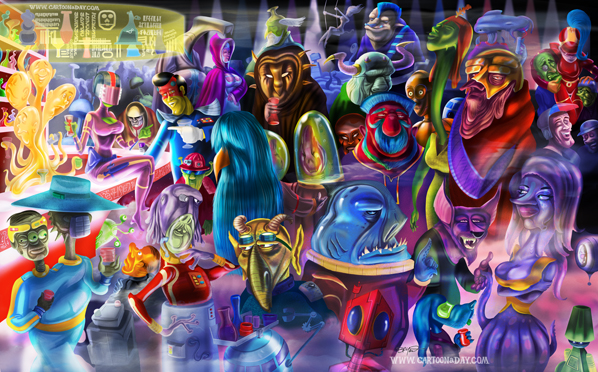
My Patreons have been routinely voting for setting overviews, which tells me something about where my attention should really be, and recently, they've come to a collective realization that all the alien races of the setting exist only in Patreon specials (with a couple of exceptions)! Thus, they've asked for an overview of the Psi-Wars races so that everyone who reads up on Psi-Wars can know what their options for alien races are. They'll be made available in the wiki as well.
There are many intelligent species in the universe. Unless one is dominant or exotic, only those with Area Knowledge of its region of space will recognize it on sight. The various aliens mingle, and there may be true interspecies civilizations... the Star Wars universe suggests a great variety of intelligent beings. --Aliens Everywhere! GURPS Space
Psi-Wars is an "Aliens Everywhere" setting. A PC who stumbles into a bar would expect to see more aliens than we can easily categorize. It's also within the "space opera" genre to treat alien races the way most fantasy games treat fantasy races: to offer numerous playable options with varying levels of depth, so that a player can pick and choose from those. But we're not going to limit our setting to just what aliens I create. In principle, any GM should be able to shove in any alien he wants.
I've talked about alien creation before, and I've talked about setting design before. What I want to do today with this preview, before I get into specific aliens, is show you the general overview I created and themes I used to inform my design decisions, why I chose the aliens that I did, and what role they serve in the setting, and where the "holes" in my setting are.
The Sylvan Spiral
has long hidden its mysteries not behind a veil, as with the Umbral
Realm, but with a mysterious web of hyperspatial filaments that
prevent travel deep into its heart. Throughout most of galactic
history, this meant that march of conquest across the galaxy largely
left this arm untouched. Those who have braved its depths find
wondrous worlds, flush with life and untouched by time.
(Patrons, don't forget to vote on which world you'd like to see more detail on!)
The Sylvan Constellations
The Spindel Web: The
gateway to the Sylvan Spiral, bio-technological adept Shinjurai
clans rule this constellation and have tamed their worlds into
beautiful gardens.
The Morass: The
great bulk of the Sylvan spiral has its hyperspace lines cut apart
by alien “thalline-filaments” along which its
space-based lifeforms travel. These interconnect the ecologies of
its many varied worlds, and make for extraordinarily diverse life
found within the thousand worlds of the Morass
The Serpentis Constellation: On
the farthest edges of the Sylven Spiral, outsider civilizations from
beyond the galaxy wage war on one another and make alliances with
the Slaver empire.
The cold worlds
and the blue suns of the Arkhaian spiral have a long history of
technological excellence and eldritch disaster. It seems to teeter
forever on the edge of collapse, with only the most recent
innovations keeping it alive just that little bit longer. The
combined calamties of the Cybernetic Union and the Anacridian Scourge
may prove to much for it, but the Valorian Empire does all it can to
save this progressive part of space from final apocalypse.
The Arkhaian
Spiral gave rise to the Eldoth, a callous race with unparalleled
technology that, for a time, held the galaxy in their sway. Their
defeat and extinction at the hands of the Ranathim cleansed the arm,
and left it free to be co free to be colonized by humanity, the
Traders and other races; even the younger races wisely gave the
ancestral worlds of the Eldoth wide berth. The arm developed into a
region of exceptional technological prosperity and wealth, and came
to rival the prestige of the Glorian rim.
When
the Anacridian Scourge descended from beyond the edge of the galaxy,
they tore through the Arkhaian Spiral, consuming
its people and laying waste to its worlds. While
the Galactic Federation dithered,
Leto Daijin acted and reformed the military and purged the Arkhaian
arm of the Scourge. The Federation may have seen him as a usurper,
but the people o the Arkhaian Spiral see
him as a hero.
With
so much loss of life, the people of the Arkhaian Spiral turned
increasingly to the support of robots, and were thus unprepared for
the rise of the machines. The Cybernetic Union, which purports to
bridge the gap between man and machine and to offer equal rights for
all, began to force cybernetic alterations on humans and purge all
who disagreed with its programs (robot or human). The now genocidal
military machine of the Cybernetic Union wages war on the Valorian
Empire, while the memory of the Anacridian Scourge and the Eldothic
race lay forgotten… for now.
The Arkhaian Constellations
The Kybernian Constellation: The last remnants of human civilization in the war-torn spiral, the Empire offers them their last hope.
The Borean Stars: The cool, blue stars at the heart of the robotic Cybernetic Union, where humanity has been forced to submit or be exterminated
The Telas Constellation: The homeworlds of the dread Eldoth, now under the protection of an ancient sect of the Templars.
The Arkhaian Chasm: The interstellar gap between the Glorian Rim and the Arkhaian spiral, with vast swathes of tranquil emptiness.
The
Galactic core is an oblong sphere roughly 15,000 parsecs (50,000
light years) across (it takes about a month for a fully cross
the galactic core).
The constellations of the Galactic Core are exceedingly easy to
navigate via hyperspace, meaning it has more than its fair share of
colonized worlds. It
also has more hyper routes than any other part of the galaxy, making
whomever controls it a master of trade across the galaxy and between
the arms, and thus it serves as the prime seat of galactic power.
The Galactic Constellations:
The Galactic Heart: the inhospitable center of the galaxy dominated by a super-massive black hole.
The Crown: The seat of the Galactic Empire.
The Trader Band: A winding, interconnected set of stars that reach from one side of the galactic core to the other, allowing for trade and filled with rebellious aliens.
The Carina Constellation: Human-settled space wracked with the tyranny of the Empire.
The Crucible: The industrial core of the Empire.
The High Halo: A set of stars once held sacred by previous civilizations.
If you are a patron (Companion or higher), you can vote on which world (if any) you'd like more detail on.
So, previously, I had a post on making a map in general,
but the problem with Psi-Wars, and space-based sci-fi in general, is
that astrophysical realities make map-making in
space especially challenging.
I wanted to spend a post talking about these difficulties and how I
plan to fudge things to make it work for Psi-Wars.
I also want to comment that I'm not entirely happy with this post. Galaxies are pretty complicated, and this post was already running long, but I hope I captured the sort of core issues that one faces when going from the surface of a planet to the black sea of the stars.
Ever since Tolkien unveiled his Middle Earth with the luxurious
map of his world therein, fantasy worlds have followed suit, and I
personally find it difficult to find fantasy novels that don’t
include a map. This has spilled into the fantasy RPG genre, such that
Dungeon Master who begins his campaign preparations by first
sketching a map has become a cliché in RPG circles. One can
do a quick search of the internet to find a glut of such maps and
software that can make them look fantastic.
Sci-fi settings seem to have less
of a close relationship with maps. Star Wars, Star Trek and
Warhammer 40k all have such maps, but they don’t seem to
feature nearly as prominently in the work. While sci-fi mappers
certainly enjoy mapping our worlds and sectors, they seem to do so
with less gusto, especially when it comes to galactic
scale maps. I think this is, in part, because such maps are less
visceral for readers. You intuitively understand concepts like
“Mountain” and “Ocean” but “blue star”
and “red star” don’t say nearly as much to you.
I’ve held off on creating a
map for Psi-Wars for a variety of reasons, but my Patrons have
requested it as a January topic (if you want to vote on the February
topic, feel free to join us and help us build the Psi-Wars setting!),
so here we are. The actual creation of a good looking
map is proving quite difficult and time-consuming, so we might not
see an “actual” map so much as a sketch and descriptions,
but I also wanted to stop and take the time to discuss what I think
the purpose of a map is, mistakes people often make, and what I’m
trying to achieve with my map.
Before we can discuss the details of a military technological framework, we should try to understand the logic behind why they use the weapons and vehicles that they use. This means understanding how a particular military force fights, how it combines its various elements into a cohesive whole. It also means understanding something about the culture behind the army, why they fight, and what their flaws are.
I did some work on Imperial military doctrines, or typical Rebel tactics, and these proved quite popular, if the views are to be believed, so I thought I'd revisit some of the thought process behind how I came up with those, and some of the thoughts that I have when creating my own military forces, both so that I can clarify my own thoughts but also, more importantly, to offer you some inspiration if you're creating your own military force.
“I understand why you’re
revisiting this technological stuff, I just miss working on the
setting” - Maverick (I think; and paraphrased, because it was
ages ago, which illustrates how much of a problem it is)
“I think its time for a new
playtest.” – The Secret Council, ominously
I am unhappy. I had wanted to round out a final playtest and a
new version of the Dreadnought, but in the latter case, it felt
redundant based on what I knew was coming up, and the former felt
unfinishable, because I would have to use “Generic everything.”
In fact, the reason I came
up with the Generic Fleet was to do a playtest, but even as I found
myself sitting down to write it, the words wouldn’t come, and I
think I know why: it’s because I’m unhappy. I am unhappy
because Maverick is right, and that sort of thing is way more fun. I
am unhappy because my mind swims with alternate races and lost houses
and Alexian secrets. I am unhappy because I know you want to see
those things and I watch interest dwindle on my discord and my
patreon.
It is very important that a
writer be happy.
Sure, he can be stressed, push to his limits and freaking out, but he
should be enjoying what he’s doing, or the words will stop
flowing. Creativity requires
an element of play, as they are deeply bound to one another! If it
feels like homework, then, perhaps you shouldn’t do it! Yes,
eventually you need to get it done, but pain (and boredom, etc) are
indicators of a problem, and perhaps we can solve that problem.
There’s a reason I’ve
done Iteration 7 the way I have, and it boils down to dissatisfaction
with GURPS Spaceships as a catchall for vehicles. We don’t
have Vehicles 4e, and I must say, this journey has showed me a lot,
and provided a great deal of useful assets I need to move forward
with this, and now that we have them, let’s move
forward, shall we?
I want to make December my
“Framework” month, not in the bland “Let’s
talk about technology in an abstract way” but concrete material
that you, as a Psi-Wars player,
can use, and I want it to reflect the setting, so we’ll kill
two birds with one stone: we’ll build a gear catalog and
develop our setting at the same time! Though
let’s be honest, this will take more than a month, but let’s
see where this takes us!
I've written about the Empire for nearly 2 months and produced more than 70 pages of content (40k words). Is it enough? Is it too much? Let me take a minute to think that through, discuss why I think my material is justified, and then to offer a summary of the whole thing, and a focus on building Imperial Characters.
My Target Audience
Back in the First Steps to a Setting, I described three sorts of people that I imagine might actually use Psi-Wars:
Star Wars fans open to something new
GURPS Sci-fi fans who want support for something Operatic
DF Fans who want to play something sci-fi-ish, but don't want to do the work.
My design has generally pushed towards a conservative design of the Empire: any fan of Star Wars will readily recognize the Empire of Star Wars in here, but with only a few major differences: Black Ops (and a similar organization surely exists somewhere in the EU), the fact that the Senate still exists, and the nature of the Emperor himself. Everything else is fairly recognizable.
From there, I've tried to focus exclusively on elements that directly support gameplay where I can. The result should be organizations that need no additional work to play with (helping the DF-types), offering insights into how such organizations might work (for the GURPS Sci-fi fans), and offering Star Wars something familiar, but not too familiar.
I've chosen for the familiar path to cut down on the need to explain things to my players. You don't need to read all 30 pages of the Psi-Wars Empire to get that it's like the Star Wars Empire: "Oh, it has dreadnoughts instead of Star Destroyers and Typhoons instead of Tie Fighters, and the Emperor is a little different. Right. Got it." This means it lacks some creativity, but I don't personally feel this is the place for deep creativity. Players should be grounded in a familiar world, and the Empire very much represents that world. This helps the "Brents" who just want to jump straight into the game and not "do homework" to play.
Most of the material focuses on organizations, what they can do for you, and how they might oppose you. This makes them a great grab-bag for the "Bjorns" who want to know which organization they should join, and why. Perhaps he'll join Black Ops, play as a Black Op commando and get some great commando toys. Or perhaps she'll play as a Imperial Security Agent who genuinely believes in the Empire, and is working to root out corruption from her post as an attache to a Minister of Justice aboard a Dominion-class Patrol Cruiser. It also helps the Rebel player who wants to know what interesting opponents the Empire can throw against him.
This focus on organizations also helps the "Desiree" player who wants to know which factions to join and what they might want. However, the elements that I expect will most interest her come at the beginning, as I discuss what it feels like to be in the Empire.
The player who will likely enjoy Imperial material the least is likely the "Willow." This material largely lacks rich lore, other than perhaps the true agenda of the Emperor, but the most fascinating elements are likely the secret cabal of evil space knights that surround him, which I haven't touched upon yet. Why? Because I need to understand space knights first, so we'll come back to them.
I also want this to be a grab-and-play sort of document for GMs, hence the inclusion of agendas (which amount to session seeds), and minions, who represent characters the GM can immediately throw at his players.
The net result is on the very small side of an SJGames supplement (on par with Boardroom and Curia) and smaller than the average Pyramid (which is about 40 pages long), unless we count gear.
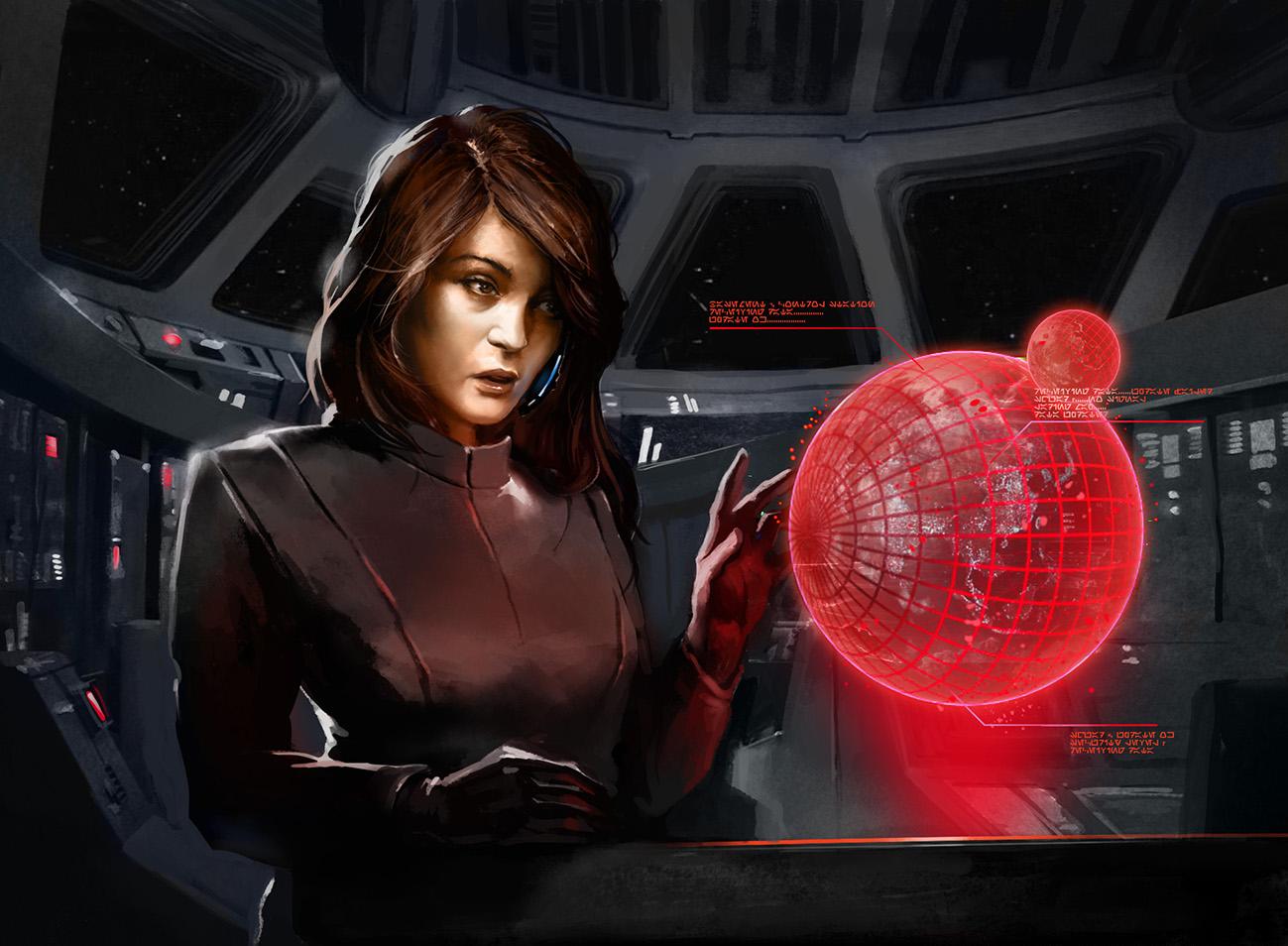
I must admit surprise that Star Wars almost never deals with the police (The films; the EU references the Imperial Security Bureau). Sure, I realize that Star Wars is, of course, about war, but so much of what Star Wars deals with actually falls under something a police officer would deal with: A smuggler should fear the port authority (and not Storm Troopers), and a conspiracy of evil Sith should be uncovered by detectives, not by space knights. In fact, we regularly see military personnel or the Jedi acting in a police role that the sudden and inexplicable abscence of the police becomes rather transparent, at least to me. That, alone, is enough to justify the inclusion of Imperial Security (something the Old Republic does as well, by the way). But I have more reasons.
Hannah Arendt, who wrote the classic analysis of totalitarianism,said that totalitarian societies had three characteristic institutions:massive propaganda efforts directed at their own populations, secretpolice forces, and concentration camps that caused mass deaths.
-Bill Stoddard, Social Engineering
A police force imposes the will of the government on the people. The Imperial Ministry may make the law but Imperial Security enforces those laws. More than that, dictatorships need police, taken to extreme levels. The Empire is almost certainly CR 6, and it must therefore police its people to make sure that no "sedition" or "corruption" has seeped in, and that nobody threatens to topped the delicate structure upon which the Emperor has settled his throne. All must embrace the cause, all must understand the divine purpose of the Emperor, and all who do not must be found, convicted and shipped off to labor camps to die out of the public eye.
More than any single force, I expect the players will run up against Imperial Security. When they try to assassinate officials, or smuggle medical supplies onto a rebellious world, or when they're trying to make sure their machinations aren't uncovered by the empire, it's Imperial Security, not the Imperial Military that they'll face. Thus, we need them, both as someone to serve (especially if you're a Bounty Hunter), but especially as opposition.
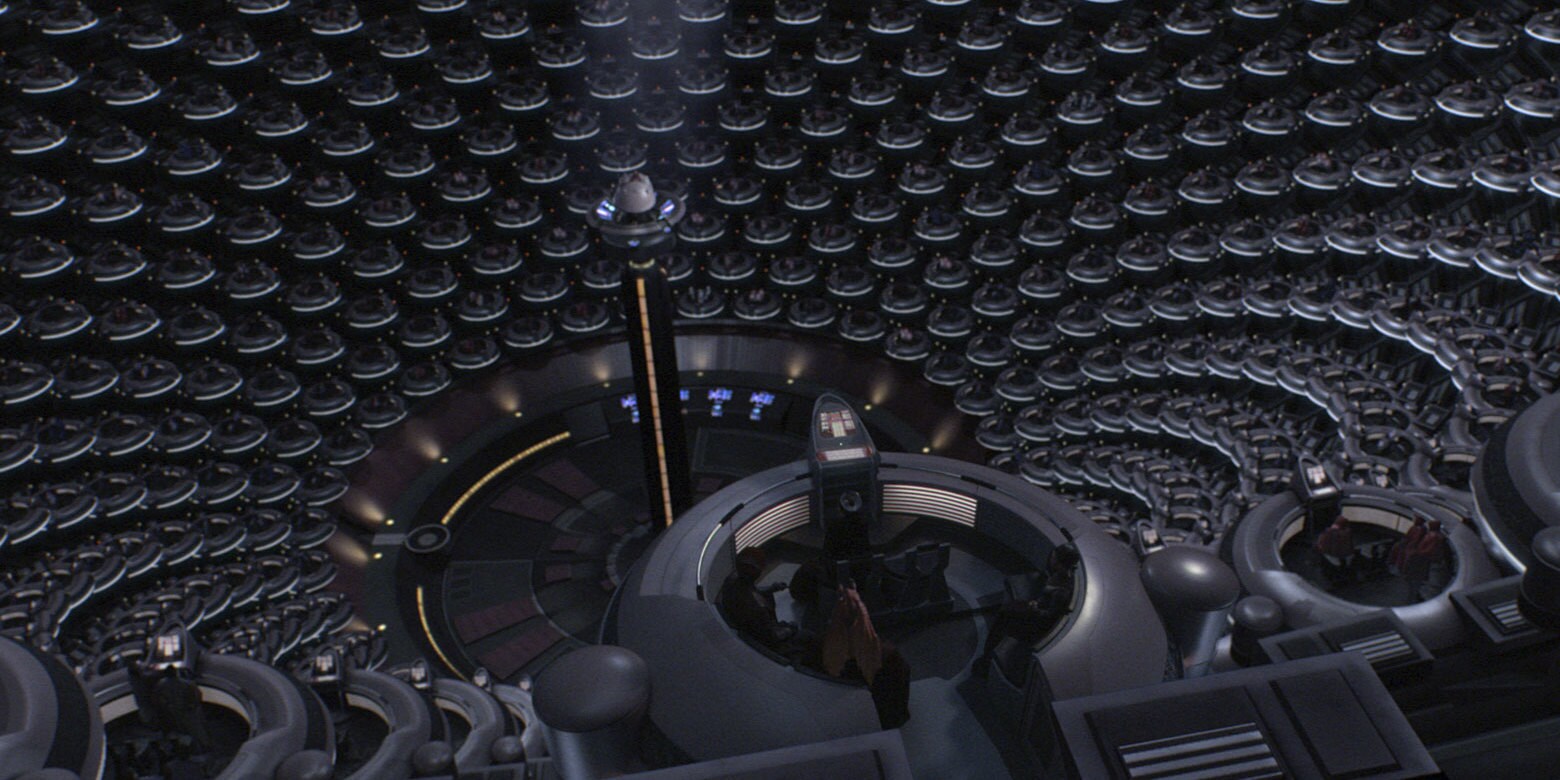
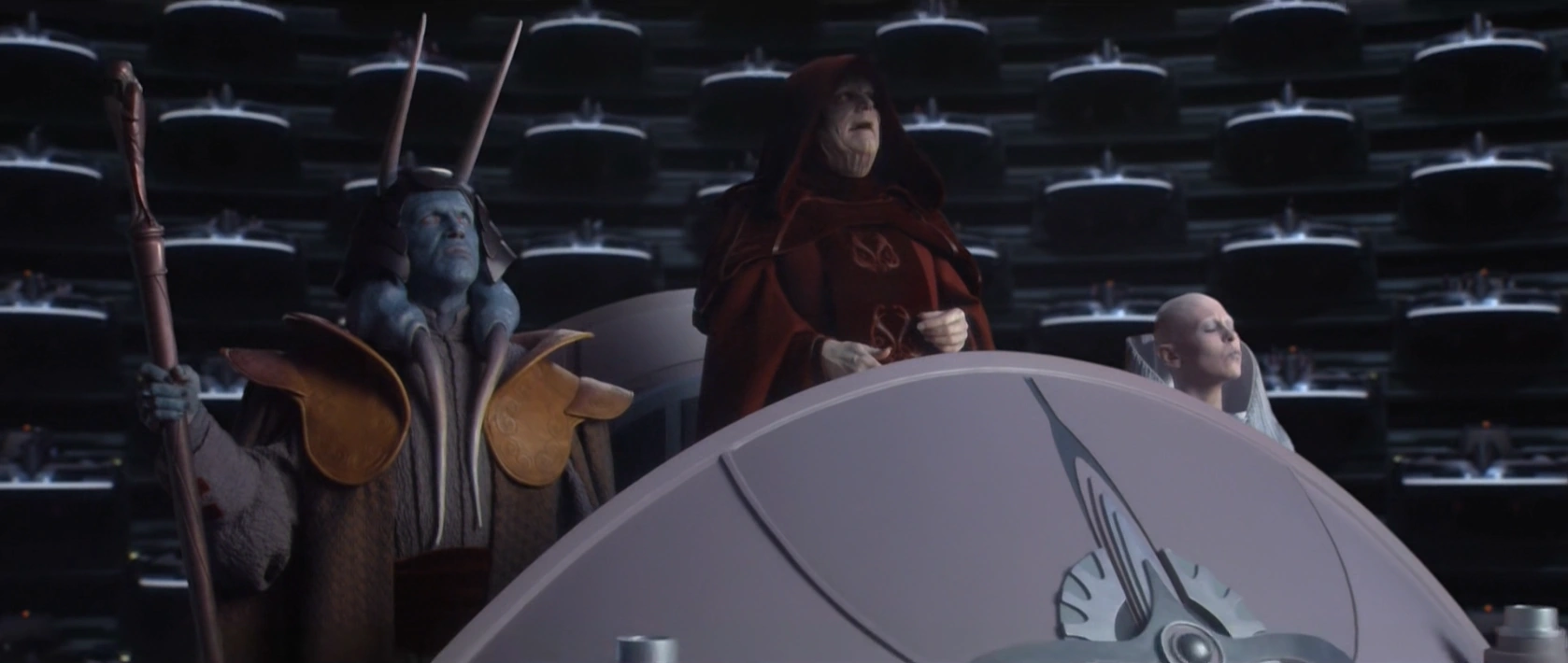
Turmoil has engulfed the Galactic Republic. The taxation of trade routes to outlying star systems is in dispute.Hoping to resolve the matter with a blockade of deadly battleships, the greedy Trade Federation has stopped all shipping to the small planet of Naboo.While the congress of the Republic endlessly debates this alarming chain of events, the Supreme Chancellor has secretly dispatched two Jedi Knights, the guardians of peace and justice in the galaxy, to settle the conflict....
-The Phantom Menace
"Control the coinage and the courts—let the rabble have the rest." Thus the Padishah Emperor advised you.
-Dune
Dreary politics and statecraft is probably the furthest thing from the minds of the players of any action scenario, and yet politics feeds into every action scenario: The Expendables features a political coup against a South American dictator at its core, and James Bond stories revolve around Cold War politics. The action hero might not be a politician, but politics often drives the context of his action.
Thus, I'd like to get the "least exciting" of our Imperial triumvirate out of the way first, and take a look at imperial politics. Of all the character types, I expect only the Diplomat will really invest deeply into the organ of state within the Empire, but any character with an aristocratic background might find himself or herself tied into it.
But everyone and anyone might find themselves at the beck and call of a powerful imperial official or a wealthy imperial senator. They'll call upon Assassins to destroy their rivals, or find themselves the marks of the Con Artist, or they'll confer quietly with their personal Spies. The point of this organization, more than anything, is to provide context for the actions of our characters.
Organizations represent the heart of every Action game. Organizations (the police, the CIA, a spooky cabal) hire heroes to fight other organizations (the Mob, terrorists, a spooky cabal). While organizations aren't central in the sense that they're not the mechanics that drive the action, they encompass, surround and provide the context for the action.
So, more important for Psi-Wars than planets, or alien races, or cool technology are organizations. Of course, some organizations will be unique to planets or regions of space, but a few major organizations so thoroughly saturate the setting that they must be defined before the rest of the setting can be: the Empire, the Rebellion and the Space Knight Order.
All of them need the same sort of questions asked and answered to work in a proper Action context, so in this introduction, I'm going to start with the Empire itself as an example of Organization design.
Four thousand years before the rise of the Galactic Empire, the Republic verges on collapse. DARTH MALAK, last surviving apprentice of the DARK LORD REVAN, has unleashed an invincible Sith armada upon an unsuspecting galaxy.
-Knights of the Old Republic, Opening Crawl
The First Jedi Temple, from the Force Awakens
The Star Wars universe boasts a considerable history, often a cyclical one. In it, Luke goes in search of the "First Jedi Temple," and we're treated to visions of the ancient city of Jedah, and we have an entire game series set in the "Old Republic" which nearly replicates the galaxy in its later state, only with a few minor changes (convenient for an RPG!).
This isn't that far from how history actually works. History tells the story of humanity, our struggle to pull out of primitive and poverty-stricken barbarism, then to rise to the dizzying heights of civilization only to experience a total system collapse and be driven back into the depths of barbarism. The history of China studies of the rise and fall of dynasties, and our own history has the rise of Europe after the fall of the Roman Empire (you might call the 14th century collapse of High Medieval society brought on by the Black Death such a fall, but Europe recovered with its identity largely intact), and Rome itself rose after a period known as the Greek Dark Ages, which followed the Late Bronze Age collapse. It is this last that some scholars argue give rise to Greek myths of a "Golden Age" that preceded the darker classica era.
Whether there's truth to that, those myths do exist, and they shape our myths. The notion of ages, of civilizations rising and falling, followed by heroes plumbing the depths of those ruins to find lost treasure and secret lore. Star Wars, following the trope of fantasy and mythic stories, whispers of lost Jedi temples and ancient Sith empires. It's not the only to do this: Warhammer 40k has a loose sketch of its considerable history (and has recently released Warhammer 30k!); Dune likewise hints at considerable history, such as references to the Butlerian jihad; Foundation features an Empire that was ancient and on its way our before the series even begins, and also has an archaeologist hunting for the origins of humanity in the Galaxy; Traveler sets its current game in the third Imperium, and has details to the previous two.
Thus, a truly ancient history certainly has a place in Psi-Wars, but as before, we need to justify it by determining what questions it answers. The most obvious to me are "So, what kind of cool ruins does this game have?" or "What's the story behind all of these aliens," though I would caution against making every alien race older than humanity. But the biggest one players will probably want to know is:
"What are the origins of Communion?"
I don't mean this in the sense of "How did the psychic phenomenon of Communion come into existence?" Presumably, it has always existed, though if we wanted some race to have constructed it, that should have happened literally millions of years ago. No, I refer to the faith of True Communion, the philosophy that drives so much of the game. Just as the Jedi faith seems to have ancient roots, and our own myths and religions also seem to have roots buried in oral traditions that existed before the dawn of time, players may well expect that Communion is an ancient faith that greatly precedes the modern era. If that is true, then we need to tell the story of the world that gave rise to it
And while we're doing it, we can answer another question:
"What are the coolest relics possible?"
If we have a truly ancient galaxy, then we can have truly ancient relics brimming with unspeakable power, the sorts of things wars might be fought over. These, too, would be grounded in our dawn era.
Your father's light saber. This is the weapon of a Jedi Knight. Not as clumsy or random as a blaster; an elegant weapon for a more civilized age. For over a thousand generations, the Jedi Knights were the guardians of peace and justice in the Old Republic. Before the dark times... before the Empire.
-Obi-Wan Kenobi, A New Hope
Now that we've settled on the basic outlines of the history of the Empire and how the Republic collapsed into autocracy, we're left with some questions:
How did the republic form in the first place?
Who are the aristocrats who dominated the republic and where did they come from?
What did the military look like before the domination of our charismatic general?
But I, personally, have a question that I think is far more pressing and likely to be asked by your players, even Brent, more often than any of the above:
"What about the Space Knights?"
Where do they come from? Where did they go? Why are they gone? What where they like? Are they still around? How? And why do they seem to be suddenly making a comeback?
Star Wars has some answers for this: The Jedi Order was, like, always there, until their enemy, the Sith, took over and used Order 66 to kill them all, and this was like 10 years ago, but now the Jedi are already legends.
Personally, this doesn't sit well with me. To me, when I heard that line above in A New Hope, I envisioned something Arthurian, this ancient order who had vanished centuries ago but somehow still had a few masters scattered across the Galaxy, if only you could find them and revive the good old ways.
Then, the real question this history has to answer is: "How to religious orders fall?"
So this is how liberty dies. With thunderous applause.
-Padme Amidala, Revenge of the Sith
When you design a setting element, or a story, or a hook you'll use to inspire yourself later, you should try to build a question into them, some element you want to explore and touch on, or let your players explore. I would argue that all of the Star Wars prequels revolve around the question of "How did the Republic become the Empire?"
George Lucas answered that question with a bit of Roman and German history, plus his own personal political philosophy. I also thoroughly believe that George Lucas wanted us to ponder this question ourselves and relate it to our daily lives, which quite a few people have certainly done, with gusto, in regards to the recent elections, if my Google Search for the above quote is any indication.
I'd like to revisit that question, using much of the same inspiration that George Lucas had, and show you how we can come to a very different conclusion than he did. I want to revisit how democracies die, and more than that, I want to look at the broader implications of the histories from which George Lucas drew his inspiration, and use that to expand the setting beyond the narrow scope Star Wars has.
I wanted to begin with history because history often explains how we got to where we were. Thus, history and cartography are usually amongst the first choices of setting-builders when they get started, as history represents where things started. History will explain why everything is where it is, making it the foundation upon which we'll build the setting.
That said, I almost held off on it, because history needs to explain how the setting came to be in the shape that it is, and without knowing what that shape will be, how can I write its history? I could just write the history and then from that history derive the setting, but if I have some crazy-good idea later on as I'm working on, for example, geography or technology, should I discard it just because it doesn't fit my history? Of course not. The intent here is not to set everything in stone, but to build, collect and curate inspiration, and tie it together well enough to create a cohesive setting. So, perhaps it would be better to write my history after I've finished coming up with the setting? After all, that's how Star Wars wrote its history: George Lucas said "Space war! Evil magical samurai! Giant planet-killing space station! Details to follow!" and made his movie, then expanded his universe.
I propose we do both. Having a decent grounding in the history of our setting well help guide us in our creative efforts. It'll create a framework that will inspire the rest, but as we work on other parts of the setting, we'll fold their stories and histories into the greater fabric of the history we're writing. Thus, we'll do this largely in two parts: Up front, to inspire our work, and at the end, a final edit of all the history we need to explain the setting we've come up with.
Before I begin, though, I'd like to do my usual discussion of setting creation theory. First, we need to justify doing this at all, and get an idea of what our intent here is. Second, we need a picture of how we're going to proceed, and finally, we need to tools at our disposal.
I'm afraid I can't find the quote by Kenneth Hite, but it amounts to this: No matter how creative you are, the real world will come up with something stranger and cooler than you can ever come up with, and you'd thus be a fool not to pillage history.
This is especially important for Psi-Wars, for two reasons. First, Star Wars, from which Psi-Wars draws is principle inspiration, is very thoroughly based on history, especially the History Channel favorites like World War 2 and the Roman Empire. If we want Psi-Wars to feel the same, then we need to draw our inspiration from a similar source. But more importantly, Psi-Wars must necessarily be larger than Star Wars, given that Star Wars is "only" a movie, while Psi-Wars needs to be a setting that supports a huge variety of different possible games. That means we need more material to steal from, and there's hardly more material than all of human history.
As before, though, I intend to pursue emulation rather than imitation. I don't want Psi-Wars to be the the Fall of the Roman Republic with the serial numbers scratched off, I want to understand what made Rome fall, and then draw parallels with that with the fall of my Galactic Empire. This is the same thing Lucas did in the prequels though I'm quite sure I'll draw different historical conclusions than he did (It takes more than a single war to turn a democracy into a dictatorship). We need to do our homework, and I certainly have (Look, I like history, okay!), and I've noted some sources below. Those are just some sources, a place where you might start. The point here is hunting for ideas, not necessarily a rigorous historical thesis, thus I've happily included semi-fictional works and well-researched RPGs. It's not meant as an exhaustive bibliography of books I've gone through.
So, what part of history can I draw on for inspiration for Psi-Wars?
The last part of setting building is research, and I'm going to break this up into two parts, starting with the other works of fiction from which I can draw inspiration for my setting. I originally intended to dedicate a week to this, because I think there's a fantastic amount of stuff we can look at, but I'd rather finish sooner than later, so let's do a whirlwind tour. As we go through the actual setting, I'll bring up sources and ideas from these original elements as necessary.
Obviously, the biggest inspiration is Star Wars itself, but we can gain additional inspiration from that which inspired Star Wars, that which Star Wars inspired, and whatever else I happen to find interesting. Star Wars itself is much bigger than just the films. Particular things that I often find myself referencing again and again