Wednesday, August 31, 2016

Tactical Analysis: Civilian Conflict

I have a draft back in Iteration 3 that never got published, nor finished, for Thug mooks.  So far, we've limited ourselves to military-scale opponents, because the most common opponent in Star Wars is a stormtrooper, and Star Wars treats its enemies as more-or-less interchangeable when it comes to difficulty.  Psi-Wars, being an Action game, accepts the notion of differing BAD levels, and thus differing levels of competency from its opponents.  Thus, we'd expect Psi-Wars troopers to be better than some opponents, and worse than others.  We'd also expect them to fight with different tactics.

A hive of scum and villainy
This creates a scale of opponents, and on the low end of that scale would be gangsters, thieves and punks, the sorts of people who might frequent a cantina.  While they might be dangerous or well-armed, they're ultimately just civilians.  They lack military discipline, skill and, most importantly, back-up.  If a soldier is BAD 12-14, then a gangster might be BAD 10-12.

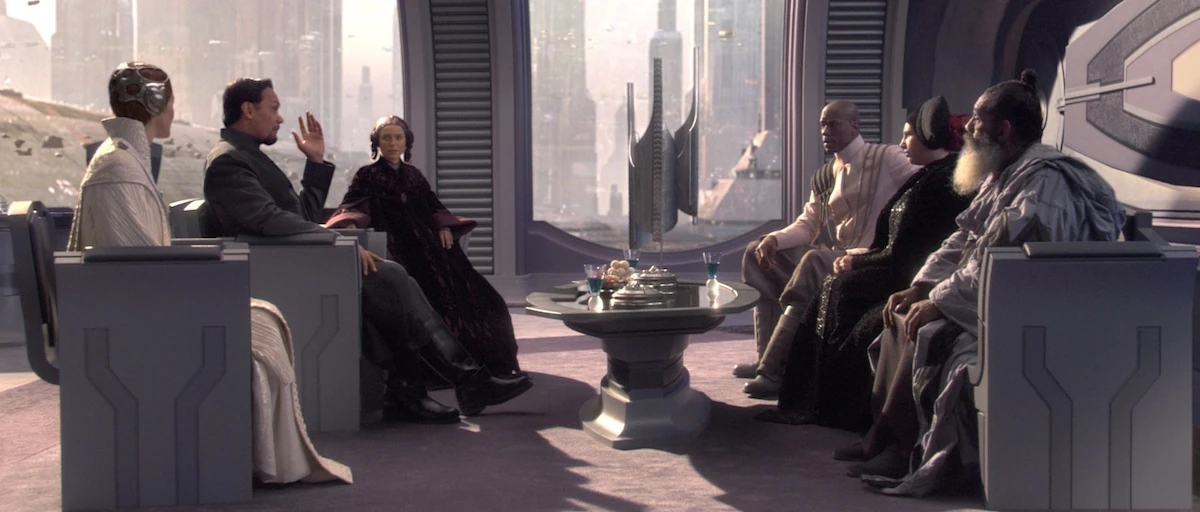
But they have something in common with an another archetype: the upper-crust civilian.  Both thieves and nobles will typically carry only a personal weapon, one that they carry as much to signal status as to protect themselves.  Both
A haven for elegance and wealth
might view personal combat (under strict rules) as a means to advance their personal status.  In both worlds, it's highly inappropriate to walk in wearing full armor and carrying a full complement of military gear, especially if your objective is to negotiate with the other party.  In both worlds, that negotiation might suddenly go south, and might suddenly turn very violent, so it behooves one to be well-protected, and in both worlds, the ideal form of protection are body guards... and making sure the other guy isn't particularly well armed.

We don't actually have stats worked out, but we can extrapolate them pretty nicely.

Standard Civilian Combatants

A typical civilian wears little to no armor (rarely more than an armored coat or a thin armored vest under their clothes).  Expect no more than 20 DR in a few, strategic locations.  Civilians rarely carry heavy weaponry.  Most thugs will be poor and will rarely carry anything more expensive than a blaster pistol or a vibro-knife, and might even wield some improvised equipment.  Nobles will have more expensive items, but not necessarily much more effective, as they're more worried about ornamentation (and statement) than self-defense.  Expect weapons like elegant holdout blasters, ornate vibro-blades, or perhaps even a force sword.  In both cases, most skill levels will be between 10 and 12.

In combat, many civilians will be non-combatants, which means they'll lack combat reflexes, freeze up if surprised, and may well panic and simply run, or attack wildly while trying to escape.  More combat-savvy characters (battle-tested gangsters or former soldiers) will fight with greater precision, but their tactics will generally be to overwhelm, perhaps even grandstand.

If civilians want to initiate combat, they'll do so either via an ambush (social or otherwise) or by trying to initiate a duel.  In the former case, gangsters and punks will probably pin someone down in a back alley, knock them over and then commence with the kicking, while nobles will probably spring on someone in a place far from the eyes of other, inflict their damage, and then demand silence "or else." A duel is more open and formal, a challenge spoken and rules (unspoken or otherwise) declared, and then the battle fought, usually under the watchful eyes of others.  Here, the point of the combat is not just the defeat of the opponent, but a glamorous victory.  A stylish duelist can gain more than just victory over his opponent as he becomes the talk of the town and his reputation begins to rise.

Bodyguards and Hit Men

Bodyguards and Hit Men are likely to be nearly as skilled as soldiers (BAD 12-14) and may well be former soldiers, but typically less well-armed.  Nobles will have heavily armed and armored bodyguards, but more money will got to making them look good rather than having them be effective.  Expect weapons like vibro-glaives, force-glaives, force-swords, vibro-blades, or ceremonial blasters, and their armor might be a combat hardsuit, but it'll be a lovely, ornate one.  Criminals will have less elegant bodyguards and hitmen, but also less effective, as a truly excellent guard/assassin/combatant could expect superior employment.  Why be a hit man to some mobster if you can parley your talent for murder into a job for a local noble?

Both will tend to stand back and survey the scene.  Their job is to be unobtrusive, a beautiful and/or intimidating part of the scenery, until violence seems immanent, and then they spring into action.

Tuesday, August 30, 2016

Tactical Analysis: Military Conflict

We've had Troopers since Psi-Wars began, back in Iteration 1, and they've been very thoroughly refined.  We have a solid idea of how they'd operate together on a battlefield.

Standard Troopers

The typical trooper has skill 12 with his blaster carbine, which has an accuracy of 10.  Assuming the soldier braces (+1) and aims (+10), he has a skill of 23, which means that he's got a pretty good accuracy out to ~70 yards.  If he's mobile and on the move, that accuracy drops substantially to making effectively wild shots. Troopers come equipped with plasma grenades, which will kill even another trooper in the same hex, and kill or seriously injure unarmored combatants out to 1 to 2 yards from the explosion point. The typical trooper also sports 60 DR on the chest and 30 DR elsewhere, making him an exceedingly tough nut to crack.  Their armor grants them microclimate control, is sealed against environmental hazards, and grants them IR vision, making them excellent night-combatants.

A typical trooper will probably crouch behind cover and lay down some massed fire with his squad-mates.  A careful trooper will aim, and an aimed shot will hit.  If they need to advance, they'll cover one another with supporting fire while making use of cover, but it none is available, they'll advance in the open and trust in their armor.  If their opponents use cover, they'll use grenades to flush them out into their arc of fire.

Elite Troopers

Troopers have three "supporting" types: The assault trooper, the heavy trooper, and the recon trooper. 

The assault trooper sports heavier armor and superior close-combat weaponry.  In an open-conflict, an assault trooper likely carries shock grenades and/or a flamer. He'll lead assaults on enemy positions, with his superior armor absorbing enemy fire, and his superior training allowing him to spearhead the attack.  Open conflicts aren't really his bailiwick, however.  He's better at urban conflict or ship-boarding operations.

The heavy troop is generally equipped with a missile launcher or a gatling blaster.  In the former case, he'll tackle hardened targets, such as entrenched "machine gun nests" or tanks, and in the latter case, he'll offer supporting fire to his side, either to defeat assaults, or to keep the enemies heads down while his allies advance.  The heavy trooper is ideal in open conflict, but suffers some in urban or ship-board conflict.

The recon trooper has superior infiltration skills and a powerful sniper rifle.  He'll slip past enemy lines and find out what the enemy is up to.  He might engage in sentry-removal with his vibro-knife, and in open conflict, he'll focus his sniping efforts either on removing high-priority targets (officers) or on frightening to soldiers into keeping their heads low while the standard troopers and assault troopers advance on the enemy position.

Advanced Tactics

In truly open conflicts, soldiers will bring combat vehicles, like hover-tanks.  A hover tank features 1000 DR on its front and turret and 500 elsewhere.  One needs something like a missile to remove it from play, and preferably from the side, rather than the front.

Soldiers aren't always constantly prepared for battle.  They could be on the move, in which case they likely use combat vehicles like Military Vertols or Hover IFVs to get around or, more rarely, they'll march. In such case, fighter support and recon troopers will scout out the terrain to prepare for any ambushes.  Alternatively, they could have settled in for the night, in which case they've set up some temporary defenses like razor wire or x-ray fences, some surveillance cameras and regular patrols, usually in the form of standard troopers and a few well-placed recon troopers.

Monday, August 29, 2016

Martial Arts Analysis: Breaking down Psi-Wars Tactics


Ultimately, if a player is going to invest points into it, a martial art needs to be effective.  Whether it's "authentic" matters less than if it doesn't work, because the last thing we want is to devise a totally cool version of Force-Swordsmanship, let a player invest 100 points in it, and then cut him down in the first battle, because our vision of Force-Swordsmanship doesn't work.  But for us to create a working martial art, we need to know what sort of opposition a player will face, and how best to tackle it (or alter the rules/opposition so a particular tactic will be effective).  What we need to create is not just an accurate translation of Star Wars that makes good use of GURPS, but an interesting tactical space where interesting player choices interact with interesting opponents, and for that, we need to know, or define, what that tactical space is.

Thus far, we've looked at Star Wars, our source inspiration, and GURPS, our target material, but we would be remiss if we thought we were developing Psi-Wars in a vacuum. Psi-Wars already exists, in large part.  We know what the spaceships look like, we know who some of the aliens are, we know what sorts of gear people use, and what soldiers look like. We've begun to form a picture of what Psi-Wars is, and we've already run some battles, and we already know how battles largely play out.  This means we can say some things about what sorts of tactics we can use to defeat our opponents.  By taking a look at the existing world, or what we expect our world to look like, we can postulate what sorts of tactics, rules and martial arts could live and thrive in such a setting.

Over the next week, I'm going to take a look at existing, or expected, psi-wars tactics.  I'll discuss the NPCs involved, how I expect them to operate, and how I'll use them to defeat the players.  Then I'll discuss the typical tactics PCs of various stripes might use to defeat them, and whether or not they'll be particularly effective, and what it would take to make them effective.

The idea here isn't necessarily to fix or design our martial arts so much as to understand our tactical space.  If it turns out that force swords are a terrible idea, understanding why will help us see how we can change things to make them work better.  If it turns out that blaster pistols are stupid under certain circumstances, we might allow that to stand (in the same way that most dungeon fantasy GMs are fine with allowing bows to be a terrible melee weapon).  But the point here is to look for potential traps, and to understand what sort of tactics the heroes of Psi-Wars might use.

I don't know if I can get to all of them, but most combat scenarios break down into the following:

  • Military conflict (an open battle against soldiers and their combat-vehicles)
  • Ship-board conflict (pirates or battles against marines in the closed confines of a ship)
  • Criminal conflict (sudden brawls in dark alleys or in bars)
  • Assassination attempts against officials (battles against bodyguards and against "soft" NPCs)
  • Battles against unusual enemies
    • Robots
    • Alien monsters
  • Gladiatorial battles (a time-honored space opera tradition!)
I won't be able to get into everything, but I'll see how far I can get. In each post, I'll discuss the tactics I expect the NPCs to use in this sort of situation, the rules according to GURPS Action (and Psi-Wars adjustments), and then I'll discuss the various expected tactics certain players might use, how effective they could be, and how well variations might work.

Friday, August 26, 2016

Azrael, Angel of Death, Games, Void, Truth and Bridges


"Not so," the eager Poet said;
"At least, not so before I tell
The story of my Azrael,
An angel mortal as ourselves,
Which in an ancient tome I found
Upon a convent's dusty shelves,
Chained with an iron chain, and bound
In parchment, and with clasps of brass,
Lest from its prison, some dark day,
It might be stolen or steal away,
While the good friars were singing mass."

-Tales of the Wayside Inn, Henry Wadsworth Longfellow

Azrael has existed for as long as most other angels remember. She did not participate in the creation of the World Tree; instead, she stands ready for that day when the World Tree must perish. She has stood as one of Lord Entropy’s most ardent supporters and one of his most ferocious warrior in the Excrucian War. Azrael does not answer questions about her origin or purpose, merely fixes those who ask her with an unwavering gaze, usually shortly before they die from remaining too long in her presence.

Azrael doe not care for mortals. They are too ephemeral, too minor, to concern so universal being as herself. She refuses to create any Powers other than the one she always creates: the Power of Death, her personal, private Reaper. Any mortal she takes as a Power must necessarily become Immortal, for they cannot die without her permission, and thus they will not pass until she withdraws her Estate. Recently, one other mortal has acquired an Estate from Azrael: When Azrael came to claim Zee’s soul and guide her to the afterlife, Zee challenged her to a game in exchange for her soul and won, thus for the first time in centuries, Azrael has more than one Power.

Azrael makes her home in the Nemesis System, the hidden black star that orbits the Solar System at a great distance, whose pertubations send comets raining down into the inner system. The Nemesis System houses the Plaza of Bridges, the True Library, the Gaming Undeground, and Azrael’s Tomb.

It should be noted that though Azrael appears in female form, she does not refer to herself as female, but as “We,” and this current appearance is relatively recent, perhaps a reflection of taking on Zee, or in response to a prophecy in graphic novel form.

Azrael's flowers are Vervain (the Key of Something Powerful) and Oak (The Key of Something that Hasn't Changed)

Estate of Death

-Death ends things (2)
-Death is terrifying (1)
-Death comes to all things (1)
-Death brings both grief and peace (1)
-All men are equal in death (1)
-Death leaves a corpse (and other evidences of its passing)

Domain Miracles of Death

  1. Finish off something that doesn't matter. Frighten someone. Kill off someone who is on the verge of death (Mercy killing). Speed the grieving process or help someone get over an event. Inflict a surface wound with a little bit of death.
  2. Know something about the death of someone just by looking at the corpse. Talk to corpses or ghosts.
  3. Make someone even more frightened of their death. Bring death very swiftly from something that could kill (a nick kills someone). Make the grieving process intense and all-consuming. Make a death really easy to investigate, or make a battlefield particularly messy.
  4. End someone's life instantly. Conjure up the fear/specter of death for nothing. End something immediately (such as a fight).
  5. Know how someone will die. See moments that surround future deaths or funerals. Ask the dead generally useful questions. Prevent someone's death, or prevent the end of something. End the grieving process for someone (but prevents them from moving on). Remove someone's fear (or their fear of death). Remove a corpse or evidence of a death. Animate the dead.
  6. Change how someone is destined to die, the hour or the form of death. Ensure that death can come even to the immortal. Make something more lethal on a wide-scale (paper-cuts can kill, in San-Francisco)
  7. Kill everyone in a city or a region. Kill an immortal. End a vast movement or principle, such as “killing a civilization,” or “the Death of Punk.”
  8. Prevent the death of everyone in a vast region. Remove the fear of death from a huge portion of the populace, or ensure that someone never fears death again. Make someone immortal (so that they will never die).
  9. Chart the deaths of large scale things, such as when and how the American way of life will die. Shape someone's destined death to a ridiculous scale, in a way that ensures that they will end up somewhere (“You are destined to die during the colonization of mars”). Shape how an immortal is destined to die. Animate an army of the dead. Bring the dead back to life.

Persona Miracles of Death

  1. Make someone a little spooky. Make someone a little corpse-like. Make people a little more equal. Make someone leave additional evidence of their passing.
  2. Become any corpse. Be present at the moment of anyone's death.
  3. Make yourself terrifying. Bring yourself to anyone. Make yourself the equal of others. Leave more evidence of your passing.
  4. Make someone else terrifying. Bring someone to you. Turn someone into a corpse-like creature. Make someone your equal, or the equal of others.
  5. Become present in any corpse, at all possible deaths. Make a corpse appear fresh and alive. Make someone not particularly scary. Create inequality between people.
  6. Make someone undead or a ghost or a reaper (“Guardian of Death”). Make death follow someone and kill those around them. Teleport to someone from across the world. Make even the whisper of your name terrifying. Make yourself the equal of immortals.
  7. Teleport someone from across the world. Make someone epically terrifying. Make someone the equal of immortals.
  8. Prevent a nation from grieving. Prevent a genetic lineage from even leaving a corpse, ghost or any other sign of passing.
  9. Make someone a local death god. Tuck a city/nation away into the world of the dead, as a salvation for the passing dead, with a cult of reapers to protect them.

Estate of Games

-Games have winners and losers (1)
-Games are governed by rules (2)
-Games always have an element of uncertainty (1)
-Games are fun! (2)
-Games challenge their players (1)

Domain Miracles of Games

  1. Make a situation a little more fun, a little more abitrary, or a little more chancey.
  2. Know the rules to any game, even abstract “head games.” Know where the nearest game is. Find a specific game.
  3. Make a game last longer. Make a gamer harder to win, or make a game even chancier than usual. Enforce fair play.
  4. Declare that events are “really” a game (fun, governed by rules, chancy). Create a new game out of nothing. Create a new player out of nothing.
  5. Declare that a game is boring, or nonsensical, or its ending already known. Excise players from the game. Remove rules from a game. Learn something about the larger world or the future by playing a game.
  6. Shape a game's destiny so it is bound to encounter a particular person. Shape the results of a particular game (who will win, who will lose, what the outcome will be). Transport a game from one culture to another (“Monopoly has always been Japanese”). Redefine the rules of a game. Shape a specific game (as in, a particular copy) so that it can grant special powers to its winners. Make it so a person is destined to win or lose a particular game (or all games).
  7. Create an entire line of games or a franchise out of nothing. Create gamers out of nothing. Declare a vast set of ongoing events are a game and follow the rules of games (such as a war), making them largely fun, fair, etc.
  8. Wipe out games from an entire region.
  9. Make a specific game deeply important to a religion or a nation. Make gaming sacred in a city (like Vegas or Monte Carlo or Tokyo). Make the result of a particular game something like gaining magic powers (“Those who manage to finish Amnesia: the Dark Descent can become immortal”). Manipulate the rules of war, or the rules of etiquette, changing a game on a large, metaphorical sense. Declare someone a winner or a loser of something more abstract (like a game of love, or a war)

Persona Miracles of Games

  1. Make someone slightly more fun to hang around, or force them to follow one particular rule, or conjure a random set of events for them that irritate or amuse them.
  2. Be present in any game. Show up inside of a video game. Suddenly turn up at any gaming table.
  3. Make yourself fun to be around. Surround yourself with uncertainty. Declare particular rules apply to you. Become a character from a game. Follow the rules of a particular game.
  4. Create a geas for someone, a rule that they are required to follow. Declare a particular element of someone's character as uncertain. Declare someone fun! Turn them into a character from a game (not making them a specific character, but giving them qualities like someone from that game).
  5. Make someone dreadfully boring. Remove the rules that govern a person's life (such as the rule that gravity affects them). Remove an uncertainty of their character. Make a video game character real by kicking them out of the game. Kick people out of games.
  6. Make someone a “true gamer” giving them a deep connection and/or skill with games. Make someone the denizen of a game, bound to that particular franchise or lost within the game. Allow a video game character to interact with the real world. Connect video games and the real world via a portal. Become an extraordinarily powerful character from a game. Follow extremely powerful rules (such as immortality, or admin-rights to a city's world-space)
  7. Turn entire cities into video-game like spaces, or turn everyone around you into a game-like qualities. Make a region fun, or follow arbitrary rules, or fill it with chance.
  8. Make someone an enormously powerful denizen of a game. Make a permanent, region-wide connection between game and world, creating a cultural connection between the two.

Estate of the Void

-The Void is the space where something could be (2)
-The Void hungers to be filled (2)
-The Void is home to very strange things (1)
-The Void is without form, substance or qualities (2)

Domain Miracles of the Void

  1. Expand space a little, making something a little farther away. Draw things together. Show a glimpse into the weird. Create a blast of wind/shrapnel from a sudden void-pulse that causes surface wounds.
  2. Know a creature of the void just by looking at them. Know the distance between things. Sense a nearby void.
  3. Make the pull of an emptiness very intense (or the strength of an implosion very great). Make the things within a void even stranger. Make a void last longer than it naturally would.
  4. Create a vast, suffocating emptiness that threatens to kill everyone in it (local only, but often has an area effect). Creating a vast emptiness where someone was is a Deadly wound, creating a vast emptiness around everyone is a area-scope Serious wound. Summon creatures from the void.
  5. Fill an emptiness with... something logical (closing bullet wounds, for example, or filling a room with air). Allow a void to have form, quality or substance (but you cannot define what it is). Learn something from spending time in an empty space, by listening to silence, by staring at the darkness between stars.
  6. Change what strange creatures live in a particular, local void. Change what is destined to occur within a particular void. Transport a particular bit of space/emptiness to another place. Create a gulf between two people emotionally. Fill someone's heart with emptiness.
  7. Summon vast armies of unnatural creatures. Erase a city or a vast chuck of landside or a mountain. Create a world-shattering implosion.
  8. Create a planet out of nothing (filling a vast with void with something. Cannot define the planet). Give a vast area of space (such as the solar system) a particular unique quality (such as ether, or space-warping capabilities)
  9. Change the destiny of a vast area of space's destiny (“The home of the Arquillian empire!”).

Persona Miracles of the Void

  1. Make someone feel a little empty inside, or a little hungry, or space out a little, or attract weird things to them.
  2. Be present in any void.
  3. Make yourself filled with strange monstrosities. Make yourself hunger greatly and able to devour nearly anything. Remove some specific form or substance from yourself (“I am without that specific substance”) such as purging yourself of poison, or removing your eye color, or removing defining elements about you.. Be insubstantial.
  4. Make a hideous monster erupt from someone (likely killing them). Make someone feel empty and a great yearning to be filled (physically or emotionally). Remove undesired qualities from someone. Make someone a place where something else can be, allowing them to be insubstantial.
  5. End someone's hunger. Give someone qualities or fill them with substances they did not have before (though you cannot define them). Become one with the space of the Solar System.
  6. Make someone a bizarre denizen of the void. Give someone the ability to survive, even thrive, in a void. Become able to spill out great armies of monster. Become able to devour mountains, or even worlds, to fill your endless hunger. Remove emotional or abstract qualities from yourself.
  7. As 6, but to others.
  8. End hunger across the world. Give everyone in a city undefined/uncontrolled qualities.
  9. Make someone a god of the Void. Make a city a denizen of the void.

Additional Estates


Estate of Truth

  • Truth shows the world for what it really is
  • Truth hurts
  • Truth will set you free
  • You can't handle the Truth
  • Truth requires wisdom and sacrifice to uncover

Estate of Bridges


  • Bridges allow you to go from one place to another, unconnected place
  • Bridges carry you over obstacles
  • Bridges grant power to those who control them

Thursday, August 25, 2016

The Minimum Viable Session

"This is the sort of thing that kills my campaigns."

I growled that comment over IM to Raoul Roulaux.  As one of my Nobilis players, I think he had a suspicion as to what I was talking about.  We have a good relationship, often complaining to one another, only to get advice on how to solve a particularly sticky gaming problem, and our preferred tactics is asking questions, a habit gained either from reading one too many of Plato's dialogues, or from being veterans GMs.

"What are you talking about?"

"The Reincarnation Engine.  That took forever, and honestly, I haven't finished half of what I wanted to."

"If that's the sort of thing that ends a campaign, why do it?  What exactly is the problem?"

"It's not the Reincarnation Engine specifically.  It's just that I get a vision, and then I can't finish it before the deadline."

"But what's finished?" He asked me.

And I was enlightened.

Martial Arts Analysis: Force Sword-And-Buckler Combat

Force Sword-and-Buckler Combat

Star Wars doesn't feature a force buckler, but Psi-Wars definitely does. The combination of force sword and force buckler over heavy combat hardsuits definitely gives the image of a knight, which is something we want, and it's become Dun Beltain's signature. Fortunately, Kelly Pederson already gave us a martial art that lets us give force buckler weilders as much fancy training as the force sword wielders. She notes that the DB bonus of a shield gives an edge to non-psychic characters, as we've already seen from the fact that a non-psychic Dun was perfectly competent in combat.

Martial Arts Analysis: Ishin-Denshin

Ishin-Denshin

Psi-Locke, psionic martial artist
Star Wars doesn't feature much in the way of hand-to-hand combat, and it doesn't really feature psionic combat techniques that aren't lightsaber duels. But why should we stick with that? The way I've designed psionic powers means we must necessarily have a somewhat baroque universe full of unique character types... so why not martial arts to match? Christopher Rice (of Ravens and Pennies) gave us three interesting styles, but unfortunately the Way of the Cerulean Blade doesn't work well with conceits of Psi-Wars (a force sword is better, and cheaper, than a psi-sword), and also, it's a style I confess that I find confusing. But that leaves us with two we can look at, so let's start with Ishin-Denshin.

You can find it in Pyramid #3-69, the article Mind and Body.

Related Posts Plugin for WordPress, Blogger...