Wednesday, January 13, 2021

Are Battle Suits Fair: Part 2 -- The Playtest


 Last time I asked: Are Battlesuits Fair?  Mostly, I approached this question from a theoretical standpoint, you know, how most of us gamers complain that something is unbalanced without actually experiencing it in the game.  Without running the numbers, it's hard to know what will pop out.  Of course, I've played games with battlesuits, and they feel overpowered, but I never really put them in circumstances that really highlighted the imbalance.  What happens if one player wants to play a combat robot and the other a guy in a battlesuit? How bad is the disparity really?

So let's run those numbers and actually break down how well a battlesuit fairs against a combat robot and a generic commando.

Monday, January 11, 2021

Keleni Revisited


 I've been tinkering a lot behind the scenes on my upcoming playtests and/or campaigns, with more of my focus on my Heist than the Monster Hunter game at the moment.  The Heist on Kronos seems an ideal moment to bring some focus to the Keleni, as they're absolutely one of the races that'll be on Kronos, and I think I have at least one player interested in trying one out.

I've found myself focusing more on aliens lately, especially on their templates, and with the extensive releases of the Menhiri (as a patreon special) and the Mogwai, it might be nice to give the "core races" a more thorough make-over, and this made me look more closely at the Keleni template. It's not bad, but I feel like their practical implementation, how I actually see them playing out has changed since they released.  I thought about rewriting it and just tossing the updated version on the Wiki, but I was pretty sure it would be controversial, and I toyed with the Discord as a means of starting a discussion, but why not just put it on the blog? I think all my readers hit the blog, and only some are active on the wiki or discord.  Plus this will give me a chance to revisit how I think about races with you, which might prove useful.

Saturday, January 2, 2021

Four Years of Psi-Wars

 I began the blog as a way of driving myself to finish some of my setting material and to share my approaches with everyone else.  My intention with Psi-Wars was to finish in a year, and I did! But it proved sufficiently popular that I've continued plugging away since.  Where are we now?

The wiki has been a big hit, and it occurred to me recently that I have all the "core rules" for running Psi-Wars up and on the wiki.  I have a few more thing to add, mostly investigations and "Epic Psi-Wars" stuff, such as monster hunting elements, but other than that, I have everything I need to run a game.

Similarly, technology is in a good place.  We have three major suppliers detailed, and while some material is in my notes rather than on the wiki, I have pretty much all military hardware in place.  What I still have left to do are:

  • Civilian vehicles (cars, bulk transports, etc)
  • Police vehicles
  • A few remaining suppliers
    • Syntech (slick, advanced super-spy stuff; vehicles and robots)
    • Wyrmwerks (mad-science tech; likely just their robots)
    • Startrodder (classic, ww2 inspired stuff; Vehicles and robots)
I also want to touch on more local, proprietary technology, such as the technologies of the Umbral Rim and the Arkhaian Spiral.

I'm also quite deep into templates at this point, though sometimes I think I make it more complicated than it needs to be.  The only templates I have remaining are:
  • Commando
  • Spy
  • Security Agent
  • Assassin
  • The Philosopher/Mystic (which will be a doozy)
I find myself considering a few more new templates, but some of that spawned the Sidekicks rules, which patrons and backers have already had a chance to see.

What I find myself increasingly drawn towards now are aliens, philosophies and cultural elements.  Psi-Wars is getting to the point where people can readily play a "human standard" game and are becoming more interested in the more exotic parts of the setting, which means I find I field more and more questions about them.  Thus, it seems likely that this year will see more work on aliens.

What drives most of my material at this point are actual games or preparation for games.  I have three I want to aim at.
  • The Heist!  This is the next playtest I run, and I have quite some notes, but it's not coming together quite as fast as I had hoped.  Still, I should have it up and running in a few months, with luck.  It drives me towards infiltration rules (up), common gear, currencies, Eldothic tech (because everyone loves the Eldoth), Zathare, and the sort of aliens one might find on Kronos (the Ranathim, the Keleni, Traders, the Mogwai and the Menhiri)
  • An Umbral Monster-Hunter Game: I've been trying to rekindle connections with my friends in the US, and I offered to run them a game, and everyone agreed that just playing Psi-Wars would be easiest for me, as it allows me to continue to just focus on Psi-Wars writing.  Given the PC ideas and themes, this will tip-toe towards Epic Psi-Wars, which a lot of Psi-Wars fans won't object to
  • A hypothetical Empire vs Alliance game: The secret council presses me for "hotspot details," ready-to-go campaign settings that outline flashpoints.  The most obvious such one is between the Empire and the Alliance, as that's the sort of game that's painfully obvious to any Psi-Wars newbie, and thus a good place to start.
I suspect most of this year will be geared towards getting those three things off the ground.  If I can get them done, then it'll be on to expanding other flashpoints or pushing into Epic Psi-Wars.  Given my pace of development, I sense that we're cresting.  Most of the "heavy lifting" work is done, and I find I'm spending a lot of time polishing elements, which suggests we're nearing the finish line.  Thus, I need to focus less on broad strokes and more on the practicality of actual campaigns, as it will show me where I'm missing material.

This has also been a great year for both my Patreon and SubscribeStar.  Between the two, I've hit record levels of donations from you, and this during a really rotten year, so thank you for that!  I'm trying to collate an art book as a thank you, but it'll take some time.  In the meantime, I'm working on:
  • More discussion of Battlesuits in Psi-Wars
  • A preview of the Arkhaians
  • A preview of the Mug
  • A poll for a servile race in the Umbral Rim
  • A poll for a lordly race in the Umbral Rim
Chances are, I'll have these out this month.

On the IT front, I'm looking into setting up my own server and hosting my own wordpress and wiki.  Discord has also invited me to become a public server, but my moderator and I are hashing out the details on my rules for Discord.

Thank you, everyone, for another great year of Psi-Wars.  Thank you and welcome to everyone joining me this year.  Here's to another great year of Psi-Wars.

Thursday, December 17, 2020

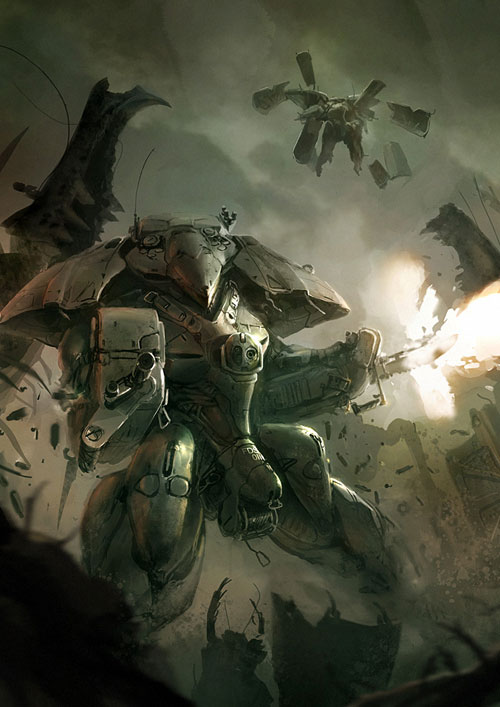
Are Battlesuits Fair?


A perennial question about Ultra-Tech gaming in GURPS is the fairness of demanding a point cost for things people can just have cheaply.  Why buy nightvision when you can have nightvision contact lenses? Why buy DR when you can just have a nanoweave T-shirt?  Yes, there are advantages to having these traits as "innate," but there's quite some assumptions baked into that statement, such as people aren't going to buy them with Gadget-based limitations, and that the costs aren't exorbitant.  After all, the equivalent of a nanoweave T-shirt clocks in at more than 40 points!  

And you can't just sidestep this issue either, because a lot of Ultra-Tech is built around the notion of buying advantages to simulate powers, namely the entire Cybernetics section! Nanoweave subdermal armor is literally a nanoweave T-shirt that's been put under your skin, for 42 points. In fact, a major theme of SF and Space Opera is that advanced technology makes "super-heroes" possible, that future humans will be as "as far beyond us as you are beyond apes."  Thus, we expect to see space opera and SF characters clocking at 200-500 points full of innate advantages like laser eyes and armored skin. But what if those things are more cheaply acquired as gear?

This is a question that often comes up in Psi-Wars (and all of my various ventures in to sci-fi and space opera in GURPS), and I think Psi-Wars has helped me articulate the answer to this question for the most part. That is this: what you're establishing with tech is your baseline. Advantages represent what you have above and beyond your baseline.  To use a modern example: is it valuable for a TL 8 character to have an innate DR of 5? It's expensive at 25 points, but it lets you shrug off most knifes, fists and baseball bats, and it reduces the damage of a pistol from a devastating 10 damage to 5 damage. Why not just wear kevlar?  Well, we can!  A concealable vest is DR 12/5 at TL 8, but it only protects your torso and it layers with our natural DR, so a normal person has as much DR as we do "naked" against baseball bats and fists, and if we wear it, we have DR 17 against bullets and knives (making is effectively immune to pistols and shrugging off most rifle shots with light injury) and DR 10 against everything else.  You can make a similar case with UT armor and gadgets: if anyone can pick up a nanoweave T-shirt, the fact that you have the equivalent DR to a nanoweave T-shit above and beyond the t-shirt that anyone can wear offers quite an advantage.  

This works best when the technology is widely available and not particularly transformative.  A nanoweave T-shirt isn't fundamentally changing how you interact with the world, and anyone can buy it, and a lot of the setting is built around the assumption that people often wear one: if you have more DR than that, it offers quite a benefit because the pistols and rifles are tuned to the idea of someone having DR 18, not DR 36!  This falls apart when someone gets access to technology that is transformative and rare, making it relatively unique to them.  A TL 8 character can buy TL 11 Hyperspectral Contacts as Signature Gear for 1 point (they cost $9600, and 1 point of TL 8 signature gear is worth $10,000)! He likely needs some additional technological skills to maintain them, but Hyperspectral Vision normally costs about 25 points, and even with a few support skills, the character with the contacts effectively has a cool power for a mere fraction of the cost of Hyperspectral Vision.  Even if we pile on the disadvantages to Hyperspectral Vision (requires maintenance, gadget, can be stolen, unique) to bring it to -80%, we're still looking at a base cost of 5 points vs 1 point.  "Okay, so if it hurts, don't do it," as an old punchline goes.  So we shouldn't do something like that.  We should only allow broadly available and not particularly transformative technology; if we violate one of these, we should reconsider where and how we use points.

Battlesuits always violate this rule of thumb.  In my experience, any time you allow battlesuits in a game, they become a prize worth seeking.  Characters with them stand apart from those that don't, and they begin to verge into "super-hero" territory.  They are virtually bullet proof, super-humanly strong, and have a suit of other advantages. Yes, there are disadvantages associated with it, but it is an inherently transformative technology.  It's also not one generally available to everyone.  It fits the genre to have only some characters wearing it, and these characters often interact with other characters. Bob might be a cyborg, while Alice might wear power-armor. Normally, Bob might normally outclass Alice, but if Alice wears power-armor, she can compete.  See, for example, numerous fights between Lex or Batman and Superman, where "power-armor" is the excuse that allows for the slugfest to go down, despite the clear difference in power-level.  Super-man is a few thousand points, while Batman is a few hundred points, and the difference is made up with gear.  In the comics, this is one-time use, but in a game, it won't generally work that way, especially if the character invests points into the Battlesuit skill.

So, don't use battlesuits, right? Or don't try to combine battlesuits with cyborgs and super-heroes and expect it all to line up well.  But I find that in Psi-Wars, that's precisely what's happening.  It's reasonable for certain highly advanced factions to sport power-armor.   We might expect a Shinjurai Cyberninja to use some sort of cyberweave suit, or the Wyrmwerk's Cleaner to use bespoke Heavy Battlesuits tricked out with gadgetry.  At the same time, we have the Saruthim, who wear bio-tech power armor, and even "wear it on the inside," summoning it in times of need.  Are these fair? Is it okay to let them have their power armor on the argument that power-armor sort of blurs the line between vehicle and armor?  I mean, someone in a car is really cool too, but the car is a baseline.  Power-armor is like... wearing a car.  Isn't that alright?

This brings us to a third group, the Arkhaians, who are essentially space opera golems, ghosts permanently bound into highly advanced power-armor.  How should they be priced?  I could use the rule precendent created by the Saruthim, who use the Bio-Mecha rules from Pyramid: you buy the armor as an ally, and then take the possession advantage. That makes sense, and you can build the armor AS armor, with traits like "Cannot Wear Armor" and standardized advantages meant to mimic technology.  This brings the costs way down and emphasizes that the armor is something "worn" rather than the literal character. On the other hand, what about robots? If we follow the same logic, they're just digital minds wearing a chassis, but Psi-Wars doesn't accept that logic (it leads inevitably to people pointing out that humans are just blobs of neurological networks wearing a skinsuit).  So, if robots have to pay full price for being literal walking shells of armor, why wouldn't the Arkhaians?  And if the Arkhaians are paying full price, why are Saruthim not paying full price for what amounts to a fancy version of Alternate Form?  And if all of these people are paying full price for all of this... why do the guys in power-armor get away with their trait for so cheap?

That was a long-winded way of me getting to the meat of his post, which is "Hmmm, what are the actual costs of a battle suit?" If you play as a character with a battlesuit, how much does it actually cost you to do so, and is that price "fair?"
Wednesday, December 16, 2020

The Fourth Mithna: Mithna Temos

Last month, I released a poll for "the Fourth Mithna."  A "Mithna" is a Ranathim noble house and, in keeping with the themes of Lithian culture insisting on being as alien as possible, they must necessarily have and use weird names for everything.  When I released the Mithanna it was as part of the aristocratic lens, and I left a poll on what sort of nobles people wanted to see, and "Ranathim Nobility" topped the charts.  I was reluctant (I feel like the Ranathim get too much attention already, but they are one of the more popular races of the setting), but I released the Mithanna to positive reception.  However, in keeping with "not overdoing the Ranathim" I kept the specific Mithna to a minimum.  Each is just a few paragraphs long, as opposed to the pages that the human noble houses get. And I thought "three is enough."  

But last month, I was looking for things to poll and when I asked the community, a lot of people reacted very positively to the idea of a Mithna poll. It made sense: they were easy to make, and I typically release "three of my own, one for you."  So why not do the same for the Mithanna? 

What came out is Mithna Temos, which is interesting in that it more closely reflects my initial conception of the Mithanna before some readers complained about a lack of context.  Even the name "Temos" came from my initial set of three Mithna. This is not a house grounded to a world, but one that wanders. and lurks behind the scenes, manipulating other Mithna for their benefit.  So, here it is: the poll results for the Fourth Mithna.

(And if you're curious what the Mithanna even are, or what the Ranathim are, click the links.  If you're completely lost, check out the primer).

Tuesday, December 15, 2020

Hey Guys, Let's Plan a Heist!


Sorry I've been quiet for the past, what, two weeks?  I'm on vacation, which means a lot of time for the kids and, of course, Cyberpunk 2077 came out (No, I haven't experienced any bugs, yes, it's an amazing game.  I haven't had this much fun with a game in a long time), so I've been distracted.  But I knew I would be! That's why the next playtest is meant to be a heist, and also why the last few polls have focused on this particular element.  While I still have some bits from the last polls to finish, my main focus will be on the criminal world of Psi-Wars.

But before I get to that, we need to know how to do a heist.  That is, we need our rules in place.  Of course, we have those rules and we've had them since Iteration 2: we just use GURPS Action Exploits, which is essentially the GURPS Heist Handbook, with some updates for our new setting.  The old Iteration 2 version mostly takes Action 2 wholesale, except for some advice on how to integrate psionic powers with the Exploit rules.  I think that's still a valid case, but I'm going to hold off on it a bit, because that might be better discussed in the pertinent psionic powers themselves (A non-psychic character doesn't need to know that a Telepath gets +4 to intimidation with a successful use of Instill Fear, but a Telepath sure needs to know that!).  However, as I go over all of these, I realize the extent to which technology plays a role in all of this, and how it raises some interesting questions.

The technology of Psi-Wars, of course, is inspired by pulpy space opera which are, themselves, just typical stories from the 1950s and earlier, reskinned as sci-fi.  Thus, they typically don't explore the more mind-bending aspects of sci-fi, and instead give us a familiar world: if we have clones, for example, it's to explain the faceless soldiers of the evil overlord, rather than to discuss the nature of genetics and identity. This makes the setting easier to handle, in that you don't really have to ask what weird technology is in place, you can just assume that they have familiar technology that's reskinned ("Do they have cell phones?" "No. They have comm devices that are holographic." "So... space cell-phones" "Yup!").  However, the more I dig into it, the more I see a need for a discussion.

First, as noted above, post Iteration 6, Psi-Wars has evolved into a distinct setting, which means there are some core assumptions that may differ from the "simple space opera" assumptions noted above.  Furthermore, however hard we try, there really are distinct technological differences that we have to account for because of the nature of our setting.  Psychic powers are real and well-known, many people armor up in vacc suits, and they travel through the space of an entire galaxy.  How do people defeat psychic powers? How do you handle zero-G? How do interstellar homing beacons work?

More than that, Action assumes deep interest on the parts of the players to cutting edge technology.  GURPS Action is more Burn Notice than pulp action from the 1950s. It goes far deeper into electronics and intrusion techniques than the average player knows or cares about.  I prefer to limit what people need to know or understand to jump in, and "detailed spy gear" is fairly low on that list when compared to signatures like martial arts, psychic powers, space battles and Communion.  So not only do we need to tackle our ultra-tech, but we need to simplify available spy-tech too.

Thus, one of the things I've been doing is going over Action 2 in detail and working out these differences, "translating" the document to Psi-Wars.  I still find Action 2 invaluable, and I don't think I can remove it entirely from the Psi-Wars canon (I also don't mind telling you to buy it to play Psi-Wars, because it's cheap, it's a great book, and it will help you run far more than just Psi-Wars), but I think there's more than enough differences that we can have quite a discussion, a lot of which is already on the wiki.  So that's what today's post is: a discussion of what I looked at and what changed.  This will be review and revision for those of you who have been following Psi-Wars from day one!

Thursday, December 3, 2020

The Great Book of Destiny

 Two events collided in my life to give birth to this monster project. First, I played Cultist Simulator, which still haunts my dreams with secretive mechanics and the clockwork ticking of the passage of time. Second, I ran Tall Tales of the Orochi Belt, and began to ponder Destiny.

See, I like the Akashic Order, and I’m not alone in liking them, I think. The idea of veiled witches who whisper with one another while manipulating the world to create the fate and destiny they want seems like a great idea. But in practice, how does that actually work? The use their precognition and see things and then… arrange events, I guess. But why? It seems vague. They seem more built to be NPCs making prophecies than PCs manipulating the flow of time. And that’s a shame. Why not have some sort of detailed “magic system” that they could play with?

The more I thought about it, the more I liked it: the Keleni would tap into that too, via the blessings of Communion. The Cult of the Mystical Tyrant, too, would want some way to manipulate, or dodge, Destiny. In fact, Psi-Wars is the only game I’ve ever run or played in where Destiny actually came up! Several times, in fact. But the destiny chosen was often vagie, players casting about for some additional detail.

So, that’s what I have for you today: the Great Book of Destiny. It clocks in at 72 pages, and includes:

  • A discussion of the Destiny Mechanic in GURPS and how you can mess with its cost
  • A system for “Creating Destiny,” the sort of thing an Akashic Witch might do, and will allow you to create “fights” over Destiny where people try to outmaneuver one another to control the future. This includes “magical modifiers” and a new “Hours” system, and tie-ins with the Paths of Communion.
  • 32 pre-defined Destiny templates, everything from Trivial to Greater Destinies, both advantageous and disadvantageous.

Woah, $1?

Chances are, if you’re one of my $1 Patrons, you’ve gone a long time without a special, and I think you deserve something. It’s also broadly useful. and my policy is to release the broadly useful ones to all of my patrons. Yes, I’ve written it from the perspective of Psi-Wars, but it’s pretty easy to scratch out those references and use it for your fantasy or modern campaign.

In the future, I might pull it down. I’d certainly like to give it some art and perhaps some cross-references. One of my original intentions was also to look at the details of the symbols and fortune-telling practices of the various groups and races of the Psi-Wars galaxy, but that had to be parked to get this done. If I get all of that, I might re-release a deluxe version at a higher “price point.” We’ll see. It depends on the sort of feedback I get.

In any case, as usual, I want to thank you for your support! And Merry Christmas! And I hope you enjoy the book! Let me know what you thought.

This special is available to all of my Dreamers ($1+).  If you're not a patron but interested, you can have it for $1 (and get access to all the other specials). If you want it, but don't want to subscribe, get in touch with me and we can work something out.  Just get in touch with me (mailanka (dot) musing (at) gmail (dot) com), or join my Discord Server.

Related Posts Plugin for WordPress, Blogger...