You know Star Wars happens in space not because it literally happens in space (I've only seen characters don space-suits and take a space walk in a few cases in the extended universe), but because it takes place on strange, alien worlds like Tatooine or Dagobah. Star Wars
has planets. Psi-Wars, obviously, needs equally dramatic and interesting planets to remind players that the action is taking place in a crazy sci-fi galaxy.
Planets for a space opera setting like Star Wars require a specific approach, however. We could dig out GURPS Space and use their planetary creation system, but that would give us detail we don't need (the orbital order of planets don't matter, nor do barren worlds that the PCs will never visit). I'm not saying you can't use it, I'm saying our needs are different. In Star Wars, planets serve primarily as backdrops and, perhaps, challenges. They largely fit the various terrain types offered by GURPS: Dagobah is a
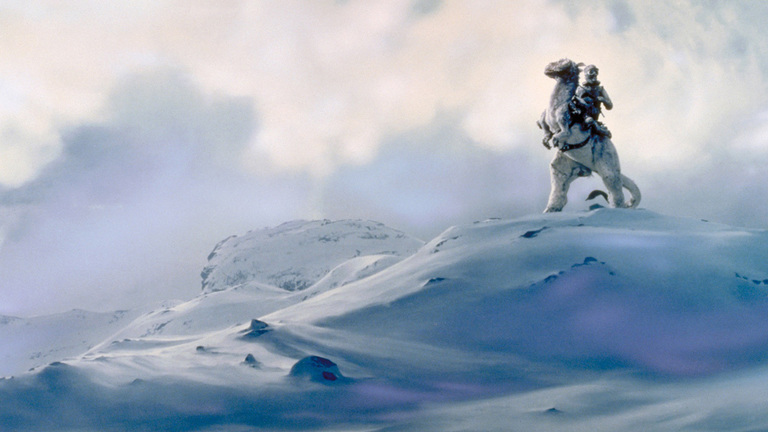
swamp world, Hoth is an
arctic world, and Tatooine is a
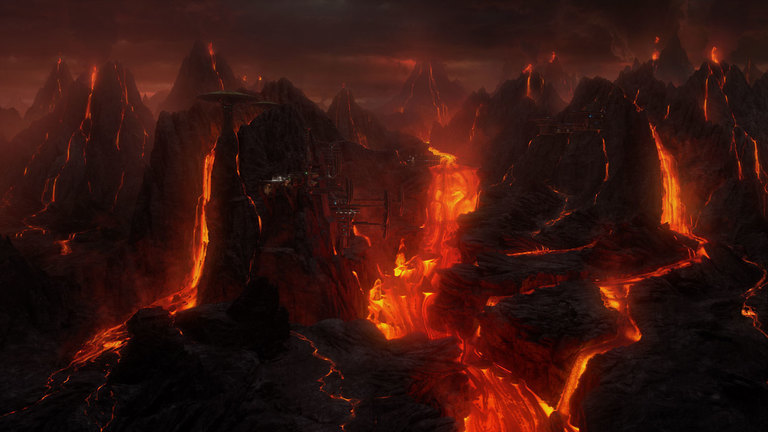
desert world. All of them have breathable atmospheres and shirt-sleeve temperatures, even the volcanic planet of Mustafar. In fact, the planets track so well with GURPS terrains and are so far removed from the GURPS Space mechanics that I would argue that we should
replace the latter with the former.
It was raining that morning on (Planet) Mongo-Jerry Pournelle
Now, a lot of sci-fi fans hate the idea of a single-biome planet, and I see their point. Setting aside the realism of a single-biome in a setting with force blades and hyperdrives, single biome planets tend to "shrink worlds down." All of Dagobah is a single swamp, all of Hoth is a single glacier, and so on. However, in practice, Star Wars tends to enjoy rather thoroughly detailed worlds: Tattooine has Mos Eisely, the vast wastes in which the Sarlacc can be found, the badlands where Tusken Raiders roam. Naboo has the rich, verdant plains owned by the Naboo, and the swamps/jungles that the Jedi first crash-landed in, and the underwater civlization of the Gungans. Star Wars actually has rather rich world-building because it tends to revisit the same worlds again and again, and sets so much of its action planetside (as opposed to Star Trek, which tends to keep most of its drama on their starships, to keep set-costs down).
Thus, in this series, I'm not going to discuss planets-as-biomes, but offer some ideas and rules for how terrains you might place on a planet. After all, Iteration 5 is about
generic setting building, about offering us the tools we need to quickly put together a new setting, and that includes conjuring planets from nothing. If you wish to create a completely arctic world, feel free. If you want to spend days working out an entire planet in excruciating detail, you're free to do that too. I would
suggest that you don't map worlds in full detail, because I honestly think most stories won't stay in one place long enough for it to matter. I think it's enough to have 1-5 biomes, with 1-5 interesting landmarks/set pieces each, in the same way that you can get far with a culture by giving them a handful of interesting distancing mechanism.