Tuesday, January 30, 2018

True Communion: An Introduction


There is no emotion, there is peace. There is no ignorance, there is knowledge. There is no passion, there is serenity. There is no chaos, there is harmony. There is no death, there is the Force. 
-The Jedi Code

Here we are at last.

The Jedi are Star Wars. While one can make the case for the importance of characters like Han Solo and Princess Leia, by the Return of the Jedi, the exploration of the Jedi and their code came to dominate the Star Wars narrative, and main characters became defined by their “force sensitivity.” The prequels told the story of the Jedi, and by Rogue One, their philosophy had morphed into the dominate religion of the Star Wars galaxy.

I’ve had a few problems with this drift, though. First, the Jedi practice, as depicted in the Star Wars movies is essentially the only religion of the setting (with an honorable mention to the Sith, though they really accept the core premises of the Jedi code, and just invert them; they are to the Jedi what Satanists are to Christians). Furthermore, the Jedi philosophy, as depicted in A New Hope is some ancient, nigh-mythical lost religion, but if you can trip over Guardians of the Whills, force sensitive philosophers and outcast Jedi in every cantina, then when Obi-Wan Kenobi explained the Force to Luke, it was more like some preist explaining Christianity to you today, rather than some martial art master explaining the lost secrets of a bygone age.

I’ve tackled the problem of “no other religion” throughout this entire philosophy series: the heroes of Psi-Wars can choose from Neo-Rationalism, the Akashic Mysteries and the Divine Masks as their driving morality and beliefs, and I’d like to think I’ve made each sufficiently compelling that someone might be willing to follow them. True Communion, then, can retain something of an exotic nature.

Two problems remain, though. First, the Jedi philosophy is, as depicted by Star Wars, one exclusively practiced by “knights,” warrior-priests. Outside of the implications of the Guardians of the Whills (we hear very little about this offshoot in Rogue One, and both of those characters are also warriors), we never get a sense of how the common man feels about the Jedi philosophy or how he might express his devotion. Do people go to temples to worship? If so, how? Does “worship” even make sense? Or is all the devotion of the Star Wars galaxy to the Jedi philosophy really a devotion to the Jedi order and the hope that these space wizard-knights will return and save them?

Which brings us to problem number two: the Jedi are thematically an ancient order of heroes with messianic elements. They saved the day long ago and will someday return to save the day again. They resemble the once and future King Arthur, or the Assassins of Assasin’s Creed or the Solar Exalted of Exalted. Thus, the Jedi Order should be dead long enough to have faded into myth, but in fact, they faded away only a generation (in the first trilogy) or two (in the latest trilogy) ago.

What we need then is a broader and more ancient order. We need to get a sense of what it means to be a practitioner of this Jedi-like philosophy without actually being a space knight. What are its priests like? Do lay people go to temples? If so, what do they do there? We also need to end the order a much longer time ago and explain what happened to them in the meantime.

We also need to integrate Communion itself into all of this. The philosophy of True Communion is not the philosophy of the Jedi for the same reasons that the Force is not Communion. True Communion is a universal, divine, psychic gestalt that contains paths, archetypes, occult elements, avatar states and world-shattering miracles. The philosophy of True Communion, then, can and should have a more distinctly religious character, and explain why a Knight of Communion is so much more powerful with Communion than, say, a devotee of the Divine Masks.

Furthermore, the core theme of True Communion must be that it is right. The base assumption of the Jedi is that their vision is correct (They are “the good guys”), and that all right-thinking individuals back them. Most psi-wars players will expect something similar in Psi-Wars, and look to True Communion as the “Right faith.” If this is so, then why doesn’t everyone worship it? And if it isn’t so, in what ways might it be wrong? How might it exploit people’s good will? How might (say) the Akashic Mysteries or the Cult of the Mystic Tyrant be more right, if the GM wishes to go in that direction?

Finally, we must understand that this is an RPG. Star Wars depicts almost all Jedi as essentially the same (all are skilled with their lightsabers; all learn the same styles; all have the Jedi Mind Trick and telekinesis and precognitive dreams and the ability to “sense” things), which is fine for a film, but players will need to express their uniqueness and differentiate themselves from one another, and explore different themes within True Communion. Ideally, one should be able to play a game with nothing but the Knights of Communion and see each player play a different character, and still have a sense that they have more they can explore.

I would like to note that unlike the other philosophies, True Communion did not spring up in this iteration, but has been quietly in the works since Iteration 4, and I’ve discussed them at length before, so if these inspirations seem familiar, that’s why.

Thursday, January 25, 2018

Patreon Special: Domen Khemet, the Ranathim Cult of Death

Last month, at the culmination of the Divine Masks, I offered my Patrons a poll to choose the fourth and last Cult of the Divine Masks: the Cult of Death.  Those poll results are in now, including Domen Khemet, a fully detailed version of the Cult, ready for play. The cult utilizes the Broken Communion miracles detailed in Tuesday's patreon post about Broken Communion ghosts.  Further, it has a unique relationship with the Cult of the Mystic Tyrant, as Anthara, the founder of the Cult of the Mystic Tyrant once swore an oath to them that the later cult broke, so be sure to check those elements out too.

This post is available to all $3+ patrons, as it represents a preview.  The Patreon Post contains a discussion of the votes and my thoughts on them, as well as the completed cult.  If you're a patron, check it out!  If you're not, as usual, I'd love to have you.  Enjoy!

Wednesday, January 24, 2018

Patreon Special: Sample Broken Communion Ghosts

Yesterday, I released a document on Broken Communion ghosts, including the means of creating your own. I want to follow this up with a few sample ghosts, in part to test how such rules work and make sure that I have all necessary pieces in place, and also to offer you, dear reader, an idea of what such ghosts might look like.  Naturally, any of these can be dropped into your Psi-Wars game, but they can also be adjusted and used in a horror or Monster Hunters game.

This is a publicly available document, available for free and it should be fairly easy to divine how these ghosts are intended to work, but if you're not yet a patron and would like a better understanding of the system behind their creation, the design document is available to all $1 patrons, and can be accessed via the link above.

If you're a patron, check it out.  If you're not a patron, you can still check it out!  And enjoy.

Tuesday, January 23, 2018

Patreon Special: Space Ghosts Revisited

Ghost Cvlt by Ramsesmelendez

When I first dove into Communion itself, I wanted to break up the simplistic duality of “good and evil” that Star Wars offered. I don’t necessarily object to “good and evil,” I just find that it can sharply limit the sort of stories GMs might want to tell or what sorts of characters people want to play. I conceived of Broken Communion as the crux of that change, as it introduced something that both “Good” and “Evil” could face off against, (the “Ugly” of “the Good, the Bad and the Ugly”), or something that could redefine “evil.” What’s worse, someone who is selfish but mostly hurts themselves, or a broken person who hurts others without meaning to? I wanted Broken Communion to offer both a terrible evil to fight, and a terrible pain to heal, creating a tension that was neither really evil, nor really good, but still a potential problem.

The core of that “problem” would be in its effects on the psionic characters who interacted with it the most. Those who wielded it would find themselves corrupted by it, and those who entered areas sacred to Broken Communion would find their psychic powers twisted by it. I also suggested that Broken Communion, unlike other forms of Communion, might “create miracles on its own.” In principle, any form of Communion might do this (Miracles “just happen” all the time), but Broken Communion seemed especially prone to doing that.

I left the details up to the GM, but the theme of “haunting” definitely arose from the ideas in Broken Communion and the nature of its miracles. Where True Communion had themes of the holy and sacred and Dark Communion had themes of fantasy-esque “cool evil,” with raging orcs and demonic seductresses and dark wizards, Broken Communion had distinctly horrific imagery. The haunted spaceship, the mass grave, or the terrifying jungle full of stalking, squamous things might all be places steeped in Broken Communion. But I left the details of this up to the GM.

I have found, though, from the feedback of my fans, that many of you don’t really like this “leave the details up to the GM” mentality. It’s rife through GURPS, especially in books that don’t really succeed, while books that make those details much more explicit, including catalog books like GURPS Magic, or campaign frameworks like GURPS Dungeon Fantasy, tend to do really well. In retrospect, this makes sense: if you knew how to do it, you would, and you could ignore any details I give you that you dislike. If you can’t, a vague suggestion is of no help, but a highly detailed discussion of how it might work helps a great deal. Thus, it’s better to favor too much detail over not enough (provided that detail doesn’t become mandatory).

Thus, I came upon the handle of ghosts.

Friday, January 19, 2018

Scoping the Competition: Star Warsiors

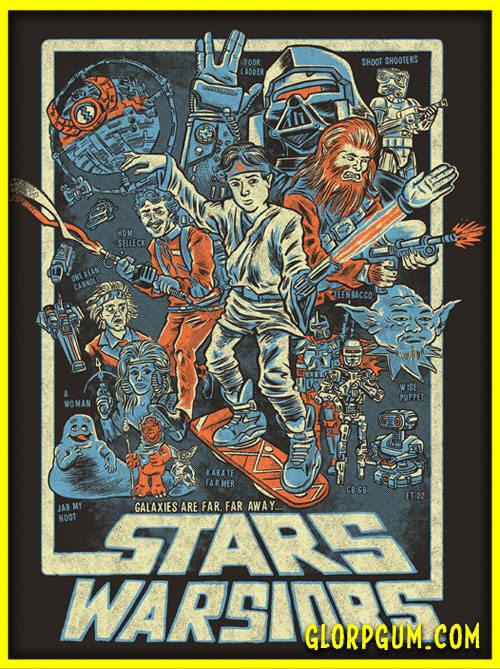
Clearly, I'm not the first person to think about filing the serial numbers off of Star Wars and building my own thing. I wonder, though, if Psi-Wars can ever reach the dizzying heights of Star Warsiors, with its heroic Karate Farmer, his master, Wise Puppet, and the villainous Door Ladder.  You can check out the story here (and here)


Thursday, January 18, 2018

Transcendent Principles: The Truths of the Cult of the Mystical Tyrant

The Path of the Mystic Tyrant is a path of transcendence. Those who walk that path violate the norms of the world and show that new things, never thought possible before, can be made to be true through the will of the Tyrant. This allows those who follow the path of the Mystic Tyrant to achieve unparalleled power, but at a cost.

Transcendent Powers are a new power-set available only to followers of the Cult of the Mystic Tyrant. Characters with Transcendent Master or Illuminated may freely learn or create them; other characters may use a Communion Oath to learn a transcendent power, provided a master is willing to teach it to him.

Transcendent Powers consist of the principle and the powers. The principle represents the world-view that the Tyrannical Master has imposed upon the world and represents a “category” or “container” of individual abilities, similar to how a psionic power contains numerous abilities associated with it. To gain access to a principle, a character needs an appropriate Transcendent Principle perk, after which he may gain any associated Transcendent Powers. Characters may only gain the Transcendent Principle perk if they have the Transcendent Master or Illuminated trait, or learn it from someone who does.

Transcendent Powers represent the effects of internalizing the Transcendent Principle. The character so completely believes the vision and so thoroughly changes the world with it that he is fundamentally changed. Thus, characters do not use Transcendent Powers, they have Transcendent Powers. Transcendent Principles can also grant access to new miracles, typically the miracles of Broken Communion paths, or entirely new miracles that the character may invoke.

While beyond the scope of most Psi-Wars games, the GM can allow characters with Transcendent Master or Illuminated to invent new principles and powers, using the Philosophy skill. A new principle is an Amazing invention, while a new power associated with a principle the character already knows is an Average invention.

Wednesday, January 17, 2018

Tinker Titan Rebel Spy Session 2: After Action Report

Talk. All they ever do is talk
As usual, I've had a busy month, but it's time to get back to the Imperial Psi-Wars playtest, so let's prep by talking about what happened last time.

If you haven't already seen them, two players have written their own reports:

They have more focus on what actually happened.  As usual, I will focus more on what was going on from the GM chair.

Related Posts Plugin for WordPress, Blogger...