Thursday, March 9, 2017

Patreon Post: A First Draft Historical Timeline

I was bothered by how uncertain my history was.  How much time should really be in each era?  Did I cover enough?  Could I cover more?  To solve it, I broke everything out into a much more detailed timeline.  I don't intend to release the timeline in the final book (who reads timelines?) but it's still a useful reference for me, and I thought my Patrons might like to read it.

So, if you're a $3+ patron, you can get the complete timeline here.  It also necessarily includes a slightly deeper look at the setting.  I'd love some comments if you have them.  If you're not a patron, as always, I'd love to have you!

UPDATE: the information in this Patreon post has been outdated for some time.  I've opened it up to the public who are curious about the older designs, and for those who want a more up-to-date version, there's an article on History on the Psi-Wars wiki

Support me on Patreon!

Psi-Wars History 3: The Roots of Communion

History doesn't repeat itself but it often rhymes 
-Mark Twain 
Four thousand years before the rise of the Galactic Empire, the Republic verges on collapse. DARTH MALAK, last surviving apprentice of the DARK LORD REVAN, has unleashed an invincible Sith armada upon an unsuspecting galaxy. 
-Knights of the Old Republic, Opening Crawl


The First Jedi Temple, from the Force Awakens
The Star Wars universe boasts a considerable history, often a cyclical one.  In it, Luke goes in search of the "First Jedi Temple," and we're treated to visions of the ancient city of Jedah, and we have an entire game series set in the "Old Republic" which nearly replicates the galaxy in its later state, only with a few minor changes (convenient for an RPG!).

This isn't that far from how history actually works.  History tells the story of humanity, our struggle to pull out of primitive and poverty-stricken barbarism, then to rise to the dizzying heights of civilization only to experience a total system collapse and be driven back into the depths of barbarism.  The history of China studies of the rise and fall of dynasties, and our own history has the rise of Europe after the fall of the Roman Empire (you might call the 14th century collapse of High Medieval society brought on by the Black Death such a fall, but Europe recovered with its identity largely intact), and Rome itself rose after a period known as the Greek Dark Ages, which followed the Late Bronze Age collapse.  It is this last that some scholars argue give rise to Greek myths of a "Golden Age" that preceded the darker classica era.

Whether there's truth to that, those myths do exist, and they shape our myths.  The notion of ages, of civilizations rising and falling, followed by heroes plumbing the depths of those ruins to find lost treasure and secret lore.  Star Wars, following the trope of fantasy and mythic stories, whispers of lost Jedi temples and ancient Sith empires.  It's not the only to do this: Warhammer 40k has a loose sketch of its considerable history (and has recently released Warhammer 30k!); Dune likewise hints at considerable history, such as references to the Butlerian jihad; Foundation features an Empire that was ancient and on its way our before the series even begins, and also has an archaeologist hunting for the origins of humanity in the Galaxy; Traveler sets its current game in the third Imperium, and has details to the previous two.

Thus, a truly ancient history certainly has a place in Psi-Wars, but as before, we need to justify it by determining what questions it answers.  The most obvious to me are "So, what kind of cool ruins does this game have?" or "What's the story behind all of these aliens," though I would caution against making every alien race older than humanity.  But the biggest one players will probably want to know is:
  • "What are the origins of Communion?"
I don't mean this in the sense of "How did the psychic phenomenon of Communion come into existence?"  Presumably, it has always existed, though if we wanted some race to have constructed it, that should have happened literally millions of years ago.  No, I refer to the faith of True Communion, the philosophy that drives so much of the game.  Just as the Jedi faith seems to have ancient roots, and our own myths and religions also seem to have roots buried in oral traditions that existed before the dawn of time, players may well expect that Communion is an ancient faith that greatly precedes the modern era.  If that is true, then we need to tell the story of the world that gave rise to it

And while we're doing it, we can answer another question:
  • "What are the coolest relics possible?"
If we have a truly ancient galaxy, then we can have truly ancient relics brimming with unspeakable power, the sorts of things wars might be fought over.  These, too, would be grounded in our dawn era.

Wednesday, March 8, 2017

Psi-Wars History Part 2: The History of the Space Knight

Your father's light saber. This is the weapon of a Jedi Knight. Not as clumsy or random as a blaster; an elegant weapon for a more civilized age. For over a thousand generations, the Jedi Knights were the guardians of peace and justice in the Old Republic. Before the dark times... before the Empire. 
-Obi-Wan Kenobi, A New Hope
Now that we've settled on the basic outlines of the history of the Empire and how the Republic collapsed into autocracy, we're left with some questions:

  • How did the republic form in the first place?
  • Who are the aristocrats who dominated the republic and where did they come from?
  • What did the military look like before the domination of our charismatic general?
But I, personally, have a question that I think is far more pressing and likely to be asked by your players, even Brent, more often than any of the above:

  • "What about the Space Knights?" 
Where do they come from?  Where did they go? Why are they gone?  What where they like?  Are they still around?  How?  And why do they seem to be suddenly making a comeback?

Star Wars has some answers for this: The Jedi Order was, like, always there, until their enemy, the Sith, took over and used Order 66 to kill them all, and this was like 10 years ago, but now the Jedi are already legends.

Personally, this doesn't sit well with me.  To me, when I heard that line above in A New Hope, I envisioned something Arthurian, this ancient order who had vanished centuries ago but somehow still had a few masters scattered across the Galaxy, if only you could find them and revive the good old ways.  

Then, the real question this history has to answer is: "How to religious orders fall?"

Tuesday, March 7, 2017

Psi-Wars History Part 1: The History of the Empire

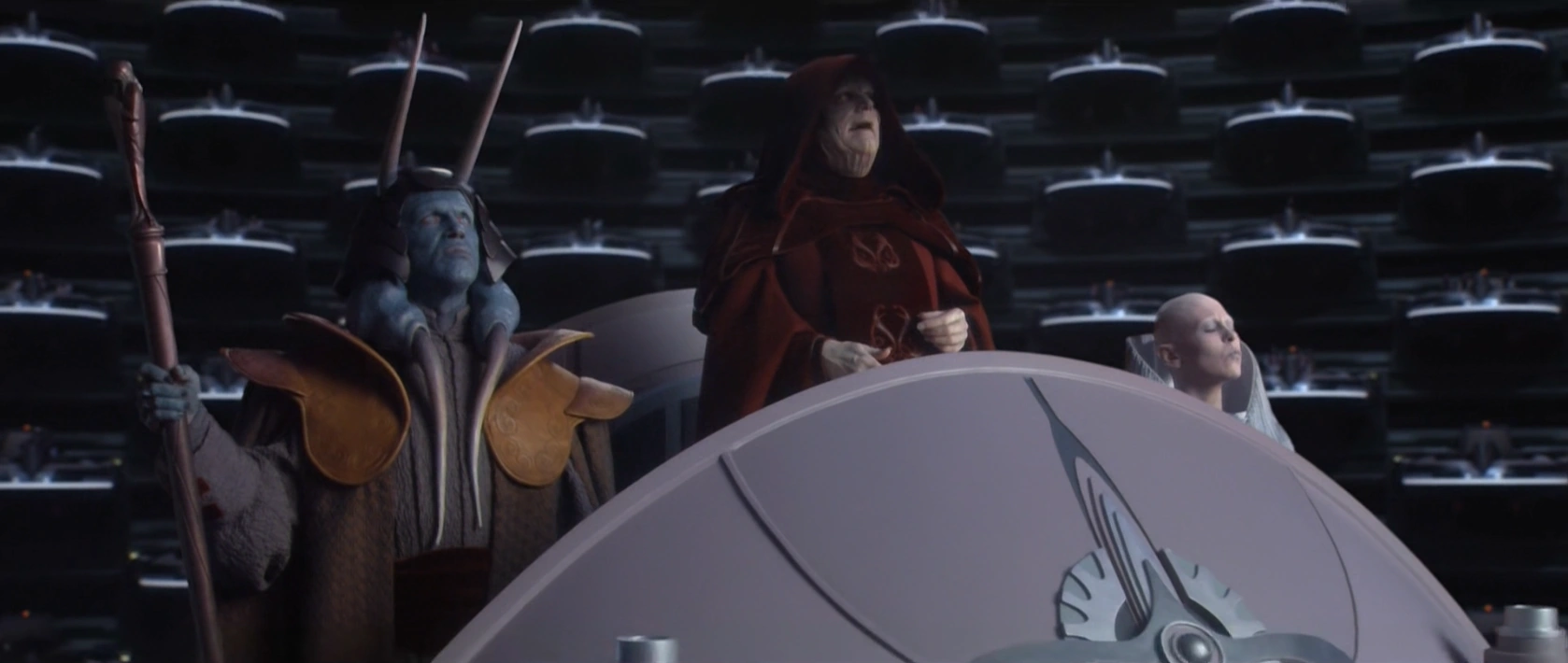
So this is how liberty dies. With thunderous applause. 
-Padme Amidala, Revenge of the Sith
When you design a setting element, or a story, or a hook you'll use to inspire yourself later, you should try to build a question into them, some element you want to explore and touch on, or let your players explore.  I would argue that all of the Star Wars prequels revolve around the question of "How did the Republic become the Empire?"

George Lucas answered that question with a bit of Roman and German history, plus his own personal political philosophy.  I also thoroughly believe that George Lucas wanted us to ponder this question ourselves and relate it to our daily lives, which quite a few people have certainly done, with gusto, in regards to the recent elections, if my Google Search for the above quote is any indication.

I'd like to revisit that question, using much of the same inspiration that George Lucas had, and show you how we can come to a very different conclusion than he did.  I want to revisit how democracies die, and more than that, I want to look at the broader implications of the histories from which George Lucas drew his inspiration, and use that to expand the setting beyond the narrow scope Star Wars has.


Monday, March 6, 2017

The History of Psi-Wars

I wanted to begin with history because history often explains how we got to where we were.  Thus, history and cartography are usually amongst the first choices of setting-builders when they get started, as history represents where things started.  History will explain why everything is where it is, making it the foundation upon which we'll build the setting.

That said, I almost held off on it, because history needs to explain how the setting came to be in the shape that it is, and without knowing what that shape will be, how can I write its history?  I could just write the history and then from that history derive the setting, but if I have some crazy-good idea later on as I'm working on, for example, geography or technology, should I discard it just because it doesn't fit my history?  Of course not.  The intent here is not to set everything in stone, but to build, collect and curate inspiration, and tie it together well enough to create a cohesive setting.  So, perhaps it would be better to write my history after I've finished coming up with the setting?  After all, that's how Star Wars wrote its history: George Lucas said "Space war! Evil magical samurai!  Giant planet-killing space station!  Details to follow!" and made his movie, then expanded his universe.

I propose we do both.  Having a decent grounding in the history of our setting well help guide us in our creative efforts.  It'll create a framework that will inspire the rest, but as we work on other parts of the setting, we'll fold their stories and histories into the greater fabric of the history we're writing.  Thus, we'll do this largely in two parts: Up front, to inspire our work, and at the end, a final edit of all the history we need to explain the setting we've come up with.

Before I begin, though, I'd like to do my usual discussion of setting creation theory.  First, we need to justify doing this at all, and get an idea of what our intent here is.  Second, we need a picture of how we're going to proceed, and finally, we need to tools at our disposal.

Thursday, March 2, 2017

Hunting for Inspiration II: Stranger than Fiction

I'm afraid I can't find the quote by Kenneth Hite, but it amounts to this: No matter how creative you are, the real world will come up with something stranger and cooler than you can ever come up with, and you'd thus be a fool not to pillage history.

This is especially important for Psi-Wars, for two reasons.  First, Star Wars, from which Psi-Wars draws is principle inspiration, is very thoroughly based on history, especially the History Channel favorites like World War 2 and the Roman Empire.  If we want Psi-Wars to feel the same, then we need to draw our inspiration from a similar source.  But more importantly, Psi-Wars must necessarily be larger than Star Wars, given that Star Wars is "only" a movie, while Psi-Wars needs to be a setting that supports a huge variety of different possible games.  That means we need more material to steal from, and there's hardly more material than all of human history.

As before, though, I intend to pursue emulation rather than imitation.  I don't want Psi-Wars to be the the Fall of the Roman Republic with the serial numbers scratched off, I want to understand what made Rome fall, and then draw parallels with that with the fall of my Galactic Empire.  This is the same thing Lucas did in the prequels though I'm quite sure I'll draw different historical conclusions than he did (It takes more than a single war to turn a democracy into a dictatorship).  We need to do our homework, and I certainly have (Look, I like history, okay!), and I've noted some sources below.  Those are just some sources, a place where you might start.  The point here is hunting for ideas, not necessarily a rigorous historical thesis, thus I've happily included semi-fictional works and well-researched RPGs.  It's not meant as an exhaustive bibliography of books I've gone through.

So, what part of history can I draw on for inspiration for Psi-Wars?

All of it.

Wednesday, March 1, 2017

Hunting for Inspiration I: Better Stories Than Mine

The last part of setting building is research, and I'm going to break this up into two parts, starting with the other works of fiction from which I can draw inspiration for my setting.  I originally intended to dedicate a week to this, because I think there's a fantastic amount of stuff we can look at, but I'd rather finish sooner than later, so let's do a whirlwind tour.  As we go through the actual setting, I'll bring up sources and ideas from these original elements as necessary.

Obviously, the biggest inspiration is Star Wars itself, but we can gain additional inspiration from that which inspired Star Wars, that which Star Wars inspired, and whatever else I happen to find interesting.  Star Wars itself is much bigger than just the films.  Particular things that I often find myself referencing again and again


Related Posts Plugin for WordPress, Blogger...