Showing posts with label The Force As. Show all posts

Thursday, June 9, 2016

The Faith of Psi Wars


We've taken a thorough look at Divine Favor as the core paradigm for the Force, so now, let's reflect on how well it turned out.

In a way, I find it the best fit.  As stated in the very first post, it allows for very dramatic effects, while still maintaining surprising balance.  In scenes where the GM wants the Space Knight to shine, he just unleashes Divine Favor and lets the player go nuts.  In scenes where he wants to spotlight another character, Divine Favor becomes more muted and subtle.  As alternative powers, the costs for learned powers remain pretty low, putting it somewhere between Psionics and Magic for cost.  It also maintains the concept of consistency among Force users, as most learned prayers are pretty similar.  Finally, it makes a great deal of cosmological sense when discussing the Force and how the typical Jedi treats it, and the Dark Side also works well as a force of moral evil.

But it has a few problems.  First, if a Jedi's power is determined entirely by his faith, then what's the point of all of their training?  Faith powers just work.  A priest needs to worry about living well, but he doesn't need to worry about perfectly controlling his psychokinesis, because it's not his psychokinesis, it's the Force's, and the Force, being divine, will never get it wrong.  This is in contrast with the Jedi, who need to learn to "control" the Force from a young age.

Second, Divine Favor is not innate. A Jedi might have a connection to the Force, but at least some of that power seems to come from himself (hence the training).  In particular, Jedi can innately do things, like sense danger and detect a blaster bolt before it reaches him.  Divine Favor doesn't allow for things like that.  It doesn't power Precognitive Parries, or grant Sense Danger.  This isn't necessarily a failing of the Divine (after all, God can up and warn people of things), so much as an element of how the system seems to work.

Third, this is not an action-packed system, and a Jedi is a warrior, while Divine Favor is meant to emulate priests.  True, Divine Favor has higher reaction bonuses during pulse-pounding moments, it doesn't actually require much action on the part of the petitioner other than faith and time.  I've adjusted some of it to make it a little more dynamic, but it still remains a passive and patient system.  Saints with Divine Favor stand around praying for hours, and God answers their prayers with the destruction of their foes.  Jedi, by contrast, are men of action, and given that Psi Wars is itself an Action game, it follows that they should be able to behave like Action characters.

Finally, Divine Favor assumes that God is a being that does what He wishes.  The Force doesn't act like that.  It doesn't punish you for breaking its strictures, nor does it act in an inconsistent way: A Jedi can know that his powers will work, over and over again without fail.

  • Divine Favor requires no training
  • Divine Favor does not support Danger Sense or Precognitive Parries
  • Divine Favor is too passive.
  • Divine Favor assumes personality that the Force does not have.

Wednesday, June 8, 2016

The Other Side of Space Faith

New Powers

While we have plenty of “appropriate” powers, we're missing some key components. We can see the future (Divine Guidance), see into the hearts of men (See Evil, Sense True Evil), but we lack psychokinetic effects, and quite a few of the common tricks Jedi often do, such as sense danger. A few new Learned Prayers might be:

Minor (Neutral Reaction)

Poltergeist

Learned Prerequisite: Divine Favor 4
Learned Prayer Cost: 3 points
A minor telekinetic effect occurs, perhaps moving a force-sword hilt to you, or pulling a key to you, or even granting you a +4 to pick a lock.
Statistics: Telekinesis 3 (Divine Favor -10%) [13.5]

Major Blessing (Good Reaction)

Ghost Motion

Learned Prerequisite: Divine Favor 7
Learned Prayer Cost: 7 points
Gain obvious, if not particularly strong psychokinetic effects, including pushing things over, throwing stones at people, etc.
Statistics: Telekinesis 7 (Divine Favor -10%) [32.5]

Miraculous Power (Very Good Reaction)

Invisible Might

Learned Prerequisite: Divine Favor 10
Learned Prayer Cost: 14 points
Gain psychokinetic effects that exceed the power of an individual human, including lifting someone off the ground, or yanking large objects off walls and flinging them at people.
Statistics: Telekinesis 15 (Divine Favor -10%) [67.5]

Divine Message

Learned Prerequisite: Divine Favor 10
Learned Prayer Cost: 12
Send a single message or vision to another character, regardless of distance. This message transcends culture and language to ensure that the target always understands it.
Statistics: Telesend (Divine -10%, Cosmic (No Die Roll) +100%, Universal +50%, Send Only -50%) [57]

World-Shaking Miracles (Excellent Reaction)

Unseen Titan

Learned Prerequisite: Divine Favor 14
Learned Prayer Cost: 27 points
Gain psychokinetic effects that exceed the maximum power of a human, including blowing gaping holes in walls, moving vehicles slowly through the air, or tearing apart a cavern.
Statistics: Telekinesis 30 (Divine Favor -10%) [135]

Alternate Forms

Avatar State
I've noted that Ten Monros has given us some pretty cool tricks without really going all the way into a Full Alternate Form, likely because their interaction with Alternative Ability frameworks are confusing, but I've addressed that very topic on this very blog... precisely because I was working on this power set at the time.

The concept of the Force flowing through someone, guiding their motions, seems to me a good example of a deep connection to the divine, something a character with a great deal of Divine Favor could certainly do. While I cannot, off the top of my head, remember anything like that from either Star Wars or the Expanded Universe, I think the Avatar State from Avater: the Last Airbender is an excellent example of what that might look like (especially given its Chinese-inspired mysticism).
The Righteous Fury powers certainly cover that sort of thing nicely, but I'd rather explore an alternate form, because it allows me to add even more powers and also to balance it with some disadvantages to create a distinctly inhuman character: You can let the Force in, let it strengthen your limbs and burn in your eyes, but then you are guided by Its will, to serve as Its agent of change in the world. When you become a Force Avatar, you serve the Force, it does not Serve You.

The inspiration behind the build comes from GURPS Thaumatology, Spirit Vessels, starting on page 211. The idea is that this “Alternate Form” is more spiritual and mental rather than physical: the character looks the same (mostly), but becomes something else.

It might look something like this: It takes one second of concentration and a cost of 5 HP (the strain of channeling so much Force takes its toll) to enter the Avatar state. Once in it, he is driven by the Force to do a particular thing (chosen by the GM), must do so in a predictable and obvious fashion, without harming others. Furthermore, the strain costs the character 1 HP per second. Fortunately, while in the Avatar State, the character is nigh unstoppable: He feels no pain and is immune to unconsciousness and will not die unless reduced to -5xHP (The Space Knight's flesh is just a shell for the Force, and while the Force animates it, it cannot die, only be destroyed). Heightened awareness gives him perfect knowledge of all danger that faces him, and the Force allows him to reach out and interact constantly with his environment around him (to a maximum range of 10 yards). Finally, the Space Knight is obviously possessed, with glowing eyes and echoing, multi-tone voice and burning strands of power lashing out around him as he floats around. This is marginally attractive, but it's as much terrifying as it is pleasant.

Force Avatar

Learned Prerequisite: Divine Favor 16
Learned Prayer Cost: 200 points

This alternate form does not include Divine Favor. The character loses access to Divine Favor for as long as it lasts. This imitates the nature of other Alternative Abilities, which also preclude the use of Divine Favor. Otherwise, all other character stats remain the same and the rest comes in addition.
Alternate Form (Divine -10%, Reduced time (1 second) +80%, Limited (Once per day) -40%, Costs 5 HP -50%) [12]

Jedi Avatar Form:

Attractive (Impressive +0%) [4]
Danger Sense (Cosmic, No Die Roll +100%) [30]
Immune to Pain [30]
Indomitable [15]
Penetrating Voice [1]
Telekinesis 21 [105]
Unfazeable [15]
Unkillable 1 [50]
Dependency (Return to own form, constant) [-25]
Hidebound [-5]
Obsession: A goal chosen by the Force [-10]
Pacifism (Cannot Harm Innocents) [-5]
Unnatural Features 5 (Brilliant, Glowing Avatar of Power) [-5]

The Dark Side


Of course, if Divine Favor represents a Good God, the Light Side of the Force, we should be able to represent an Evil God, the Dark Side, in a similar fashion. Divine Favors actually discusses this at length on page 12.

The rules for Petitioning are the same, though you're not required to maintain the -10 points worth of religious devotion. We can continue to use the Meditation rule for the Dark Side, but we could also say that if the character is willing to fail a self-control roll for certain appropriate psychological disadvantages (Bad Temper, Berserk, Bloodlust, Lecherosness, Overconfidence, Sadism or Selfish) and/or to act it out in detail, he gains a +1 for the duration of being under that disadvantage. Instead of using the Fatigue rules, though, consider using the Black Magic rules: Each +1 costs 4 points of Corruption, rather than 4 fatigue. The Dark Jedi will pay the price, but only later, and from his form and sanity.

The Reaction Roll works  as the side-bar suggests: How much does the Dark Jedi's proposed action facilitate the Dark Side's objectives? And what are the Dark Side's objectives? Generally death, chaos, ruin and the fulfillment of the Dark Jedi's baser needs: the Dark Side will absolutely help someone fulfill their ambition or kill those who insulted him, but it won't generally help him save the life of those he loves, or sacrifice himself for the greater good.

Finally, when the Light Side faces off against the Dark Side, the Dark Side always loses. For example, Consencrate beats Desecrate.

Minor (Neutral Reaction)

Poltergeist

Eyes of Hell (Pyramid #3-36, page 10) the Dark side can see in the dark of course. Explains why they're always lurking in Shadows.

Servant of the God of Lies replaces Sermonize (Pyramid #3-36, page 10)

Divine Guidance

Stoicism

Mantle of the God of Lies (Pyramid #3-36, page 10) is a bit of a stretch, but I could see the Force reshaping someone's face to deceive others. Also, shapeshifters are practically a cliché in space opera.

Major Blessing (Good Reaction)

Ghost Motion

Eyes of Hell (Enhanced) (Pyramid #3-36, page 10) the Dark side can see in the dark of course. Explains why they're always lurking in Shadows.

Power of the Abyss (Pyramid #3-36, page 10) “Good. Good. Let the hate flow through you.” The dark side parallel to Righteous Fury.

Corrupting Touch (Pyramid #3-36, page 10) The ability to destroy life with just a touch seems appropriate to the Dark Side and makes a good parallel for Force Healing.

Sense True Good (Pyramid #3-36, page 11) the reverse of the Light side's ability: the Dark Side can as readily sense the Light Side as the reverse.

Guide My Hand: (Pyramid #3-36, page 11)

Dark Glory (Pyramid #3-36, page 12) The ability to inflict fear on an opponent definitely fits the Dark Side of the Force.

Desecrate Ground (Pyramid #3-36, page 12) one of the things that supposedly tainted Dagobah was the presence of a Dark Lord. This suggests that those who follow the Dark Side of the Force can certainly “taint” the world around them.

See Good (Pyramid #3-36, page 12) This allows a Dark Lord of the Sith to look into the heart of another and see the Hate and the Hope roiling around within them.

Holy Fire (Pyramid #3-36, page 12) A Jedi never uses the Force for attack... but a Sith certainly does. Holy Fire won't work... but we could create a variation for Lightning blasts.

Miraculous Power (Very Good Reaction)

Invisible Might

Corrupting Touch (Enhanced) (Pyramid #3-36, page 12) The same as the above, but better.

Power of the Abyss (Enhanced) (Pyramid #3-36, page 13) As above, but better.

Vampiric Touch (Pyramid #3-36, page 13) The ability to drain energy from others. This expands on that concept to include the draining of life to feed the character. While this is a stretch for classic Star Wars, the Expanded Universe does contain straight up vampires, and it fit the idea of having pyshic vampirism in Psi Wars.

Holy Fire (Enhanced) (Pyramid #3-36, page 14) As above

Desecrate Ground (Enhanced) (Pyramid #3-36, page 14)

Dark Glory (Enhanced) (Pyramid #3-36, page 14)

World-Shaking Miracles (Excellent Reaction)

Unseen Titan

Eclipse pushes the bounds of what might be possible: I can almost see the Force altering the orbits of planets slightly.  And if anyone would bring darkness to the sky, it would be a master of the Dark Side.

Dark Metamorphosis: (Pyramid #3-36, page 14). As Avenging Angel, but Dark!

Drain Soul: (Pyramid #3-36, page 15). The expanded version of Vampiric Touch.

Earthquake

Tuesday, June 7, 2016

The Faithful Space Knight


Making a Jedi with Divine Favor couldn't be simpler: Take Divine Favor 8 [45], and you have 5 points for whatever character-candy you want... probably learned prayers, but we'll come back to that.

So how does it work? When the Jedi needed to invoke the Force, he'd spend 1d6 seconds concentrating and then roll against his Divine Favor. On a success (that is, on an 8 or less) he'd invoke the Force, and he'd roll a Reaction roll. A really bad result means the Force lashes out against him or causes him problems. On a decent result, the Force does something and it benefits the hero, but it's often a minimal intervention. On a really high roll, the Force might do something spectacular, but only if the Force feels it's warranted (thus, it only ever does as much as the GM wants).


Consider, for example, the following scene: A dark Space Knight needs to get at a fabled force sword that has fallen far from him, while another novice Space Knight is also trying to get at the fabled force sword. The dark Space Knight invokes Divine Favor by closing his eyes and concentrating for a few seconds and holding his hand out to the force sword hilt. He rolls and successfully invokes Divine Favor, then rolls for a reaction. On a high reaction result, the force sword would fly to his hand and then instantly ignite, burning with a baleful glow that terrifies all onlookers, as though to say “This is my chosen champion. Fear him.” On a more modest reaction, the force sword hilt would merely fly to him. On a really bad reaction, though... it might even fly to his opponent, landing in the hands of the female novice, as though to say “The Divine chooses this person as your slayer, you filthy patricide.”

Of course, this model instantly shows a few flaws. First, 8 or less seems rather difficult to come up with, which makes the Force rather unreliable. Let's look at that first.

Monday, June 6, 2016

The Force as Divine Favor

Jedi Cross
For my ally is the Force, and a powerful ally it is 
-Yoda, The Empire Strikes Back

Your sad devotion to that ancient religion has not helped you conjure up the stolen data tapes or given you clairvoyance enough to find the Rebels' hidden fort... 
-Motti, A New Hope

I see Star Wars as taking all of the issues that religion represents and trying to distill them down into a more modern and more easily accessible construct that people can grab on to, to accept the fact that there's a greater mystery out there 
-George Lucas, The Mythology of Star Wars
The Force is best depicted as Divine Favor.  While you can overstate religion's influence on Star Wars (the first sentence before George Lucas's quote above is "I don't see Star Wars as profoundly religious"), it definitely bears some of the trappings of faith.  It features desert hermits, prophecies, immaculate conception, celibate warrior-priests, knightly orders and a moral metaphysics.

As Obi-Wan teaches Luke the Way of the Force, he spends a great deal of time persuading Luke to give up his agency and to put his trust in the Force, in the same way religion often asks us to put our faith in God. In Empire Strikes back, Yoda discusses a matter of size, leading to the quote above, which suggest that anything that depicts the Force as an internal power, coming from the Jedi himself, is a fundamental misunderstanding of the Force.  The Force might "come from all living things," but a Jedi is connected into and aware of that larger interconnection. He calls upon it, channels it and is guided by it.  When Yoda stretches forth his hand and Luke's X-wing floats into the air, Yoda is not lifting it, the Force itself is.  Yoda petitions the godlike power of the Force to act, and the Force does so.  That was the core of Yoda's lesson to Luke.

On the flip-side, when Darth Vader says "You do not know the power of the dark side of the force," he does not mean the power gained by following a particular philosophy, or the strength of particlar powers, but the power of the dark side as an entity.  When you let "the hate flow through you," you channel the Dark Side, become connected with it in a primal way, the way a voodoo cheval connects with his Loa: You become possessed and driven by this greater cosmic power, something greater than all of humanity, and also something fundamental to all humanity.

The Light and the Dark Side of the Force also make profound theological sense.  The Force is the incarnation of good: God.  The Dark Side is the incarnation of evil: the Devil.  Though, perhaps, we're better off viewing it through the dualistic lens of Zoroastrianism than the monotheistic lens of Christianity, as both sides are equal and necessary.  The balance spoken of in Star Wars isn't a true balance between Light and Dark, but the day, the final day, when evil is purged from the universe and good will reign at last.  Anakin, who was immaculately conceived, was meant as a Messiah to deliver the universe from the threat that faced it, but he fell, and it was up to his (forbidden!) children to carry on that mantle of Messiah.

The Jedi fit the pattern of Warrior-Monks.  They study an ancient philosophy and maintain it throughout time. The Jedi Order, including the position of "knight" and "master," its independence as a military order, its importance to the world order, and its sudden and precipitous fall followed by its legendary status, closely resembles the Order of the Knights Templar.  The Jedi must have no attachments and must remain celibate, just as priests did, a major plot-point for Anakin Skywalker, whose submission to love and lust began his first true step down the Dark Side.

The Force as Divine Will immediately solves many of the problems of Star Wars.  Just how powerful is the Force?  How much weight can a Jedi lift?  How reasonable is it that Rey is able to perform a Jedi Mind Trick without any training at all?  Why can't you genetically engineer Jedi?  What's all this about Destiny?  Divine Will answers all of these: A Jedi doesn't lift anything, the Force does, and the Force will lift as little or as much as It wants.  Of course Rey can perform a Jedi Mind Trick, if the Force wills it.  You can't genetically engineer Jedi because the Force chooses with whom It has a connection.  And Destiny is the Force making that choice, laying out Its plan for the life of someone.  No matter how scientific a universe gets, the Force must necessarily remain mystical, because a mercurial, psionic god-force does what It wishes, even whimsically, rather than following predictable physical laws that can be codified and applied.  It also explains why people use terminology like "I can show you the ways of the Force" or why people should "Trust in the Force."

Finn: We'll figure it out. We'll use the Force.
Han Solo: [irritated] THAT'S NOT HOW THE FORCE WORKS.
-The Force Awakens

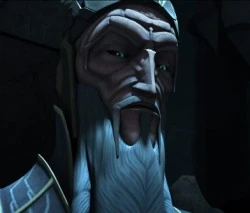
The Father of Mortis, Clone Wars
This model does create a few problems, however.  First, the Force seems relatively reliable in Star Wars.  Once a Jedi has learned to shove over some battle-droids, he can always shove over some battle-droids.  Anakin violated his religious vows and his Force-God didn't abandon him.  Furthermore, religious power can create passivity: Why wield a lightsaber when you can just pray to your Force-God to strike your enemy dead?  The Force doesn't seem to work that way: It works through people, rather than on its own... though sometimes we do see Force Miracles and Force Spirits (The ghosts of dead Jedi, the "Dark Spirit" of Dagobah, and the Father, Son and Daughter of Mortis in Clone Wars) and such... but Psi Wars is an Action Game, not a Sit-Around-And-Pray-For-A-Miracle game.  Finally, Divine Favor usually assumes some kind of relationship with a divine figure, while Star Wars depicts an, at best, impersonal God. The Force doesn't seem to want anything. It just is, this great and terrible, dualistic Energy Field that pervades the universe. It does what it does in some kind of unfathomable way.  Why it bestows its favor on someone seems to have little bearing on moral principle.

GURPS Divine Powers as the Force


Even so, a Divine Powers model has some merit.  In particular, it works very well for GMs.  Rather than fussing over the exact power levels of the Force, characters can roll for a miracle and get one.  Need to grab your force sword?  Sure, Force-God allows it.  Need to lift your Starhawk out of a swamp?  For the faithful, Force-God allows it.  Need to yank an Empire-Class Dreadnought out of orbit with nothing but furious pulling gestures? Force-God is feeling generous today, so what the hell, why not?  But if the Space Knight is too cool and the the GM feels like emphasizing the lockpicking skill of the scavenger, then suddenly Force-God can't be bothered to help the Space Knight unlock a door.  Why didn't the Space Knight know about the ambush, even though he regularly sees the future?  Force-God just didn't feel like telling him, you know how it goes.  The Force is mysteeerious. By modeling the Force with Divine Powers, we fundamentally institutionalize GM fiat, which goes a long way to modeling the narrative nature of Star Wars.

Divine Powers, as a variant of Patron, tends to keep the costs of your powers down as well.  Since your power all comes from a single source (and additional powers tend to be relatively cheap offshoots), you can model a fairly powerful Space Knight on a decent budget.  We might run into a few problems in that the Divine Powers tend to be very Christian in tone and theme while the Force is very oriental, more Daoist... but Daoism is also a religion and, after a fashion, the "Universe" is the "God" of Daoism: One should trust in it, it can "provide" for the faithful, and Daoist priests can certainly work miracles, after a fashion.  We'll need to modify Divine Powers to make it work, but it can work.

Obviously, for this cycle, we'll rely entirely on GURPS Powers: Divine Favor.

Going Forward

As usual, tomorrow we'll take a look at Divine Favor, which powers work well out of the box and which powers don't, and what a Jedi with 50-points of Divine Favor might look like.  Wednesday, we'll adjust those powers and expand them out into Light and Dark and touch on some alternate systems to make that work.  Finally, Thursday we'll take a look at the results and see what a Divine Universe might look like.

Thursday, June 2, 2016

The Tao of Psi Wars

Now that we've finished looking through Chi Powers, how do I feel about them as the power-set of choice for Psi-Wars?

Largely, I find that the Cinematic Skills go a long way to representing the Jedi, as a Jedi is mostly just a cinematic swordsman with a few mystical powers added on (such as seeing the future and moving things with his mind).  In that sense, Chi is probably the most conservative take on the Jedi.

Likewise, Daoist philosophy definitely hits all the right notes for the metaphysics of Star Wars.  Here, we can again discuss "balance" and we can talk about the complexity of the force, and we can start to see why a Jedi would need to spend years studying this rather nuanced topic.

The problem is that it's too Daoist. The Force acts more like psionics and good/evil duality wrapped in the trappings of 80's "oriental mysticism," as opposed to genuine Daoist philosophy.

Specifically, the characters that come out of this system, especially with the Elemental Chi Powers, look nothing like Jedi, though they look more like Jedi than they would with generic Chi Powers.  For example, Anakin is clearly a Void-Aspected Jedi, hence his affinity for flying through space and force choking and dark garb, in contrast with the Emperor's affinity for lightning, and Yoda is clearly Life-aspected (hence his ability to adapt to hostile environments and his ability to absorb Dooku's lightning), and so on.  However, the expanded universe, and fan-expectations, have demanded that all Sith/Jedi more or less look the same and exhibit the same powers (With the exception of a few, high-level "signature" powers).  The Chi Powers here tend to encourage diversity and gives a structure to that diversity, while the Force tends to be rather unified: You have the light side (healing, absorption, blah blah) and the dark side (lightning, force choke, force drain, blah blah) and with the exception of one or two characters with a unique trick ("That one guy can do retrocognition!"), most characters can do the same sort of stuff.

Elemental Chi Powers also lack a moral dimension to its Dark Side.  In this model, the Dark Side exists, but is unfairly vilified.  It's not evil, it's just misunderstood.  I happen to like that, but it's debatable how "true to Star Wars" that is.

It also lacks quite a few of the signature moves of Star Wars.  I fussed to make Push sort of a telekinetic attack, but what about a telekinetic pull?  And what about the deep mind reading that Kylo Ren does?

Finally, these powers really require (and reward) substantial investment.  50 points of powers didn't get you much, though it looked a touch better than what Psionics gave you for the same point totals.
  • Too much complexity compared to Star Wars
  • No "Evil" side
  • Lacks signature tricks of Star Wars
  • Expensive

Wednesday, June 1, 2016

The Five Sides of Space Chi

The Five Chi Elements
Bill Stoddard gave us an entire supplement dealing with Elemental Chi Powers, which tracks pretty closely to my understanding of Daoist elements from my time running/playing Weapons of the Gods and Legends of the Wulin. Having discussed yin and yang in our first post, let us instead focus on the five elements of Daoism.

Unlike Western Elements which stand in contrast to one another (“Fire is the opposite of Water”), Daoist elements flow into one another. Wood promotes Fire (Fire burns wood), Fire promotes Earth (fire burns down to ashes), Earth promotes Metal (Metal can be extracted from Earth), Metal promotes Water (Metal melts down into water) and Water promotes Wood (Water nourishes Wood).

We also have counter-positions, where elements defeat or control other elements. Wood consumes Earth, Fire melts Metal, Earth dams Water, Water extinguishes flame, and Metal cuts Wood. The elements also have Yin and Yang associations: Wood is lesser Yang, Fire greater Yang, Metal lesser Yin, Water greater Yin, and Earth is balanced.

This means that all elements interact with other elements in more than one way. This principle of fives and trying to create balance still exists in China (for example, five spice powder, and how Chinese cuisine tries to balance “Yang” flavors like heat and sour with “Yin” flavors like sweet and savory).

Tuesday, May 31, 2016

The Kung Fu Space Knight

A Jedi uses the Force for knowledge and defense, NEVER for attack. 
-Yoda, the Empire Strikes Back 

In our Huashan Sword School style Kung Fu, the key lies in the words ‘Inner Energy.’ Once your inner energy is developed with Qi-Gong practices, then regardless of what you use as your weapon, let be your fists and legs, or knives and swords, you will succeed whenever you go. That is the righteous way for training in our school. But among the senior grandmasters of our school, there were a group of people who believed that the key of our school’s Kung Fu lied in the word ‘Sword,’ and that once someone developed his sword skills, even with ordinary level of inner energy, he could still defeat the enemy. The main divergence between the righteous branch and the evil branch lies right here. 
-Yue Buqun, Smiling Proud Wanderer, the Lanny Lang Translation

Martial Arts mostly treats passive chi abilities as advantages (e.g., Resistant to Chi Abilities) while modeling active ones as cinematic skills – Lizard Climb, Power Blow, etc. – in order to make them easier to tie into the styles in Chapter 5. Comic books and video games, however, often depict all such capabilities as something akin to psi powers or super-powers. 
-Chi Powers for Martial Artists, Martial Arts, page 46

Cinematic Skills


For today's post, I'm going to limit myself to a discussion of Cinematic Skills as the basis for Chi Powers, not because there are no suggestions or thoughts on how I might handle Advantage-based Chi Powers, but because no existing framework of Chi Powers exists in Martial Arts. We'd have to build one, using the suggestions in the book, and if we were to build an advantage-based system from scratch, then that would defeat the point of trying to use as much generic GURPS resources as possible, and also, such a system would probably look rather similar to Psionic Powers, which we already have. I do actually have a Chi Powers system derived from the suggestions in GURPS Martial Arts, which I devised for Cherry Blossom Rain, but I don't think now is the time to introduce that.

Martial Arts breaks the cinematic skills into two categories, each associated with one talent (Both found on MA47): Forceful Chi (for the “External” powers), and Inner Balance (for the “Internal” powers). Now, we don't have an explicit “Light/Dark” split in these, but in keeping with the themes of Chi, this does have a “Yin/Yang” split, with Forceful Chi as Yang and Inner Balance as Yin. As Jedi tend to be more balanced and Sith tend to be more Forceful, I suggest we make our split thus: The “Light Side” is associated with Inner Balance and the “Dark Side” with Forceful Chi. Of course, I'm sure you already see a problem with assigning morality thus. There's nothing inherently evil about Forceful Chi, or righteous about Inner Balance, but that's also in keeping with the themes of Chi: Evil is found in disbalance and corruption, while righteousness is found in balance.


Monday, May 30, 2016

The Force as Chi

Galactic Yin Yang
The force is an energy field created by all living things, it surrounds us, it penetrates us, it binds the galaxy together 
-Obi-Wan, A New Hope
A more immaterial understanding of chi might treat it as a web linking together all planets with life, somewhat like the Force in Star Wars. 
-Bill Stoddard, GURPS Thaumatology: Chinese Elemental Powers 

The Force is best represented with Chi powers.  This is because the Force is chi.  The quote above ties in nicely with the Odic Force or other vital forces I mentioned in the Force as Psi, but those concepts themselves derive from the ideas of chi or prana: an all-pervasive life-force.  Like the force, chi comes from the living (it is literally the breath of life).  It binds people together, and it connects us to each thing in the world.  More importantly, chi is dynamic, and it has two sides: a light side and a dark side.

In this iteration, I have discussed the Force at length, but I haven't discussed the Jedi themselves.  In each model, we might connect nicely to the way the force seems to work, but we don't connect well with what the Jedi are: They are not psychic sideshows or magicians, but samurai.  George Lucas was deeply inspired by the works of Akira Kurosawa, especially the Hidden Fortress and other jidai-geki, or "period pieces."  In fact, the name "Jedi" derives from "jidai."  It makes sense, then, to use the very powers we associate with cinematic martial artists to model how the force works, because then our space knights will feel like jedi. And that means chi powers.

You refer to the prophecy of The One who will bring balance to the Force. 
-Mace Windu, The Phantom Menace

Moreover, the Force is deeply daoist.  Yoda speaks in the sorts of riddles that would make any  daoist master happy, and the philosophy of the jedi, one that demands trust in the Force and expecting the universe to provide, fits perfectly with the daoist way.  I enjoy wuxia fiction and my time running Weapons of the Gods/Legends of the Wulin has surely biased my view, but I cannot help seeing daoism all over the place in Star Wars.  The Force has a "light side" and a "dark side," but despite how the movie treats the dark side as inherently evil, the movie also suggests that both sides need to be in balance.  In the original trilogy, it might be that "bringing balance to the force" is about removing the cancer of the dark side, but in the prequel trilogy, the Light side already dominates, and Anakin's contribution to the "balance" of the Force is to reduce both the Light and the Dark side to two practitioners each: Balance. This suggests that the "Dark Side" isn't inherently evil, but as necessary to the universe as yin and yang.

In daoist thought, "yang" is heat, light, joy, anger, passion, life, the masculine principle, substance, and "yin" is cold, darkness, sadness, peace, death, the feminine principle, void.  A teacup needs its porcelain substance to work: without it, you could not hold the cup, and the cup could not hold the tea: Yang. But a solid block of porcelain isn't useful either.  You need an emptiness in the bowl and in the handle to allow you tea a place to reside and a place for your finger to rest: Yin.  Neither principle is evil, neither principle is good, and both must exist in harmony with one another: balance.  Too much of one or the other leads to sickness and trouble... hence the need, in Star Wars, for a chosen one who would bring "balance."

This view of the Dark Side must necessarily color our approach for this model, and it means we'll need to define it up front.  Here, the Dark Side isn't a corrupting force, a cancer that needs to be removed.  Instead, it's the other side of a coin, another way of approaching the Force, one that's equally valid to the "light" side, and unnecessarily vilified.  In this version, the "Sith" aren't necessarily evil, just perhaps heterodox (and that they are seen as heterodox is a sign that the universe has become unbalanced).

The principles of Chi can also be found in how the Jedi practice their arts.  The Jedi learn to use their lightsabers, certainly: they learn how to attack and how to defend and they harden and hone their bodies.  They practice the arts of war.  This is the external expression of their martial art, the Yang of the Way of the Jedi.  But they also cultivate a deeper relationship with the Force.  They learn to listen to it, to let it guide them, to trust it.  A Jedi master needn't move swiftly, for by listening to the Force, he is already where he needs to be.  A Jedi master need not be strong, for the Force will guide his hand and allow him to strike where what strength he has is sufficient.  This is the internal expression of their martial art, the Yin of the Way of the Jedi.

The result is a rather complex take on the art of the Jedi: An internal and external expression of both the Light and the Dark side, but this isn't far from how (for example) the Old Republic portrays the Jedi and the Sith, the Jedi Knight (External) and the Jedi Consular (Internal), and the Sith Warrior (External) and the Sith Inquisitor (Internal).

But Daoist thought goes even further.  It breaks the world down into 5 elements, with varying degrees of yin and yang association: Wood, Fire, Earth, Metal, and Water.  These five elements have their own Internal and External expressions, and their relationships with the other five elements.  Think of this as different expressions of the Light and the Dark, similar to how the cold ruthlessness of Darth Vader is as much the Dark Side of the Force as the berserk brutality of Savage Opress.

This rich complexity gives us the amazing dynamics of wuxia martial arts and their cousin, the chambara samurai films that inspired Star Wars, and gives us a great deal of material to work with.  It also possibly causes a problem with this model.  First, the classic chi powers include things like accupressure techniques that don't fit perfectly with our model, and the five elements don't really work out-of-the-box with Star Wars.  Finally, Star Wars is pretty simple: Light side good, Dark side bad, m'kay?  Suddenly if we have masters of the Internal Techniques of the Void Expression of the Dark Side fighting the masters of the external techniques of the Technological Expression of the Dark Side, things might get a little crazy-cool, but I'm not convinced they're precisely Star Wars.

GURPS Chi Powers and the Force

GURPS primarily expresses Chi Powers as Cinematic Martial Arts skills, which can be found in the core book.  We'll use this as the base for our Chi Powers as well, but we'll expand out. For our core Chi Powers, in addition to GURPS Powers, we'll use GURPS Martial Arts as our primary source.  If we expand into additional options and general Chi theory, we'll use GURPS Thaumatology: Chinese.Elemental Powers.

The Cinematic Martial Arts skills work well enough as a base. The ability to sense your opponent's intent becomes Sensitive.  The ability to parry a blaster bolt becomes Precognitive Parry.  The ability to leap becomes Flying Leap, the ability to knock your opponents over becomes Push, the ability to influence your opponent's mind becomes Hypnotism and the ability to resist influence becomes Mental Strength.  The internal cultivation of the Force becomes the Inner Balance talent of GURPS Martial Arts, and the external expression of the Force becomes the Forceful Chi talent.  This ties in nicely with part 2 of this Iteration, where we explore Martial Arts.

But these aren't really powers.  They tend to be subtle and specific, rather than broad and reaching like some Force Powers can be.  For that, we could turn to Chinese Elemental Powers.  The anger, electricity and rage of Yang becomes the "Dark" side (Wood and Fire), and the peace, calm and poise of Yin becomes the "Light" side (Metal and Water), or we can create an entirely new model of powers that both fits the concepts of a five elemental theory while using science fiction themes.

The result will surely be martial arts mayhem.  Our Jedi will need to train extensively, which is appropriate; they'll become excellent warriors, which is appropriate; and they'll need to balance their training between the arts of war and the power of the Force, which is appropriate, but, as noted above, we may find the resulting theory too complex, something more appropriate to a Space Wuxia full of a million martial arts rather than Psi Wars. We'll see.

 Going Forward

This week will have a slightly different structure.  Tomorrow, we'll explore Cinematic Martial Arts skills and expand them so they better fit Star Wars, and then look at what 50 points of these skills might look like.

Wednesday, we'll dig out Chinese Elemental Powers, explore some possible new themes and create the skeleton of a new power set based on those themes and then look at what 50-points of Chi Powers might look like.

Finally, we'll look at what's working, what isn't, and what a wuxia universe inspired by this particular power set might look like.

Thursday, May 26, 2016

The Secret Magic of Psi Wars


So, we've looked at how we can use the Magic system to imitate the Force of Star Wars, created a few characters and explored the edges of that magic system.  How did we do?

While Psionics obviously captures the intention of the Force better, I'm rather pleased with this implementation.  The powers are exceptionally affordable, appropriately-skill based, the Dark Side feels Dark, the Light Side feels just as powerful (only in a different way) and suitable for what the Light Side should be.  The magic items seem a touch wonky, but Destiny might work exceptionally well for them. But it does have a few problems.

The Magic system relies on active casting: A wizard would intentionally cast Sense Danger or Mage Sense rather than simply knowing, the way a Jedi would.  Jedi typically receive visions or "a bad feeling," or even sufficient warning that they can use a precognitive parry to defend against an attack.  For that matter, precognition in magic is very specific and doesn't match what we see in Star Wars.  The typical scene in Star Wars has a Jedi meditating on the future and receiving visions, and there's no explicit spell to do that in Magic.

Magic is generally wonky and specific, likely stemming from its Fantasy origins.  In addition to active casting, you have arbitrary prerequisites (why is Glitch so much harder than Steal Energy?), and the fact that spells were meant to be cast on others, while a typical Jedi only augments himself.  Finally, many of the spells (especially the enchantments) have a distinctly fantasy feel to them, even if we strictly limit ourselves to just a few spells, such as lightning's ability to cut through metal armor (what armor in Psi-Wars counts as "metal?")

Finally, the typical Jedi can attempt things at "default," such as Rey's struggle to use a Jedi Mind Trick, while the default spell system allows nothing like that.
  • The Magic System relies on active casting, while many of a Jedi's gifts "just happen," such as his awareness of danger, or visions granted to him by the force
  • Precognition, in general, seems lacking in the standard Magic system.
  • Many magic spells can be cast on others as well as on oneself (Jump, for example)
  • Magic generally has some inherent wonkiness that gets inherited by this new system, such as the extreme difficulty of some of the ergokinesis spells.
  • Jedi can generally try stuff "at default" while Magic doesn't allow that.
As usual, we'll look into how best to solve those problems if we want Space Magic to feel more like the Force... or what happens if we discard the need to adhere strictly to the Force and go in our own direction.

Wednesday, May 25, 2016

The Other Side of Space Magic

Now that we have a basis for our Space Magic, let's consider some of the details and flexibility the magic system offers us.  Specifically:
  • I take a look at how to implement the Dark Side, and the Light Side, in the Magic system.
  • I take a look at using Enchantment in an appropriate fashion for a setting inspired by Star Wars
  • I examine Destiny, how best to treat it, and how it fits into the larger picture

Tuesday, May 24, 2016

The Magical Space Knight

lifeweb by tanathiel
If we're going to use Magic-As-Psi (from Pyramid #3-29), we should get an idea of how that will look.  What can such a character do?  Is it sufficient to emulate a decent Jedi?  Can we afford such powers with 50 points?  And how well does this system work?

Before we begin, some notes.  The Magic-as-Psi system removes the standard prerequisite system.  Instead, it counts prereqs and requires a Will + Talent equal to 10 + prerequisites, so a spell with 2 prerequisites requires a Will + Talent of 12 before you can learn it.  Furthermore, for our purposes, I'm going to disregard individual talents in favor of more generic Magery.  This tests the "pure" magic system better, and better emulates the generalist nature of the Jedi.  Finally, the article offers "recommended spells", but we won't use all of them (for example, we won't have pyrokinetic space knights), and we'll add a few more to emulate specific elements (for example, their list seems to neglect Choke).

I have collected a list of recommended powers per talent below, including the Will + Magery prerequisite, the spell, a page reference (always to GURPS Magic) and a cost, the last for my own reference to get an idea of how much energy reserves a typical Space Knight might need to accomplish much.


Monday, May 23, 2016

The Force as Space Magic

Space Wizard by 3nrique


That wizard is just a crazy old man 
-Owen Lars, A New Hope

Thought it was a bunch of mumbo-jumbo. A magical power holding together good and evil... the dark side and the light. Crazy thing is... it's true. The Force. The Jedi. All of it. It's all true. 
-Han Solo, The Force Awakens

Now since “paranormal” is a long word, and I am basically lazy,we can now introduce the word “psi.” . . . I’m sorry to have to keep doing this, but as we said before, in magic things often become what we call them. 
– Isaac Bonewits, Real Magic
The Force is best depicted as Magic.  The Force itself is described as an energy field that pervades the universe, an energy field that certain individuals are sensitive to and can manipulate through concentration, training and expenditure of energy.  Sometimes, this energy field becomes twisted and aspected in a particular direction, such as Dagobah, which is "Strong in the dark side of the Force."  You know what that sounds like?  Mana.  What do we call the manipulation of mana through concentration, training and expenditure of energy? Magic. While it's true that the effects seen in Star Wars more closely resemble psionics, the entire point of psionics is to replace mystical claptrap with scientific-sounding claptrap when discussing paranormal phenomenon.  But Star Wars returns that mystical claptrap to its paranormal phenomenon.  What do we call mystical paranormal phenomenon? Magic.

Magic can absolutely perform the sorts of tricks we see the Jedi perform.  Oracles and diviners can see the future.  Magicians regularly seem to hover or levitate objects, just as Jedi do, and magicians regularly read and/or influence minds: from stage magicians hypnotizing an audience or reading which card they're holding to witches who "fascinate" or "enchant" their subjects.  In fact, "magic" and "psychic" are largely synonymous terms, especially when it comes to sideshow fortune tellers or stage magicians.

Furthermore, Star Wars is full of magical elements.  It has places of power, such as the dangerous cave Luke stepped into on Dagobah, or the Jedi Temple of Yavin 4 from the Extended Universe, or the tombs of Corriban.  Star Wars also seems to place significant emphasis on artifacts and relics: Kylo Ren's obsession with Anakin Skywalker's lightsaber makes little sense in a scientific context (that makes about as much sense as a modern soldier desperately hunting after Hitler's favorite pistol), but it makes an enormous amount of sense in a mystical context (such as an obsessive hunt after Excalibur or the Spear of Destiny). Star Wars also emphasizes destiny, not just in the sense of "I have foreseen a future and in it, you did this," but in the sense of a metaphysical weight behind someone, a purpose determined by a higher power.  Star Wars generally places a great deal of emphasis on the old and ancient: The Jedi are an ancient religion, and ancient order, unchanged by time.  Why?  Because the Jedi operate in a fundamentally mythic way.  The Force is not a science to be developed over time, but an ancient wisdom to be understood.  The tombs of the Sith contain more wisdom than the laboratories of the Empire.  The result is a setting that trades more strongly in the tropes of fantasy fiction than it does in the tropes of science fiction, thus some people even refer to Star Wars as Science Fantasy.

About ten years ago I set out to write a children's film, and I had an idea of doing a modern fairy tale... I wrote many drafts of this work and then I stumbled across The Hero With a Thousand Faces. It was the first time that I really began to focus. Once I read that book I said to myself, This is what I've been doing. This is it... It was The Hero With a Thousand Faces that just took what was about 500 pages and said, here is the story. Here's the end; here's the focus; here's the way it's all laid out. It was all there and had been there for thousands and thousands of years, as Mr. Campbell pointed out. And I said, "This is it." 
-George Lucas, National Arts Club, 1985, in regards to the inspiration for Star Wars
George Lucas deliberately set this mythical element in Star Wars.  Where most Space Opera makes an effort to hide its origins in some other genre, George Lucas brought it to the forefront.  If we dismiss the idea of the Force as Magic out of hand, we dismiss a major element of Star War's inspiration.

GURPS Magic as the Force

Using GURPS Magic opens up all kinds of great options for us, as it's the most well-supported "powers" system in all of GURPS.  It's supported right out of the core book (like Psi is), and it has an entire hard-back volume expanding it (GURPS Magic) and then another (Thaumatology).

For this exploration we will, of course, be using GURPS Magic.  GURPS absolutely brims with support for Magic (another point in its favor), so we'll use some of those resources, including GURPS Thaumatology, which we'll use to refine any magical concepts that don't entirely fit.

I will not be using the more recent, and increasingly popular, Ritual Path Magic.  I leave designing Space Ritual Path Magic to whatever reader that wishes to explore that concept.

Of course, we don't expect space knights to intone space-latin while making arcane gestures and then shooting a fireball at their opponents.  We expect something that at least looks somewhat psionic.  But fortunately, David Pulver is already a step ahead of us.  He wrote an article entitled "Magic as Psi" in Pyramid #3/29 Psionics. where he tackled this very problem.  He noted that many spells in GURPS Magic already readily imitate Psionic abilities: the Mind college and the Communication college allow the reading and influence of minds, the Movement college allows for telekinetic effects, and the Knowledge college allows for extra-sensory perception.

Magic also has relatively low point-costs associated with them.  Where a psion easily spends 50 points on a single power, a magician with 50 points of spells and Magery is already well on his way to magical mastery.

GURPS Magic does come with quite a few baked-in assumptions, but those aren't necessarily so bad.  The expenditure of fatigue applies to Psionics as well, and tracks nicely with the idea of "Force Points" as seen in other systems.  Spells require concentration to cast, but the Jedi certainly concentrate when casting their spells.  Incantations, wands, staves and magic books are inappropriate, but also removed by Pulver's article, so no longer a concern.  We have more spells than we need, but we can always pare the list down, or even add a few new spells as we need.  And if we find that an element is especially inappropriate, we can always adjust the rules with the help of GURPS Thaumatology.

The only real problem I see with using GURPS Magic is that many Jedi powers seem fairly innate.  They work whether or not the Jedi actively activates them: He dreams what the Force wants him to dream, and the Force warns him of danger moments before it happens.  A Jedi doesn't need to "cast" each ability to activate it.

Getting Started

Like last week, I'll explore what 50 points of magic spells will get you, though unlike Psi, I'll show you what a more integrated Jedi might look like, as Magic allows for much broader characters.  Then we'll dig into the Light Side and the Dark Side of magic, and we'll use Thaumatology to look at how we might handle the different metaphysics, and we'll look at things like enchantment, places of power and destiny.  Finally, we'll look back, see how it all went, what we can do to make it even more Force-like, and what Psi-Wars might look like if we went crazy with a Magical universe.

Thursday, May 19, 2016

The Mysterious Power of Psi Wars


We've just spent a week looking at Psionic Powers and trying to find a way to make a power framework that looks something like the Force.  How did we do?

Personally, I find that the effects of the powers definitely feel close to how we see the Force operate in the films.  Psions can jump great distances, grab their fallen force swords, yank blasters out of their enemy's hands, blast back a wave of battle-bots, read their opponent's next move or his darkest secrets, know when danger is coming, have prophetic dreams and sense a disturbance in the psi.  It looks great.

It has a few problems, though.  First, the price.  For 50 points, you can effectively do one of the above, while most Jedi seem capable of doing everything.  You could have a psychokinetic space knight or you could have a ESPer Knight, but you couldn't have both.  Even if we squeezed in another 50 points, the typical space knight isn't doing nearly as much as a typical Jedi.

Moreover, Psionic Powers tends to emphasize this with its talents.  To be good at ESP and Telepathy and Psychokinetics, you must drop a minimum of 15 points in talents just to get started.  Then you need to buy all of those various powers and you need to invest in skills in them!  Easier, instead, to pick a single power and a single ability within that power, and then master all of its intricacies.  A Jedi-style Space Knight isn't practical.  An ESPer knight makes more sense in a variety of ways.  You'll have specific characters with specific, unique powers.  No two Space Knights would look remotely the same, while two Jedi often exhibit very similar powers.

Then, of course, we have Antipsi and Psychotronics, both of which must exist if we use Psionics-as-written.  Who has Antipsi?  You could make the case for Jedi being able to stop other Jedi.  Does that mean all space knights should have Antipsi, giving them yet another place they need to spend their points?  Or are there specific characters with Antipsi who walk around, "soulless" characters?  You also have to have some kind of technology to stop Psions, and what's to stop every non-psionic organization from equipping all of their minions with null-field generators other than price?  Setting aside the fairness of doing that, it's something you never see in Star Wars, even in the prequels when the stormtroopers turned on the Jedi.  The Force is practically unstoppable, and you defeat a Jedi by overwhelming him or forcing him to choose between his loved ones and his desire to win, etc.  You don't defeat him by shooting him with a dart full of Muffler.

Finally, that all important element, the Dark Side of the Force, feels underdeveloped.  Sure, the temptation to use it is there, and the rationale behind why psis must behave a particular way, but it's far more theoretical. The Dark Side, in this model, is not a palpable force, just a metaphor for a choice psions must make.  Nowhere here is there the faith of the Jedi, with the Dark Side as the devil, offering power at a price.  Worse, certain characters would be naturally stigmatized or canonized as saints.  For example, if your character happens to have the Psychic Vampirism talent as their only psionic talent, that makes them a Psychic Vampire, and therefore evil.  Why?  There's no morality inherent in any of these powers, no reason why a Psychic Vampire can't be a saint, and a Psychic Healer a genocidal jerk-face.

The net effect is a setting that feels less like Star Wars, to me, and more like the X-men in space.  You have individual, unique psions with their own talents and powers who must live by a code to keep people from fearing them, while fighting those who violate that code.  They study and train their unique powers, and those with scary powers tend to be more socially reviled (but are not necessarily immoral themselves), and those without powers can fall back on scary, technological means to put the psion population down, if they wish.

Putting the Force back into Psionic Powers

How can we make Psionic Powers feel more like the Force?  We have several problems:
  • The high cost of Psionic Powers
  • The way talents encourage specialization rather than generalization
  • The presence of Psionic countermeasures
  • The abstract nature of the Dark Side of Psi.

The High Cost of Psionic Powers

While the Psionic Powers I've noted feel right, we don't quite have to use them in a full-developed way.  The Extra Effort rules, which I discussed yesterday, allow for characters to take cheap powers and expand them when they need them.  For example, consider Telerecieve.  Level 1 requires skin-to-skin contact, which is frankly strange for Star Wars, but costs a relatively modest 21 points.  And yet, in the Empire Strikes Back, Luke seems able to connect with the thoughts of others over great distances, closer to Telerecieve 6 (75 points).  However, if we make Godlike Extra-Effort standard and grant most characters Energy Reserves and substantial Will (both of which are entirely justifiable), then we can increase our Telerecieve, or Psychokinesis, or Precognition, or Combat Sense, or whatever else we need, to high levels for a modest character point cost.

This has the added bonus of making characters more generic (as Energy Reserves and Will apply across the board) and emphasizes training over power, which fits the martial arts vibe Star Wars has.

Talents Encourage Specialization

The solution here is simple: Remove the specialized talents.  Instead of having specific talents, have a single pan-psionic talent that costs 10-15 points per level, called "Psi Sensitivity."  If you're Psi Sensitive at all, then the whole Psionic smorgasbord is open to you: You can as easily be psychokinetic as telepathic.   The only difference, then, becomes choice and direction of training.  Paired with the Extra-Effort solution above, we encourage generalists over specialists.

Psionic Countermeasures

The solution to psionic countermeasures is to remove them.  Psi Campaigns has a model for "Old Time Psionics" which lowers the modifier to -5%, assuming antipsi still exists.  If we also remove antipsi, then we're left with a -0% modifier, which is fine.  Powers don't have to have modifiers.  It does raise the cost of those powers, though, or we need to apply some kind of new modifier.  

In the Other Side of Psi, we discussed the possibility that all Psi-Powers are uncontrollable without the mitigating factor of mental discipline.  We could say that Meditation can replace Will for Uncontrollable Rolls and have that replace the -10% (and assume that destructive powers never actually harm people or say that those powers have a worse cost to them).

The Dark Side

So, philosophical arguments as to why Psi must be controlled isn't enough.  If we use all the solutions above, then characters can have access to all aspects of Psionics.  What if they couldn't?  What if there were set-side powers, such as Psychic Vampirism and Ergokinesis for the Dark Side, and Psychic Healing for the Light Side.  "Dark Side" and "Light Side" could be talents, and all powers associated with them have a moral limitation, such as Pacifism (Cannot Harm Innocents) for the Light Side powers, and Uncontrollable for the Dark Side powers.  If you ever choose to gain a Dark Side power, you have a dangerous edge to you, but if you ever gain a Light Side power, you cannot use your them if you ever act in a particular way, forcing you to remain on the straight and narrow.

We could even make the Light/Dark side talents stack with Psi Sensitive, gives us specialization in the right direction.  Characters can choose which path to follow, and we can even make the Talents moral in nature: You'll lose the Light Side talent if you violate the Code of Honor (Psychic's), while you'll lose the Dark Side talent if you violate some hypothetical "Evil Psychic's" Code of Honor (say, inspired by the Way of the Sith).  Thus, a character who has invested in one path or another is more powerful than a character who hasn't, but can only use his powers in a particular way.  The Philosophy skill would even be appropriate: You could roll it to check with the GM to see if a particular use of a power or an action would violate your code ("Is it okay to TK-Crush a slaver to rescue a slave?")

Going Crazy with Psi in Psi Wars

Psi Wars isn't Star Wars... so why should Psi necessarily feel like the Force?  It doesn't have to.  We could go in any direction we want with it, and we could embrace Psi for what it is, rather than trying to hammer it into the mold of Star Wars.  I have two suggestions for possible directions Psi Wars could go in while embracing Psi in all of its glory.

Super-Powered Psi Wars

I mentioned that Psionics felt more like the "X-men in Space" than Star Wars.  Why not embrace that comic-book vibe and go a step close to lensmen, and into the wild and wooly world of the sort of anime inspired by Star Wars?

First of all, the specialized nature of psionics doesn't have to eliminate the martial arts component of Psi Wars.  ESPer characters could learn to master their Third Eye in the art of war, while Telepaths could learn to read their opponents.  Christopher Rice has an excellent article in Pyramid #3-69 "Psionics II" called Mind and Body that addresses exactly that. We create a baroque universe full of unique and specific psi/martial traditions arising from specific powersets.

Those powersets are, of course, genetic, and thus inherited, father to son, mother to daughter.  Thus, you could certainly pass on your martial wisdom, or your pyschotronic technology to your children, and it becomes natural that certain worlds, certain civilizations specialize in particular psionics, as both a genetic and martial legacy.

Psychotronic greatly empowers warriors.  Imagine how dangerous an Telepathic starfighter pilot with Telepathic Switches is!  He can simply sit in his (psychically locked ship) with his eyes closed, read your moves and then adjust the ship to compensate.  If you get close enough, or your connection with him is strong enough, he might even blank your mind so that your ship just drifts, pilotless, while he comes in for the kill.  Or imagine an ESPer general.  She can see how the way the battle will play out.  She knows who she needs to kill days or even weeks to make sure he victory is assured.  She spends her time fighting the future, and has you beaten before you even step onto the battlefield.  The setting is called Psi Wars because it's fought with Psi.

We make them full Supers too: 500 points.  Space Knights are the natural rulers of worlds, wielding the powerful psychotronic technology and martial arts of their ancestors, fighting a war with powers mere mortals can barely conceive of, let alone effectively combat.  Some are heroic, psionic paladins who fight for the little man, while others are dreaded villains, inflicting fear on their foes or devouring the life essence of entire towns to power their enormous Godlike Extra-Effort powers.  It's Super Space Knights.

Conspiratorial Psi-Wars

On the other hand, Psionic Powers promotes themes of paranoia.  You never know who could be reading your mind, or what the government is doing.  Psionic Powers can also have transhuman themes, with characters transcending both physical and mental limits thanks to sinister sciences.

Our characters remain specialized, but they can be engineered or cloned for those powers.  A few characters (the PCs, most likely) manage to expand out of those designed conditions, which makes them dangerous loose cannons in a carefully controlled universe.  Psionic booster drugs fuel armies of psionically-empowered clones, with trauma maintenance systems in the hardshell armor keeping them pumped up, and psychotronic mind-control technology keeping them loyal.  Truly powerful psions find themselves under the government's lock and key, and those who escape quickly become enemy number one (hunted by the Empire's "sniffers" and soulless, creepy "antipsi"), only to be picked up by one of a variety of psionic conspiracies, some of which want to overthrow the shackles humanity has put on them, some of which want to expose the secret psionic masters that control humanity, and some of which want to live in coexistence with humanity, once this dark empire is overthrown.

This is a setting of secret powers and conspiracy that suits the Action framework of Psi-Wars well.  It doesn't support martial arts or space knights very well, though.  This is Psi Wars as the Mind-Gate Conspiracy, or as Push.  The characters remain low-key, perhaps the standard 250 with psionic powers chosen out of your unspent Advantage points, or from unique new "Psion" templates, perhaps based on the Soldier or Secret Agent templates from Psis.

Wednesday, May 18, 2016

The Other Side of Psi

The Force and Psionic Powers represent things too complex to easily fit into each other.  Here, we'll look at edge cases for both. First, we'll take a look at how to represent "the Dark Side of the Force" with Psionic Powers, then we'll look at some Psionic Powers that aren't a perfect fit in the Force, and we'll end with a discussion of Psi-Tech.


Tuesday, May 17, 2016

The Psionic Space Knight

If we're going to use Psionic Powers to represent the Force, let's break down what the Force actually does. The Force tends to do one of three things, broadly speaking: Provide information to the Jedi (ESP), allow him to interact with other minds (Telepathy) and allow him to manipulate the physical world (Psychokinesis). There are many edge cases: “Force Lightning” seems to be Electrokinesis; some fiction discusses “force healing” which seems to be psychic healing, and some fiction seems to imply low-level force wielders might have “probability manipulation.” Not all of this works, of course: Force Wielders tend to lack cryokinesis or pyrokinesis, for example, and if they have electrokinesis, it seems limited to lightning blasts (there are jedi mind tricks, but no jedi droid tricks), and so on. Still, we can use this as a basis for where we start with our power choices.

The following attempts to distill the power choices down to a few options, so we can get an idea of what psi in the Psi Wars setting might look like, without trying to digest the entire book at once. I'm choosing the most obvious and iconic powers, just to start with, rather than exhaustively cataloging every power that ever showed up, or could theoretically show up, in Star Wars.

All page references are for GURPS Psionic Powers unless otherwise stated.  For other Psi packages, look at GURPS Psis.


Monday, May 16, 2016

The Force as Psionic Powers

Telekinesis by Remplica

Without the midi-chlorians, life could not exist, and we would have no knowledge of the Force. They continually speak to you, telling you the will of the Force. When you learn to quiet your mind, you will hear them speaking to you. 
-Quigon Jin, the Phantom Menace

Star Wars (George Lucas, 1977) and sequels. Heavy use of psi (“the Force”) in a space-opera context, including training sequences and telekinetic swordsmanship.  
-Inspirational Material, GURPS Psionic Campaigns

The Force is best represented by psionic powers.  Star Wars constantly depicts Jedi as moving things with their mind (telekinesis), reading or influencing the minds of others (telepathy) and seeing distant places or receiving glimpses of the future (extra-sensory perception).  Depending on your source material, Jedi also heal themselves or others (psychic healing), shoot people with electricity (electrokinesis), and draining others of their energy (psychic vampirism).  In most computer games and rpgs, Jedi abilities are even described as "Powers."

Psionic powers have a long history with science fiction.  Parapyschology began in the 19th century as an effort to meld the science of the Englightenment with the mysticism of the Spiritualist movement.  Psuedoscientists wanted to apply scientific concepts to mystical ideas: a witch doctor didn't curse you, instead he was a latent psychokinetic unknowingly focusing a constant flow of detrimental micro-pk at you; exorcism didn't really remove demons, it was just a telepathic effort to push an astral parasite out of someone; and so on.  By rephrasing supernatural concepts in scientific-sounding terms, psuedoscientists hoped to lend their profession the air of rationality that would make them more socially acceptable, and to an extent, it worked.  Sci-fi author John W. Campbell fell in love with the concept of psionics and pushed it into the sci-fi mainstream, connecting psychic phenomenon to future sci-fi works, including Star Wars.

Star Wars isn't even the first to describe psionics as a "force."  In the mid-19th century, Carl von Reichenbach postulated the existence of an "Odic Force." Likely working from the "ideas" of Frans Anton Mesmer or Swedenborg, he explored the idea of life affecting life via bio-magnetic fields, and argued that all living things emanated, and were connected by, these bio-magnetic fields, which had both a light and dark "flux." Sound familiar? Of course, Reichenbach wasn't the only person to postulate some sort of "vital life force," a force that would join the forces of gravity and electromagnetism to explain why life was living.  These efforts all proved in vain, of course, but most of those elements continue to thrive in the ideas behind psionics.  Presumably, an advanced society would "finally" uncover the secret to the "life force" and manipulate it as easily as we manipulate electro-magnetism.

The problem with using psionics to represent the force, though, is precisely its attempt to strip paranormal phenomenon of their mystical trappings.  From the Demolished Man to Push to Akira, psionics has been associated with science and scientific trappings.  In these stories, psionics have a genetic basis (and thus psions can be engineered), they are studied with scientific precision (with Kirlian cameras and Zener cards), and they can be augmented or defeated with a physical injection of special drugs.  We tell stories of conspiracies trying to control or weaponize psionics, with secret communist psychic plots, or even the very real Project Stargate.

Mace Windu tests Anakin using principles similar to Zener cards
Star Wars, on the other hand, explicitly retains mystical trappings.  The one time they attempted to step away from philosophical claptrap to explain the Force is the very first quote I note above, audiences universally reviled it.  Yoda's mysterious statements defined the Force for most fans, not the psuedoscience of midi-chlorians.  One cannot genetically engineer Jedi, Jedi do not take Force-boosting drugs, and they certainly do not test their future Jedi using Zener cards.  A Jedi is closer to a cinematic samurai, a warrior who cultivates his qi and learns at the feet of a master, than he is to a genetically-engineered CIA test-subject using his LSD-induced ESP to uncover cold-war secrets.

GURPS and Psionic Powers

GURPS Psionic Powers
Now that I've outlined both the advantages and disadvantages to using Psionic Powers to model the Force, let us quickly look at how GURPS models psionic powers.

I chose psionic powers as our starting point not just because psionics so closely models the effects of the force, but because psionic powers are right there in the core book.  Nonetheless, we won't be using those psionic powers for this iteration, but the ones found in the following books: GURPS Psionic Powers, GURPS Psis, GURPS Psionic Campaigns and GURPS Psi-Tech.  As previously mentioned, it may be useful to have GURPS Powers on hand as well.

Allow me to offer a brief outline of these powers for the uninitiated: GURPS handles Psionics as a set of associated advantages, each of which have a power modifier, a talent and the list of associated advantages. Psionic Powers expands this by defining skills for each power, including techniques, and defining elements like Extra-Effort for Psi and Psionic burnout, etc.

The power modifier means that all Psionic powers can be defeated by "anti-psi" and psionic countermeasures (the aforementioned psi-dampening drugs).  The Force never has to deal with these problems, but if we're going to use psi as written, then we must.  We already have some psionic countermeasures defined in Iteration 3 in the form of power damping collars, but we'll also need to explore anti-psi as a core basis for powers in Psi Wars.

The presence of distinct Psi talents and Psi powers makes each psi unique.  Psionic powers, as written in GURPS, works closer to those depicted in Push or the X-men than in Star Wars.  A Star Wars character is or isn't force sensitive.  He can read minds, see the future and move objects with his mind, or he can't (or he just needs additional training).  In GURPS, by default, a psi can do only what he's talented in.  Some psis might only have a single, highly specific ability ("I'm a firestarter!"), or they might have a suite of powers (Jean Grey can do nearly everything), but most powers tend to be unique to the character, and they tend to fall within the defined categories: the firestarter might eventually expand out into a complete psychokinetic, but she'll never uncover the ability to read minds or see the future.

He is too old. Yes. Too old to begin the training.
-Yoda, the Empire Strikes Back
Skills and extra-effort do certainly match our expectations of the Force.  A Jedi needs years of training to use his powers properly.  Those who switch to the Dark Side also need extensive training, despite the fact that their core powers don't seem to change that much: both sorts of Jedi can move things with their mind, but those on the Dark Side, for example, seem more adept at choking people, or "channeling their anger."  This seems to match the idea of "different psi styles" where characters learn different sorts of skills that revolve around the same basic powers.

Extra-Effort seems to match the occasional burst of extreme power depicted by Jedi, and even the fact that they can sometimes exhaust themselves in so doing.  Video games often depict the Jedi as having "Force Points" that they expend when exercising their powers, and that matches closely with fatigue or special "Psi-only" energy reserves.

Getting Started

Psi certainly seems to have some strengths and weaknesses when it comes to modelling the Force.  Over the next week, I'll explore the specifics of powers, see how well they match up with our expectations and see what roughly 50 points of psionic powers can buy us.  We'll explore how the Dark Side might look with psionic powers, we'll look at how we can adjust psi to make it look more like the Force... and what Psi Wars might look like if we were to discard the concepts of the Force and replace them completely with psi.  Finally, we'll look back and see how we feel about the whole exercise.
Related Posts Plugin for WordPress, Blogger...