Showing posts with label Philosophy. Show all posts

Tuesday, August 3, 2021

Wiki Highlight: Hackers and Bloodsiders


It's been a rough month for my health, and Undercity Noir has dominated my attention, but my blog discipline has been slipping.  My apologies for that.  Even so, I do have more material on the wiki. In case you missed it, or wanted some "Creator commentary" here we go.

Hacker

Fulfilling my last "Release the Balloon People" poll, I've released the Hacker cross-training power-up. This represents a sea-change in how I'm handling cross-training: instead of treating it like the Specialist Skill-Sets from Action, I'm treating them more like the Cross-Class Templates from DF, though not in the sense of literal cross-class training.  Instead, I generally find I prefer creating a list of things you can further invest in.  Rather than construct a character by picking a base template and 5 or so highly determined micro-templates, I'd rather you picked One Big Template and then One Big Power-Up, because this is conceptually simpler.  You might be a Cyborg + Space Knight or Psychic + Con-Artist. Similarly, I'd rather see Hacker + Assassin.  This also works very well for the "side-kick" templates I've built: you can take a 125 point "mini-template" and grab a 50-point power-up template, and then fill out the other 75-125 points with additional skills and advantages from your template.

In my experience, when I make characters with templates, at some point I already know what I want.  Following the details is nice, but eventually I get it and I'm tearing off on my own.  I suspect less experienced players eventually do the same, and they'll want more things from their advantage list than fits into the default value, more skills than they can afford, etc.  So, I feel like hitting fewer "high concept" templates like this works a lot better for this sort of character creation.

So you can see the Hacker template and the new, updated cross-training templates here.

Bloodsiders

So quite some time ago, I released a list of criminal organizations in Psi-Wars, and offered up a poll for who you wanted detailed first, and the House of Bastards won handily, so naturally I did the Bloodsiders first.  Why? Because they were pertinent to Undercity Noir and half the characters took some sort of relationship with them so they needed to be expanded.  The result took more time than I expected, mostly because of their Mythos.  They have street magic that's steeped in their superstitions and urban folklore, so I needed to create the set of stories and oaths they would acquire from this.  This makes it a "minor philosophy," and largely a subset of the Divine Masks.

The Undercity Bloodsiders are descendants of refugees from the Umbral Rim who gathered together to form new bonds in the crowded undercity of Kronos.  They recreated their own vision of the culture of the Umbral Rim in those mean streets, and the resulting criminal gang is a savage group of bloodthirsty punks with a fixation on the occult and their own strange tales of the Undercity.

You can check out their organization here and you can check out their mythology here.

Friday, April 20, 2018

The Templar Chapters: the Far Striders

Alternate Names: The Templar Vagabonds

The rim of the Galaxy has more than its fair share of beggars and religious pilgrims. One can find them in a cantina drinking quietly, or sitting in the street with a raised bowl, begging for credits or scraps of food. They seldom stay in one place long, often wending their way to some distant temple, or to richer planets. They make easy pickings for thugs or pirates, but most criminal scum native to the rim tend to leave religious itinerants alone, for they know who travels with pilgrims. Those who violate this taboo may find themselves casually disarmed by a staff-wielding pilgrim or wake up in a gutter with no memory of what happened after they first uttered a threat. The religious itinerants of the Rim enjoy the protection of the Templar Vagabonds of the Far Strider Chapter.

The Templar Vagabonds resemble the pilgrims they protect. Many wear simple brown robes, belted with a sash over a tunic and pants and sturdy, serviceable walking shoes. Others might wear an old, well-worn, patchwork vacc-suit. They often wear hats, to keep the sun off their face, or a scarf over their face to keep out dust. They typically wield either a staff, usually just a very long length of pipe or some rough-hewn wooden walking stick, or a cobbled-together force sword at their belt. Many mistake them for scavengers, beggars or wandering trash; the Templar Vagabonds prefer it that way.

Thursday, April 12, 2018

The Templar Chapters: Wardens of the Monolith

Alternate Names: The Templar Pariah, The Templar Wardens

Those who fought against the Great Galactic Menace, when away from prying ears, will sometimes whisper of a rumor of assistance from deep in that arm of the Galaxy. The wildest intelligence reports from the Cybernetic Union which discuss looming threats against the Terminus Council, confirm these rumors. Both discuss mysterious, armored space knights seemingly unstuck from time, caricatures of the Knights of Communion from before the fall of the Alexian Empire with devastating force sword skills, powerful psychic abilities and a message for all who came to the world of Sepulcher “Go. This world is forbidden.”

The Wardens of the Monolith are real. Their massive Temple-Fortress guards Sepulcher, the ancient homeworld of the Eldoth. A fully militant order, they cut an imposing figure in their traditional armor. They often fight in perfect silence, operating in squads of two to five, and they move with psychic synchronicity, intuitively knowing one another’s plans. When roused from their quarantine of Sepulcher, they have a military fleet of carriers and fighters at their disposal; they could be powerful military allies against the Cybernetic Union, or against a returning incursion of the Great Galactic Invaders and, indeed, quietly assisted Leto Daijin’s efforts to defeat the first of such incursions.

Thursday, April 5, 2018

The Templar Chapters: The Dark Vigil

Alternate Names: The Templars Vigilant

In the heart of the Tangled Expanse, on the cusp of the riotous and exotic Dark Arm of the galaxy and the ordered and imperial galactic core, lies the former ocean world of Alhari. Upon a shallow, turquoise blue sea and abutting a the great island mountain of Alhari sprawls the canal city of Maon. Hyperspace travel to and from Alhari is easier than any other world in the Tangled Expanse, and once one reaches Alhari, the restof the Tangled Expanse is easier to reach. As such, Maon is the busiest space port of the Tangled Expanse and serves as its de facto capital. All merchants, treasure hunters and pilgrims who seek to explore and exploit the Temple Worlds of the Tangled Expanse pass through it, and enjoy its rich, colorful and riotous culture. Where money flows, so too does crime, and Maon overflows with vice, with casino barges, floating brothels, and thieves clambering the tall buildings of Maon. Despite all of its crime, however, Maon has a reputation as a safe city, free of slave traders and assassins, because even with the grip the criminal underworld of the Dark Arm has on Maon, they fear one thing in the shadows whose name they mention only in hushed whispers: the Dark Vigil.

The Dark Vigil Chapter, a remnant of the legendary Knights of Communion, are Maon’s guardians. The popular image of them depicts them either in rich, silken black robes, with a force sword belted in their sash, or as extraordinarily fit and athletic men and women bearing tattoos on their backs, shoulders and arms. They perch atop the towering buildings of Maon and watch over their city; they have hidden bases and vaults scattered throughout the city in which they hide untold treasure and the secrets of immortality. They are more than just the boogeymen of the Maon’s criminal underworld, but it secret masters, demanding a cut of all profits and dictating what may and may not happen on Maon: the casinos and brothels get a nod, slavers and assassins disappear into the night. And when those in need, be they escaped slave or orphaned child, call upon the darkness of Maon for help, the Templars Vigilant answer them.

Thursday, March 22, 2018

The Knights of Communion and their Chapters

Long ago, the Knights of Communion formed the first Knightly Order of the Galaxy. The Maradonian knights that made up its ranks gave up aristocracy and the Akashic Mysteries to pursue a crusade to liberate the Temple Worlds of the Keleni. For an age, they protected those worlds, unmasked the criminal conspiracies of the Cult of the Mystic Tyrant and then fell in a war against the Alexian Empire in which they slew the last Alexian Emperor.

The Knights of Communion, or the Templars, may have fallen as an order, but they still existed. In truth, the Order had always been comprised of multiple smaller chapters, each of which served a local temple. The defeat of the Templars did not destroy the order, only scattered it and drove it underground. Many Chapters fell in the ensuing chaos, caught up in reprisals by the Cult or by last Emperor’s pogrom, but many slipped away and vanished in the shadows where they carefully watched and cultivated the growing Federation, offered their assistance secretly to the remaining temples of Communion, guarded the Temple Worlds from the shadows, and protected the lost secrets of the Templar Order.

They remain in the Galaxy to this day. Some have strayed far from their original roots and have fallen into heresy or “innovative” True Communion doctrines. Others have had to sacrifice their more knightly ways in the name of secrecy and the material means necessary to keep their orders alive. All are aware that the rise of the Emperor, the dominion of their traditional enemy, the Cult of the Mystic Tyrant, and the threat posed by the Coming Storm. All stand ready to act, stepping forth from the shadows to create a new age of prosperity and harmony, if that is what Communion will.s

Tuesday, March 20, 2018

The Temples of True Communion

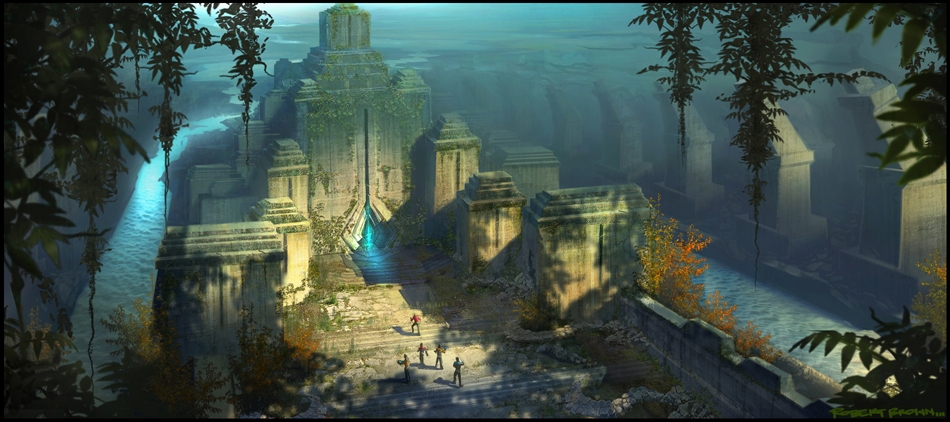
Sci-fi Temple Ruins by Robert Brown
True Communion stands in a strange position, at once one of the most popular philosophies of the Galaxy, but at the same time, reviled by the elites of both Empire and Alliance; it is a closeted philosophy, one that many adhere to, but few willingly admit. Even in its heyday, True Communion had little true hierarchy: only when the Keleni Temple-Worlds had total independence and the Keleni were united as one people, one nation, beneath their royal dynasty, did True Communion begin to look like a truly united philosophy. Instead, when one seeks to find adherents of True Communion, one finds scattered communes and communities, usually of lower class individuals, who gain their spiritual guidance from a nearby temple.

A Temple represents the core of the True Communion faith for a local community; its abbot represents the highest spiritual authority that they know. True Communion builds its temples in naturally occurring “holy places,” which tend to be found in remote, uncivilized regions. There, they seek to condense that spirituality into the heart of the temple, where Eloi Fragments can form. They also gather relics and philosophical lore for any who seek them. Ultimately, the purpose of a temple is to provide a safe haven for sacred things, and a place where those who wish to learn the ways of True Communion can go and discover themselves in peace.

Despite this, most temples end up acting as a central hub of religion for the locals. Though they must travel far (or the temple must come to them, often sending priests to look out for the local faithful), people regularly bid the monks of the temple to give them blessings, knowledge, healing, guidance and to officiate their ceremonies. Thus, temples become the secret hearts of the community of the True Communion faithful.

Wednesday, March 14, 2018

The Psionic Arts of Communion

Traditional Keleni Healing Arts (Jalteran) 5 points

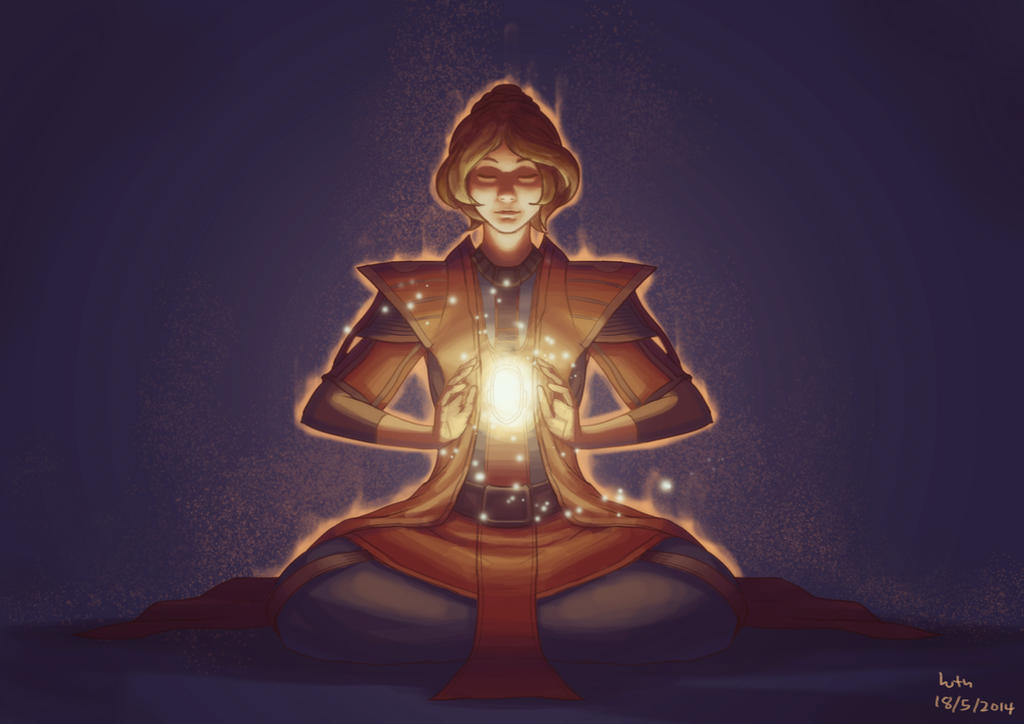
King Kashekim Nedakh by DrMistyTang
Jalteran refers to a specific guild of healers within the Keleni culture, thus referring to their preferred style of healing would be like calling Western medicine “Doctoring,” but nonetheless the word has stuck around. Jalteran is the unique practice of “folk healing” that the Keleni have been practicing for centuries and has become virtually synonymous with True Communion, to the point that those who practice the art might even call the location of practice a “temple,” and those who regularly attend for treatments might refer to themselves as “Followers of Communion.” Some healers embrace this, and also hold religious services on the side or act as mentors, while genuine Communion temples will also learn Jalteran to fulfill the dual expectations of those who come to their temple.

The Keleni healing arts derive their premise from the core principle that the physical is just a manifestation of the mental; this means that the health of the body is ultimately a reflection of the health of the mind. To purge someone of an illness requires that person to at least calm their mind and find harmony between their conscious mind and the subconscious id that rules their physical manifestation.

The most common forms of treatment are meditative. The healer first diagnosis the illness and what might be causing it; such diagnoses are often abstract, but some Keleni healers are astute psychologists and can find genuine psychological issues that the patient currently suffers from. Next, the healer guides the patient through meditative exercises, teaching them to turn their eye inward and calm whatever inner turmoil they have to better improve their physical state. To facilitate this, some healers learn the art of massage and interior decoration (creating a calm space will help create a calm mind). What effects this has tends to be questionable and ultimately depend on what the GM will allow Esoteric Medicine to do: it will certainly helps heal psychic issues (such as psychic crippling) and curing diseases that are psychic in origin as well as physician would cure the physical equivalent; for physical ailments, it generally does little more than provide a +1 to HT rolls to naturally recover.

While not required to learn the Keleni healing arts, most Keleni who practice them also study the Psychic Healing power, something Keleni naturally excel at. By putting the patient in a meditative state, they have a far easier time practicing their craft and their study of esoteric, psychic principles prevent them from ruining their target’s psyche or body during delicate procedures. Their near miraculous ability to heal nearly any problem via psychic healing contributes to the belief that anyone who engages in the trappings of the Jalteran will be as effective, which has led to a reputation of quackery. Rumors also persist of Jalteran sages who can cure aging and are thus both immortal and capable of granting that immortality to others. At the GM’s discretion, this can be true! But even if it is not, the perception of its truth drives many a wealthy or powerful man to seek out the finest Jalteran physician.

Keleni practitioners of Jalteran often have the honorific suffix -alta added to their name.

Required Skills: Diagnosis, Esoteric Medicine, Meditation, Philosophy (True Communion).

Additional Psionic Skills: Aura Reading, Cure, Disease Shield

Cinematic Skills: Mental Strength, Pressure Points

Secret Psionic Skills: Life Extension

Techniques: Introspective Ceremony

Perks: Auric Squint, Healing Bond, Healing Massage, Healthy Decoration, Meditative Massage, Secret Power (Life Extension, up to level 2), Sacred Healing, Soothing Touch, Stabilizing Skill (Psychic Healing, Esoteric Medicine), Wishful Medicine,

Optional Advantages: Psychic Healing Talent, Sensitive or Empathy

Optional Disadvantages: Charitable, Disciplines of Faith (Asceticism or Mysticism), Delusion (“Holistic medicine can cure anything”), Reputation (Quack)

Optional Skills: Artist (Interior Decorating), Exorcism, Expert Skill (Psionic), Teaching, Professional Skill (Massage), Psychology

Tuesday, March 13, 2018

Traditional Keleni Martial Arts

New Weapons

The Resonance Staff

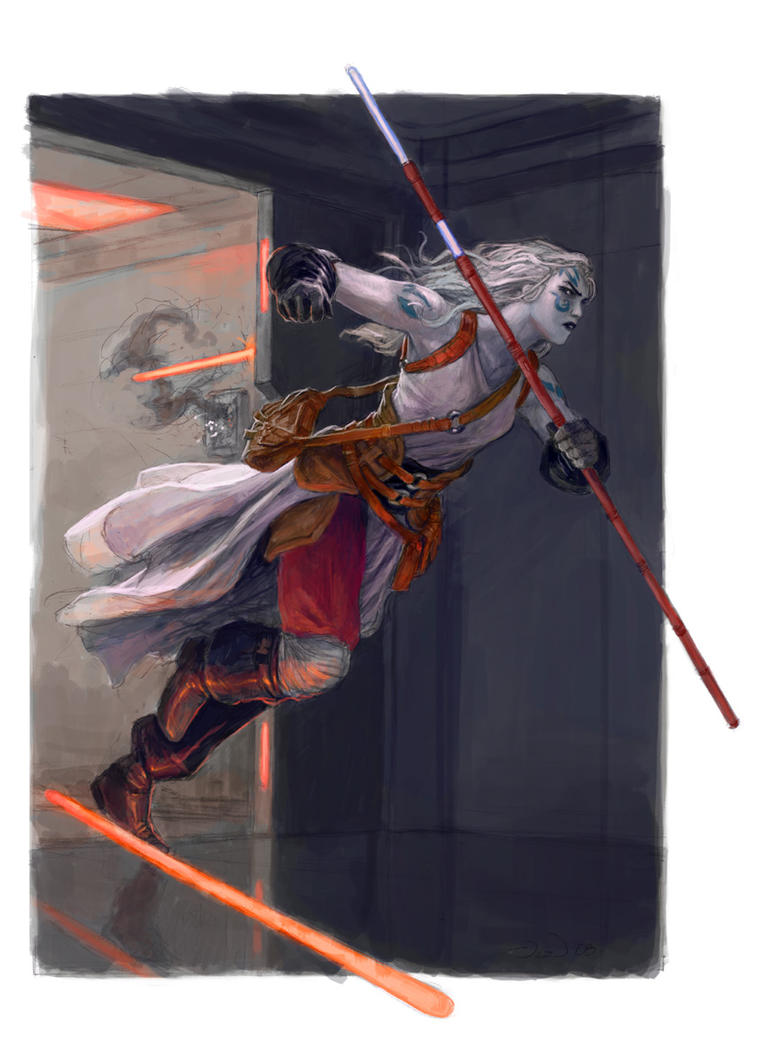
Jarael by Artpox
Ancient Keleni had long ago mastered many of the arts of psionic resonance, which allowed the wielder of a weapon or item to “attune” his psychic powers to the item. This might allow him to power the item or imbue it with an element of his own power. They called this technology “resonance,” and a resonant item has an aura, invisible to mundane senses, flowing around it.

A resonance staff is the most common application of this technology. It seems a standard staff, though it tends to be made either of a nano-tube cellulose that is “grown” for the purpose of forming a resonance staff, or made of a metallic nanocomposite. All forms have an embedded eloi fragment or a pseudo-fragment that can attune the weapon with the user. Once so attuned, the staff acts as an extension of the wielder: what the staff touches (or strikes) counts as “touched” by the user for the purpose of psionic powers. This has numerous combat applications: see the Resonance Charge ability below. Second, the aura around the weapon can be “hardened” to dissipate destructive forces. This means that energy weapons, such as force swords, can be parried without damaging the weapon, similar to the effect a neurolash-field can have on a force sword. See Resonance-Field Parry below.

Treat a Resonance Staff as a Quarterstaff, with a CF of +9 and an additional flat cost of $500 (thus a resonance quarterstaff costs $600). Add bonus damage to all strikes equal to the wielder’s best psionic talent.

The Psi-Blade

Where Keleni resonant weaponry had originally been for self-defense, with the Eldothic invasion of their homeworld, some Keleni repurposed the technology for greater lethality, so that they could murder their enemies. They created the first “psi-blades,” a technology described on page 39 of Pyramid #3/51 “Tech and Toys,” that allowed them to manifest their psychic energy as a purely destructive force.

Treat a Psi-Sword as described in the article above (with the same weight, cost, reach and other traits as a force sword) except that its damage is equal to +1d for every 10 points of appropriate psionic ability, with bonus damage equal the wielder’s talent, and with an armor divisor of 5 or the armor divisor noted in the appropriate psychic ability whichever is better.

Keleni traditionally created smaller weapons, such as the Psi-Blade, which is more comparable to a long knife than a sword. Treat Psi-Blades as using the same rules as Psi-Swords (but with the same weight, cost, reach and other traits as a force blade, from UT page 166), but its damage is +1d for every 12.5 points of appropriate psionic ability (or +2d for every 25 points) and bonus damage equal to the wielder’s talent.

Thursday, March 8, 2018

The Heterodox Virtues of True Communion

No! My heresy is just beginning!
Comprehending the fullness of True Communion lies beyond the reach of any single individual. While the three orthodox virtues capture perfectly the three paths of True Communion some among the practitioners of True Communion argue that they do not capture the totality of the virtues of True Communion or, perhaps, that they are but lesser virtues or distractions from the true virtues of Communion. The practitioners of Traditional Communion naturally have a low opinion of such attitudes and note that such heresy became rampant in the Knights of Communion shortly before their demise, but those who adhere to these heterodox Virtues seem to achieve genuine connection with True Communion in new and innovative ways!

Treat Heterodox virtues as identical to Orthodox virtues except for social attitudes. They may present a risk to the saint who adheres to them, but orthodox virtues have a similar risk in dogmatic devotion to ancient ideals. Importantly, following a Heterodox Virtue is not a violation of True Communion, nor a one-way ticket to a fallen state and becoming bound by Dark or Broken Communion.

The Knights of Communion have lost much since their fall, and the lingering chapters often only have a fragment of the original truths of Communion, and may have picked up new and innovative (or “heretical”) ideas about what true unity with Communion involves! Most such chapters have access to one or two Heterodox virtues!

Heterodox Virtues are not “invented” but “discovered,” usually through intense philosophical study and deep, meditative introspection. A GM who wishes to allow players to explore new heterodox virtues might use the invention system, with the governing skill being Philosophy; any such virtue is an Amazing “invention.”

Tuesday, March 6, 2018

The Orthodox Virtues of True Communion

A true master of Communion seems nigh divine in power, but this unstoppable power comes not from their command of Communion, but their unity with it. Its will is their will, and they are a living manifestation of Communion itself.

To achieve this level of oneness requires a deep mastery of the very nature of Communion, called virtues by the True Communion philosophy. After a student has learned to Commune with the infinite cosmic, their master begins to teach them one of the virtues of True Communion. At first, such a virtue seems limiting, requiring the student to strictly control their behavior, but eventually, as their behavior perfectly aligns with a virtue, they find that their facility with Communion grows and expands and they begin to manifest miraculous abilities within themselves. This is the source of the true power of all the great masters of Communion.

The True Communion faith has splintered under the weight of oppression. Without a singular guiding figure or doctrine, most followers of Communion turn to a local temple and a local abbot for spiritual guidance. However, each temple emphasizes its preferred facet of True Communion. Mastery of a virtue is the internal, spiritual equivalent to mastering a martial art or a powerful psionic skill: no living master of Communion has mastered every Virtue, and indeed, temples disagree as to which virtues should be mastered! As such, while all True Communion faithful accept the same basic precepts, the specifics and the depth of their devotion to particular values vary greatly. This can create conflict between temples, thus far little more than hurled accusations of heresy or dogmatic literalism, but on the other hand, some devotees to True Communion believe wisdom comes from a multitude of perspectives. Modern masters often take to wandering from temple to temple, learning the unique principles found in the scattered remnants of the faith and try to weave together a better understanding of the totality of Communion through the experience.

Thursday, February 22, 2018

Patreon Post: More Transcendent Principles

At the culmination of the Cult of the Mystical Tyrant, I released three "transcendent principles," visions that followers of the path of the Mystical Tyrant could attempt to enforce upon the world to grant themselves unique powers.  Since then, I've had discussions with Patrons and fans alike about additional possible Transcendent Principles, and I wanted to share a preview of two more: Acausality (which allows the manipulation of time) and Inhumanity (which allows the manipulation of the mystic himself).

This post is available to all $3+ patrons. If you're a patron, check it out!  If not, as always, I'd love to have you!

Wednesday, February 21, 2018

Patreon Post: the Cult of the Emperor

The Cult of the Mystic Tyrant has existed for millennia, though its form has changed over time from an imperial cult of a sacred king to a nihilistic philosophy to a deeply personal morality.  With the rise of the Valorian Emperor, the Cult has changed again into a movement of imposed rationality, vision and progress.  As the Valorian Emperor's fist has closed around the Galaxy, so too has he come to dominate the remnants of the Cult of the Mystic Tyrant, with only a few splinter sects still in defiance of his ideology.

Last month, my Patrons voted on the fourth Schism of the Mystical Tyrant: the Cult of the Emperor; yesterday, I gave you the results.  Today, I give you the actual cult, including how to handle it as a lens on the Cult of the Mystic Tyrant esoteric skill, what oaths it demands, what its symbolism is, and its "mask" conspiracies within the Empire.

This post is available to all Fellow Travelers ($3+, as a preview).  If you're a patron, check it out.  If not, I'd love to have you!

Tuesday, February 20, 2018

Patreon Post: The Cult of the Emperor - Poll Results

Last month, I had a poll of the last schism of the Cult of the Mystic Tyrant: The Cult of the Emperor.  Herein, you guys voted not just on what the substance of the Cult was, but who the Emperor is, who the War Hero was, and who the Emperor's Hand is.

Today, those results are revealed!  Behold the Emperor unveiled.  This Patreon Post is available to all Fellow Travellers ($3+ patrons); If you're a patron, check it out; if not, as always, I'd love to have you!

Thursday, February 15, 2018

Annara or Traditional Keleni Communion

Keleni traditionalists call Annara the pure form of Communion, the one that Keleni practiced in the past and still practice today. This may or may not be true; evidence suggests that the ancestral form of Communion gave rise to both Annara and True Communion, and that each has a piece of the original.

Annara, the Kelen word for “Communion,” (or more accurately, total unity of all things, or a sense of transcendence gained from feeling connected to all things), focuses more strictly on the natural telepathy of the Keleni people. It cultivates unity through telepathy and connection with one’s ancestors, and trains the Keleni in empathy for all beings, Alien or Keleni, sapient or animal. It also cultivates the ancient tradition of prophecy that traces its lineage back to the dawn of the Keleni faith-philosophy.

Unlike True Communion, Annara retains traditional Communion trappings, such as “folk healer” exorcisms and esoteric medicine. They also often learn Religious Rituals to better serve their community. Dogmatic traditionalists may teach their followers to fight with the resonance staff, and ancient Keleni weapon, but many also teach the force sword.

The intent focus on Keleni matters means that followers often learn a great deal about the language, history and culture of the Keleni. It also means that the religion attracts religious fanatics and xenophobic traditionalists. Many practitioners of True Communion hold Annara in awe, seeing it as the “lost half” of Communion secrets, but non-Keleni often find it difficult to win the trust of a Keleni master well enough to learn the style.

Tuesday, February 13, 2018

True Communion as Esoteric Skill

A True Communion disciple first learns to meditate. True Communion teaches that, through introspection, self-knowledge and self-discipline, one can begin to understand the world around him. They learn to listen to their own inner voice, then to their instincts, then to Communion itself. Through obedience to Communion, they can learn who they truly are, how they connect to the world, and what their true purpose is. Once one has mastered this art, the next step is to teach others. Teaching methods vary, but True Communion strongly favors teaching through example, riddles and challenges. It seeks to get the student to discover a principle for himself, rather than to simply be told something that they will soon forget, or learn only superficially. By teaching others, the student masters Communion more deeply and, more importantly, learns to connect with his own students and thus finds himself in an unbroken chain of masters and pupils extending back to the birth of True Communion.

True masters of Communion have deeply powerful meditative techniques that allow them to reach a trance-like, to empower their connection with Communion, and to even regain their psychic energy more quickly. They learn to discard their own selfish needs and, as they become more attuned to Communion, to become more attuned to their community around them and to being to understand the deepest secrets of spirituality. Those who masters the art of teaching, according to legend, have the ability to unlock the psionic potential of anyone, and can even teach those forever locked away from Communion to overcome their limitations and join the greater galactic gestalt.

The galaxy will forever associate True Communion with the Templars, and so many monasteries and temples also teach the force sword as part of True Communion. Most also teach the history of the faith, or give insight into the holy places and relics of the faith. Communion often holds that inner knowledge can come from dreams, and those who believe this teach their students to interpret their dreams.

This form of Communion is the Communion of the Templars and the one most commonly practiced across the galaxy. It is assumed to be the “default” form of True Communion.

Thursday, February 8, 2018

The Symbols and Rituals of True Communion


Aniconism

True Communion believes that depictions of the supernatural, be they idols or symbols, tend to unduly distract one from his inner journey in understanding the world. One can hold onto an idol, put his faith in that idol, and forget that the physical thing he holds is an illusion, nothing worth having faith in. Moreover, once the divine is given a face, people begin to forget its cosmic qualities and begin to overly humanize it. Thus, True Communion often, though not universally, chooses to eschew any symbolism at all.

True Communion symbolism tends to focus on things that naturally guide on to right and proper conclusions. They tend to be known by their tools and their words, rather than their great idols or symbols. Thus, the temples of True Communion tend to be remarkable bare of baroque imagery, favoring instead creating a place of profound peace and introspection, a natural place where one can lose himself in his own introspection.

This is not a strict taboo, however. The Keleni traditionalists are more likely to eschew imagery than human/alien traditions, as Traditionalists believe that True Communion and Keleni culture go hand in hand. Alien traditions, especially human traditions, feel the need to differentiate themselves from others and humans especially, caught up in their empires and factions, feel the need to have some symbol of their faith that they can point to. Even more extreme versions, such as the cults inspired by True Communion found within the Divine Masks tradition, absolutely have idols, but arguably have fallen far from what True Communion stands for.

Tuesday, February 6, 2018

The Beliefs of True Communion

  1. Everyone matters, no matter how lowborn
  2. We are defined by our connections with others.
  3. True knowledge can be found within, by listening to one’s intuition and accepting the morality one already knows in their heart.
  4. The “real” world is an illusion; only the “inner world” of thought, dream, perception and connection is “real.”
  5. All people are but facets of an infinite cosmic divinity; through introspection, we can understand the infinite cosmic and understand how it connects all people together.
  6. Virtue is found through aligning one’s self with the will of Communion, and in accepting one’s true purpose in life, one’s destiny.
  7. Time is as much an illusion as the world: there is only the Eternal Now.

Thursday, February 1, 2018

The Cultural Context of Communion

The Origin of Communion

A race native to the same region of the Galaxy as the Ranathim, the Keleni, first discovered the phenomenon of Communion and, around it, created the philosophy of True Communion. Naturally telepathic, this race has an innate connection to one another and to their own ancestors. The origins of the idea of communion came from studying ways to deepen this connection, allowing communication across vast distances of space and time. Eventually, the Keleni discovered that they could interact with this inherent connection itself, that they could do more than just commune with one another, but that they could commune with the state of communion itself, this great unconscious gestalt that surrounded them and bound them to one another.

The Keleni had a rough history with other races. First, the great and terrifying Monolith Empire conquered them and shattered their temples and scattered them in an attempt to “cleanse” their temple-worlds. The rise of the Ranathim Empire broke the Monolith Empire, and the Ranathim allowed the Keleni to return to their worlds and rebuild their temples, but they introduced their own strange religions that they demanded the Keleni acknowledge, and they demanded slaves of the beautiful and graceful race. Whenever an Empire has arisen, the Keleni have found themselves under the boot of oppression. They became an oddity in the galaxy, an insular race often found in enclaves on alien worlds where they practiced their unique meditations and ceremonies regardless of what the prevailing ideology. Oppression only made martyrs of the Keleni faithful, or drove their faith underground, but it remained, made resilient through adversity and empowered by the legitimate enlightenment that True Communion gave them.

During their diaspora and while interacting with these great empires, the Keleni discovered that most other races lacked their innate psionic abilities and those who had innate psionic abilities, such as the Monolith or the Ranathim, were bound to entirely different, alien and dangerous forms of Communion (Broken Communion and Dark Communion respectively), leading the Keleni to conclude that their access to Communion was unique to them. Even so, other races, especially the dispossessed among the galaxy, watched the miracles worked by the Keleni with awe and wonder. Many began to treat them as sages, begging at their temples for a miracle cure, or to learn at their feet.

The debate over what to do with aliens who petitioned to join the ranks of True Communion sowed the seeds for the first true schism in True Communion. Traditionalists claimed that because only the Keleni could naturally access Communion, only the Keleni should practice it. They argued that despite the tenets of tolerance native to their faith, that all “people” should be brought into “Communion,” only fellow Keleni counted as “people.” They pointed angrily to their mistreatment at the hands of other races, to the unique Keleni bond, and to the need to protect their culture and way of life. On the other side of the debate, Keleni argued that true tolerance required patiently forgiving the sins of others. Some among them had managed to teach other aliens, such as the Ranathim, the means of Communion. They advocated strenuously that if the Keleni were a special and chosen people, then their destiny was to bring Communion to the entire Galaxy.

Tuesday, January 30, 2018

True Communion: An Introduction


There is no emotion, there is peace. There is no ignorance, there is knowledge. There is no passion, there is serenity. There is no chaos, there is harmony. There is no death, there is the Force. 
-The Jedi Code

Here we are at last.

The Jedi are Star Wars. While one can make the case for the importance of characters like Han Solo and Princess Leia, by the Return of the Jedi, the exploration of the Jedi and their code came to dominate the Star Wars narrative, and main characters became defined by their “force sensitivity.” The prequels told the story of the Jedi, and by Rogue One, their philosophy had morphed into the dominate religion of the Star Wars galaxy.

I’ve had a few problems with this drift, though. First, the Jedi practice, as depicted in the Star Wars movies is essentially the only religion of the setting (with an honorable mention to the Sith, though they really accept the core premises of the Jedi code, and just invert them; they are to the Jedi what Satanists are to Christians). Furthermore, the Jedi philosophy, as depicted in A New Hope is some ancient, nigh-mythical lost religion, but if you can trip over Guardians of the Whills, force sensitive philosophers and outcast Jedi in every cantina, then when Obi-Wan Kenobi explained the Force to Luke, it was more like some preist explaining Christianity to you today, rather than some martial art master explaining the lost secrets of a bygone age.

I’ve tackled the problem of “no other religion” throughout this entire philosophy series: the heroes of Psi-Wars can choose from Neo-Rationalism, the Akashic Mysteries and the Divine Masks as their driving morality and beliefs, and I’d like to think I’ve made each sufficiently compelling that someone might be willing to follow them. True Communion, then, can retain something of an exotic nature.

Two problems remain, though. First, the Jedi philosophy is, as depicted by Star Wars, one exclusively practiced by “knights,” warrior-priests. Outside of the implications of the Guardians of the Whills (we hear very little about this offshoot in Rogue One, and both of those characters are also warriors), we never get a sense of how the common man feels about the Jedi philosophy or how he might express his devotion. Do people go to temples to worship? If so, how? Does “worship” even make sense? Or is all the devotion of the Star Wars galaxy to the Jedi philosophy really a devotion to the Jedi order and the hope that these space wizard-knights will return and save them?

Which brings us to problem number two: the Jedi are thematically an ancient order of heroes with messianic elements. They saved the day long ago and will someday return to save the day again. They resemble the once and future King Arthur, or the Assassins of Assasin’s Creed or the Solar Exalted of Exalted. Thus, the Jedi Order should be dead long enough to have faded into myth, but in fact, they faded away only a generation (in the first trilogy) or two (in the latest trilogy) ago.

What we need then is a broader and more ancient order. We need to get a sense of what it means to be a practitioner of this Jedi-like philosophy without actually being a space knight. What are its priests like? Do lay people go to temples? If so, what do they do there? We also need to end the order a much longer time ago and explain what happened to them in the meantime.

We also need to integrate Communion itself into all of this. The philosophy of True Communion is not the philosophy of the Jedi for the same reasons that the Force is not Communion. True Communion is a universal, divine, psychic gestalt that contains paths, archetypes, occult elements, avatar states and world-shattering miracles. The philosophy of True Communion, then, can and should have a more distinctly religious character, and explain why a Knight of Communion is so much more powerful with Communion than, say, a devotee of the Divine Masks.

Furthermore, the core theme of True Communion must be that it is right. The base assumption of the Jedi is that their vision is correct (They are “the good guys”), and that all right-thinking individuals back them. Most psi-wars players will expect something similar in Psi-Wars, and look to True Communion as the “Right faith.” If this is so, then why doesn’t everyone worship it? And if it isn’t so, in what ways might it be wrong? How might it exploit people’s good will? How might (say) the Akashic Mysteries or the Cult of the Mystic Tyrant be more right, if the GM wishes to go in that direction?

Finally, we must understand that this is an RPG. Star Wars depicts almost all Jedi as essentially the same (all are skilled with their lightsabers; all learn the same styles; all have the Jedi Mind Trick and telekinesis and precognitive dreams and the ability to “sense” things), which is fine for a film, but players will need to express their uniqueness and differentiate themselves from one another, and explore different themes within True Communion. Ideally, one should be able to play a game with nothing but the Knights of Communion and see each player play a different character, and still have a sense that they have more they can explore.

I would like to note that unlike the other philosophies, True Communion did not spring up in this iteration, but has been quietly in the works since Iteration 4, and I’ve discussed them at length before, so if these inspirations seem familiar, that’s why.

Thursday, January 25, 2018

Patreon Special: Domen Khemet, the Ranathim Cult of Death

Last month, at the culmination of the Divine Masks, I offered my Patrons a poll to choose the fourth and last Cult of the Divine Masks: the Cult of Death.  Those poll results are in now, including Domen Khemet, a fully detailed version of the Cult, ready for play. The cult utilizes the Broken Communion miracles detailed in Tuesday's patreon post about Broken Communion ghosts.  Further, it has a unique relationship with the Cult of the Mystic Tyrant, as Anthara, the founder of the Cult of the Mystic Tyrant once swore an oath to them that the later cult broke, so be sure to check those elements out too.

This post is available to all $3+ patrons, as it represents a preview.  The Patreon Post contains a discussion of the votes and my thoughts on them, as well as the completed cult.  If you're a patron, check it out!  If you're not, as usual, I'd love to have you.  Enjoy!
Related Posts Plugin for WordPress, Blogger...