Showing posts with label GURPS Action. Show all posts

Monday, December 6, 2021

GURPS Action: How Balanced are BAD Guys?

 At the GM’s option, henchmen without character sheets have an effective skill of 10 + absolute value of BAD: 11 at -1, 12 at -2, and so on. As with all BAD things, this is abstract. Actual skill, equipment quality, extra time, and anything else that might matter is all rolled into one handy number. -- GURPS Action 2, page 5

Last time, I looked at BAD.  I meant to look at Mooks too, as that's the real point of this exercise for me, but I took so much wordcount just looking at BAD itself. With that out of the way, let's look at Mooks themselves.

I will note, as I noted last time, that Mooks in Action, don't actually have (Absolute BAD)+10 skill; per page 45-46 of Action 2, they have skill 10-15, which might be completely unrelated to the BAD.  Skill seems to be all that matters: they have a static Dodge of 8, Parry of 8, and ST of 10.  The game largely takes damage out of the equation, and that makes sense: with guns available, characters who get hit tend to get removed from the fight pretty quickly, so we'll largely dispense with weapon other than to note melee vs ranged and focus on chances to hit.  

We'll focus almost entirely on combat capabilities (Action even suggests not using BAD for combat), as that's the point of balance I'm most interested in.  When it comes to things like "I try to Fast-Talk the guards" I'm fine with just applying a BAD penalty.

GURPS Action: How Balanced is BAD?

As an alternative to detailed modifiers, the GM can set a sin- gle difficulty – the Basic Abstract Difficulty (BAD) – that covers all aspects of a particular phase of the adventure. This is simply a penalty from 0 to -10 that replaces detailed situational modifiers. The only other modifiers that apply are those that the PCs bring into the picture: bonuses for equipment, penal- ties for disadvantages, etc. -- GURPS Action 2, page 4

At the GM’s option, henchmen without character sheets have an effective skill of 10 + absolute value of BAD: 11 at -1, 12 at -2, and so on. As with all BAD things, this is abstract. Actual skill, equipment quality, extra time, and anything else that might matter is all rolled into one handy number. -- GURPS Action 2, page 5
I have long taken these words as gospel and applied them to Psi-Wars verbatim.  Should I?  That might seem like an odd question, because the value of BAD, it's simplicity, seems obvious on its face.  You have a single difficulty and you apply to (almost) everything.  What's wrong with it?

Well, nothing specific, but I often find that what I think of as a reasonable bad per what GURPS Action tells me, the PCs will absolutely blow through.  That's not necessarily a problem.  Sometimes, the heroes really do blast past the issues they face like they're nothing. Action heroes are, after all, larger than life.  Even so, knowing you'll pass every check makes the game somewhat tedious and drains all the fun out of a scenario, especially if it happens unintentionally.  Sometimes I find it useful to meditate on these values and what they mean.

This goes double for mooks.  Should we just give mooks absolute BAD +10 for their stats? I will note that if you go to the back of Action 2 and look at the actual stats for Mooks, they don't explicitly follow this. What's a good, base value for a mook? And what sort of challenge levels are we looking for.

Monday, August 30, 2021

GURPS PDF Challenge 2021: GURPS Action Adventure 1: Templar's Gold

 So, here we are, the PDF challenge completed!

This has one chapter;

  • The Adventure: which is the adventure.
I was really looking forward to this adventure, and delighted to see it unlocked. The actual thing didn't quite live up to my expectations (I liked Green Madonna better), but it's not bad. The adventure is somewhat barebones, you'll need a good knowledge of Action to make it work, and the adventure suffers from an incomplete understanding of Action's core mechanics, but there's nothing really deal breaking here, and it makes up for it in rich historical context and detail that, I think, really sells the adventure. Recommend

Saturday, February 22, 2020

Patreon Special: Minion Enhancements

As I began working on the combat scenes of Tall Tales of the Orochi Belt, I hit on the idea of expanding them from the drab rules of GURPS Action (though there is much to be said for their simplicity) in favor of the more intriguing options found in After the End and Dungeon Fantasy. I had touched on this already with the "Trademark moves" on some of my mooks found in previous iterations of Psi-Wars, but I wanted to explore the concept more fully, as discussed in this blog post

As this one the most recent patreon poll, I now present to you Minion Enhancements. This is a 20-page document discussing how to use advantages and disadvantages to make more interesting combat encounters with mooks and henchmen, as well as about 20 worked examples of more detailed enhancements, and 6 worked examples that you can drop directly into a generic Action game.

This is a Patreon special for all Dreamers ($1+ patrons; yes, just $1).

Monday, April 1, 2019

Epic Psi-Wars: A Conspiracy in the Making

This isn't one of my regularly scheduled posts, and I hope my patrons will be patient with this, as their discussions have inspired me, and I find these thoughts racing through my head, so I need to get them out while it's still fresh.
"Unless it's a Templar.  Then you're just effed" - A typical comment on the Templars
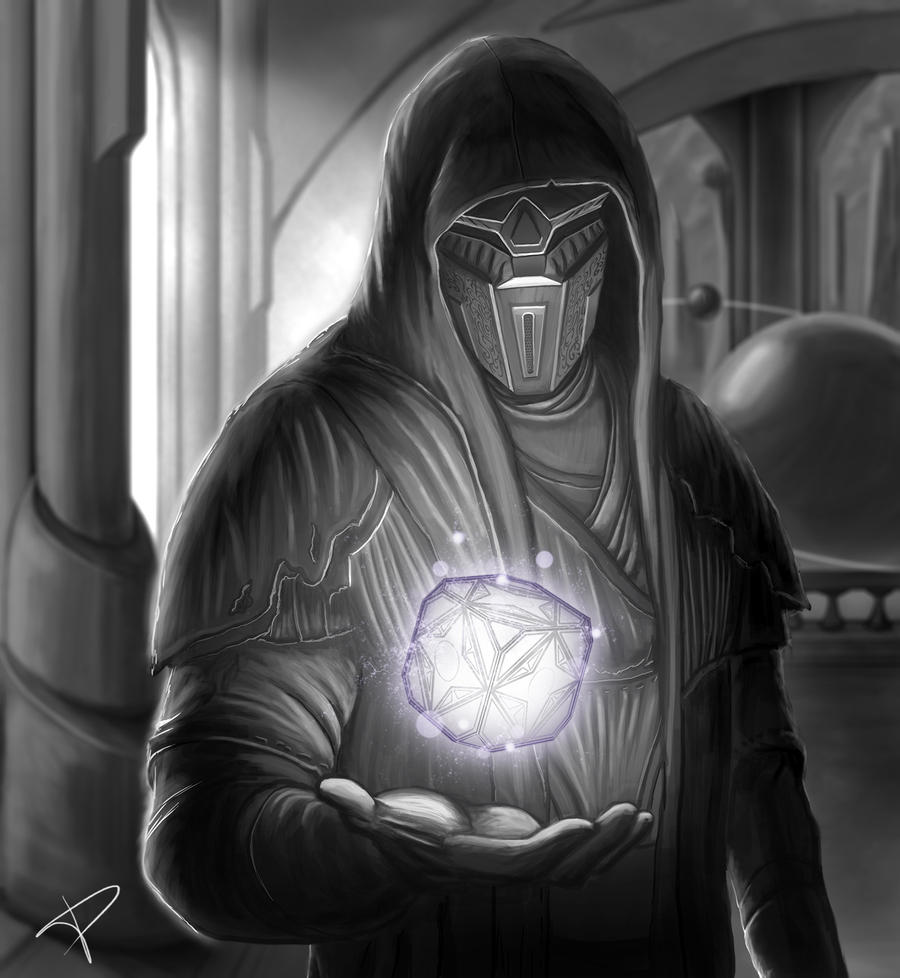
There is a fundamental disconnect between how people who know Psi-Wars talk about Psi-Wars, and what I know for a fact is written on paper and it mostly centers on the Templars.  There is this idea that Templars, or other forms of Space Knight connected with Communion, are on a completely separate level from other characters.  The see a team of commandos as dangerous, able to take on entire platoons of mooks and win, but a team of Templars should strike fear into the hearts of Imperial officials and threaten to turn the tides of a whole war. 

However, if you look back at the playtests back in Iteration 4 and earlier, you'll note that Dun Beltain, Space Knight, is not really better than Leylana Grey, a spy, or Kendra Corleoni, a bounty hunter. Yes, they're all cool, but the space knight isn't on a different level. This is a fine and acceptable thing for Space Knights to be.  They could be people in armor with one subtle psychic power ("I an sometimes tell when I'm in danger and maybe dodge a little better" or "I can sense when people are sad") and know enough about fighting with a force sword that they can hold their own with other combat templates and definitely take out a bunch of mooks.  On the other hand, the super-heroic space knight isn't especially bad either.  It depends on what you want.

"What you want" is quite a question to ask.  You can't even go back to the source material and get a fair answer.  Yes, the Jedi as depicted in the prequels are straight up super-heroes (sort of; they rarely really make use of the Force other than as a dramatic display of power; you see far more overt uses of telekinesis than subtle uses of telepathy or ESP), but their power-level in the original trilogy is much more understated.  When Obi-Wan defeats the thugs threatening Luke in the Mos Eisley Cantina, nobody freaks out like Clark Kent just took off his glasses, and you might think they would if you pondered the implications of a Jedi suddenly showing up after years of supposed extinction. Instead, they just go back about their business.  This makes more sense if you think of Obi-Wan, in his original conception, as more of a wandering ronin in a bar hanging out with a cowboy and a princess and a farm-boy-of-destiny.  Obi-wan is not dramatically more special than most heroes in A New Hope, as opposed to Jedi characters in most of the rest of Star Wars, who are on a completely different level.  No help there, then.

So, it's up to us to decide for ourselves what we want out of Psi-Wars.  Do we see Space Knights as "just another character type?" or "setting defining super-heroes?" And the answer seems to be "Yes!"  The sense I get is that Dun Beltaine is fine, and we can imagine a lot of heroic aristocratic space knights on a similar power level, but Imperial Knights and Mystical Tyrants and Templars are on a different level.  Thus, we have two worlds and two different takes on the game: a modest, "street-level" game and a more dramatic "cosmic-level" game.

The question then becomes:
  • How do you handle that without making the game unbalanced?
  • Who gets to be epic-tier? Just space knights?
  • What do the epic-tier characters do?

Friday, November 30, 2018

Let's talk Ranges: Remote Combat and the Casaba Howitzer

Something hitting from Remote range strikes me as best used as a plot device. - Brett Tamahori
First, let me apologize for my lack of posts lately.  My wife's having a rough pregnancy which means I sometimes need to step in, and this is happening more and more lately, so I get in posts when I can.  I'm almost finished with the rules, and I have one last "playtest" I'd like to post and then I'll move onto something much more fun, I promise. In the very least, I've been looking forward to it.  In the meantime, I wanted to take a moment to post something I've really wanted to since I saw a discussion on my discord channel, so if you'll humor me, I'd like to jump in and tackle it.

I feel like the ranges offered in GURPS Action and GURPS Dogfighting and my own system are pretty abstract.  What is Remote range anyway? For that matter, what is "Extreme" when it comes to space combat?  And what sort of ranges should you allow in your games?  As a bonus, I wanted to talk briefly about the "Casaba Howitzer" that one poster brought up, and whether it "breaks" Psi-Wars.

Tuesday, November 27, 2018

Psionic Powers in Dogfighting Action!

"The Force guides my controls!"

―Delta-7 pilot

Star Wars often discusses the fact that Jedi made amazing pilots, and during the Clone Wars, they even employed different starfighters than the rest, precisely because of the advantages their force sensitivity gave them. In principle, Psi-Wars should be the same, and we expect Templars and Space Knights to be exceptional pilots. However, while Star Wars offers nebulous reasons for Jedi excellence as pilots (“The force guides them,”) in an RPG, we need more concrete reasons for that excellence. Hence, we need to discuss how psychic powers and offer advantages to a pilot.

I wanted to move away from GURPS Spaceships Combat for a few reasons, but the big one is that it involved “incomprehensible distances.” That is, I certainly didn’t understand how to handle the scale of distances involved, and I notice that when I start talking about remote ranges, people get uncomfortable and talk about it causing problems even though it’s the shortest range of GURPS Space Combat, which highlights the problem. Worse, GURPS doesn’t really operate that well on those ranges. It can, of course, but most material out there assumes more terrestrial, rather than celestial, distances, because that’s the distances in which the average human character operates in.

This definitely applies to psionic powers. This was a topic I intended to visit at some point, and when I finally did, I immediately noticed that the change from Spaceship combat to GURPS Action chase rules immediately made a lot of psychic powers more relevant “for free” precisely because we reduced ranges to something that GURPS Psychic Powers could handle “out of the box.”

Wednesday, November 21, 2018

Why Capital Ships: Space Artillery and Tactical Command (Part 2 of 2)

Yesterday I dove into the basic theory of capital ships in my GURPS Action chase update. Today, I round it out with a look at truly long range combat, and gaining a tactical advantage on your opponent.


Remote Combat

Lando Calrissian: Yes, I said *closer*! Move as close as you can, and engage those Star Destroyers at point blank range!

Admiral Ackbar: At that close range we won't last long against those Star Destroyers!

Lando Calrissian: We'll last longer than we will against that Death Star! And we might just take a few of them with us!

--Return of the Jedi

GURPS Action’s Chase rules do not extend beyond “Extreme,” because we begin to struggle with horizons and ground clutter at some point. However, Dogfighting Action! includes two new ranges: Distant and Beyond Visual, which represent ranges made possibly by the extreme distances of air combat. I want to add two more: Remote and Beyond Remote.

Once we get into space combat, ranges begin to widen to an impossible degree. Orbital bombardment takes place from distances up to 100 miles away! In principle, one should be able to blast another target in space from such a distance. Of course, this is “point-blank” in GURPS Spaceships, and too extreme a distance begins to diminish the “in your face” visuals of Star Wars and Psi-Wars, but nonetheless, I think there is room for powerful artillery ships blasting one another from a phenomenal distance, or at least a seemingly phenomenal distance.

Every range band in the Action system is roughly five times as far as the previous band. Extreme is up to a mile, while Distant is up to 5 miles, and Beyond Visual is “beyond that.” If we follow the progression, Beyond Visual would end at up to 25 miles, and “Remote” would end at up to ~125 miles or -27 to -31.

We need to answer a few questions before we can introduce a new range band, as there are always degrees of distance between ourselves and every object in existence, but most such distances are not tactically relevant. We need to know if Remote is tactically relevant: can a ship at that distance coordinate others, can it attack, can it be attacked, and can people reach it on the time-scales of GURPS Action Chase sequences?

For coordination and attack, the answer is an easy yes. We can easily have communications and sensors devices with ranges at about 100 miles, which is roughly the range of Remote. We can also easily attack out to that distance with pretty much any blaster weapon of any reasonable size. In fact, it’s so easy to attack from 100 miles away that I’ve reduced the ranges of blasters. I’ve included the details in the new version of my Vehicles conversion. Suffice it to say, only Super-Heavy capital turrets and most super-weapons have this sort of range now, as opposed to even fighter-level cannons.

A greater problem with an attack are the accuracy penalties. For a capital ship firing an aimed blaster cannon at another capital ship from 100 miles away, we’re looking at an average crew skill of 12 + an SM of 13 + 5 from sensor lock and targeting computer and +9 from accuracy – 30 from range penalties, or 9, which is less than a 50% chance of hitting. We’ll need some ways to improve this, as well as some reasonable ways to defend from such a long-range attack.

The trickier question is if it can be attacked or if a ship can reach it on the GURPS Action time-scales. In principle, we can say a ship is unreachable (say, 10,000 miles away) but is freely able to shoot you. This does not create fun gameplay, naturally, as combat occurs on vast, strategic distances and over exceedingly short time-scales, similar to how an ICBM-based nuclear war would go. This is not what we want. So, can we reach a ship that’s about 100 miles away in a minute? Or, more accurately, can we go from between 125 and 26 miles away to between 25 and 5 miles away from a target within a minute at our chosen speeds?

Our target speeds are about 1000 mph for a fighter, 600 miles per hour for corvettes, and between 300 and 100 miles per hour for a capital ship, and an action turn takes one minute. In a single minute, a fighter can cover 15 miles, a corvette can cover 10 miles, and a capital ship can cover between 5 and one-and-a-half miles. Frankly, this already begins to cause problems at dogfighter distances because going from beyond visual (minimum of 5 miles away) to distant (minimum of 1 mile away) is beyond the possibility of slow capital ship. In the best case scenario, a fighter reach a target at 26 miles away in two minutes; 125 miles takes closer to 10 minutes. A corvette can reach a target 26 miles away in up to 3 minutes, while 125 miles away takes nearly 15 minutes. At 300 miles per hour, a capital ship will reach a target 26 miles away in ~5 minutes and 125 miles in nearly half an hour. It is not possible in any account to really interact with a remote target in exactly one minute, though it’s not so far away that it’s really beyond the chase rules: in most cases, you could hand wave things away and suggest that the target is reachable on a 5-minute scale rather than a 1-minute scale, or that you can reach the target, but you’ll suffer several attack attempts.

If we take all of this together, it suggests we should treat remote carefully if we’re going to use it at all. To be useful in combat, we might add an “aiming” action which represents something similar to using the Dead

All of this together suggests we should treat remote carefully, if we’re going to handle it at all. First, remote requires some sort of time-consuming “precision aiming” action where you carefully line up your shots, the same idea as Precision Aiming from GURPS High-Tech; we can grant a +4 to hit, but also a +2 to dodge, representing the fact that at such distances, even a slight evasive action can offer considerable defensive benefits, and also mimics the Telegraphic attack rules. This gives a capital ship a roll of 13 or less to hit a target, but improves another capital ship’s dodge from an average of a pointless 2 to a possible 4, while corvettes and fighters are effectively impossible at that range. Second, I would require a minimum of 100 mile range on weapons, comms and sensors to effectively operate at that range. Third, I would argue that a Remote vehicle cannot gain advantage on another target (you’re too far away to meaningfully outmaneuver your target at any speed). This helps reduce the lethality of the remote ship: you’re firing with a more limited number of your guns, your target is hard to hit, and your opponent can adjust his force screens so they face your direction. A generic battleship is only going to hit with two or three of this super-heavy cannons, and against a target with 10k force screens, he’ll fail to penetrate DR at all. You really need a super-weapon to operate at such a range, or you need to target a less well-defended vehicle. Fourth, when it comes to movement, we can treat moving from Remote to Beyond Visual as a two-shift move. This is a little cinematic, as it means that a fighter can move from remote to beyond visual in a single minute with a good roll, while corvettes will typically require two minutes, and capital ships will require a lot of rolling to successfully chase down their target, unless their target is static (which is possible). Finally, I would make this an optional rule: it’s an interesting scenario when dealing with orbital bombardment or when tackling a super weapon, and it’s a good place to park your carrier if you want it help coordinate your battle, but it’s probably more detail than necessary in any other cases.

Formation and Tactics

One important element of GURPS Spaceships is the ability of the commanding officer to exert his tactical acumen to grant his vessel a benefit over his opponent. The Officer template excels at Tactics, and thus we would expect them to be able to bring their excellence to bear against opponents here too.

The first and most obvious way in which an Officer can gain the strategic upperhand against his opponent is with the already existent foresight rules. I’ll talk more about Lucky Breaks later, but suffice it to say, Foresight can translate directly into a Lucky Break, in the same way that Serendipity can.

However, I’d like to make tactics more directly useful, moment by moment. I can simply borrow the tactics rules from GURPS Spaceships, but I want to revisit them and see if we can return to base principles and see whether or not they still fit. After all, the Chase rules don’t use tactics, nor does the Dogfighting rules. Why should we? What sort of benefits would they provide?

In reality, I do think you see tactics in chase scenes! Random mooks who simply point their vehicles at the enemy and drive as fast as they can tend to be less effective than, say, law enforcement officers who coordinate their various vehicles, from helicopters to a fleet of squad cars, to catch their opponent, or back them into a blockade. This feels like a form of tactics that might offer some sort of complimentary bonus to chase rolls.

When it comes to dogfights, we definitely see the use of tactics as well. A good example of this was the “Thatch Weave:” if a less agile fighter had a zero on its tail, it would “weave” with its wingman to bring the zero into the sights of its wingman. Larger capital ships would also maneuver with one another to maximize their firing arcs while minimizing their opponent’s firing arcs.

All of these examples of coordination have something in common: they involve coordination between multiple craft. GURPS Spaceships doesn’t require this, but it assumes teams of characters on one ship, while we’re going to see teams of characters on multiple ships, and thus requiring formations might be an interesting idea.

Formations are a concept also from GURPS Spaceships, but is semi-visible in the GURPS Chase rules in the concept of “chase groups” with leaders. We can call these formations. We can do a few more things with formations: consider that the job of many smaller capital ships are as “escorts,” we can allow a ship in formation to “block” another ship in formation. We can also allow an area jammer to protect everything within that formation. Finally, formations of two or more ships can engage in tactics.

GURPS Spaceships gives tactics the ability to apply a +1 or -1 to dodge, but this is often not useful to the very ships that will want to use tactics the most: Capital Ships, as they often have an abominable dodge. Instead, I suggest the following: in a formation of two more ships, a character within the formation may make a Tactical Coordination action against a single target (either a single vessel, or a single formation); if the target is a formation, that target may roll Tactics to resist in a Quick Contest. If successful, the formation may gain one of the following benefits

  • Defensive Tactics: Opponent either has -2 to hit the vessels of the formation, or the vessels of the formation gain +1 Dodge.

  • Defensive Tactics: Opponent either has -1 to dodge the attacks of the vessels of the formation, or the vessels of the formation gain+2 to hit the target vessel or formation.

  • Pursuit Tactics: +2 to chase rolls against the target for this turn

In practice, this allows capital ships to reduce their opponents’ barrages by a hit or two, which might mean the difference between life and death.

Tuesday, November 20, 2018

Action Vehicular Rules 1.1

Currently on my Patreon, if you're a Patron, you get a one week preview of the Action Vehicular Rules, the Space Opera update for the Action Chase rules into a full dog-fighting and space combat system.

If you're a patron, you can check it out here.  If you're not, come back next week, and it'll be available to you!  As always, I want to make a shout out to my patrons, and give them a big thank you.  I know it's been a quiet few months.

Why Capital Ships? New Rules for Dreadnoughts in GURPS Action Chase rules (Part 1 of 2)


My apologies for my absence.  Between illness and family, I've been busy, but also, the topic I had selected to tackle turned out to be exceptionally large, so large that I've had to break it down into several smaller posts.

The core issue I want to tackle are Capital Ships and how they fit into our new combat paradigm.  I had intended for this to be a single post, but it turned out to be nearly 4500 words, so I'm going to break it down into a two parter.  Today, we start with some theory, and then dive into a greatly expanded set of rules on Passenger Actions.

Why Capital Ships?

Most space-based combat games find that they naturally center around a “sweet spot” of design. For games like Wing Commander, this is the fighter; for settings like Star Trek, this is the capital ship. For settings like Star Wars (and thus Psi-Wars) we need to justify multiple sweet spots to make our visions of our desired form of space combat come to life.

Psi-Wars focuses mostly on the model of “one character, one ship,” and this works best with starfighters, and thus starfighters are probably the prime form for participating in space combat. Thus the other models, the corvette and capital ship, need their justification. I’ll put off justifying the corvette, except to note that it offers an opportunity for multiple characters to lend their skill on a ship that is competitive with starfighters.

The Dreadnought offers a far greater concern when it comes to justification. They represent enormous resource investments that lack the speed and agility of a fighter, and sport similar firepower, and are vulnerable to starfighters. Why, then, would someone field capital ships at all, instead of fielding fleets and fleets of starfighters? Moreover, how does the capital ship fit into the model of “one character, one ship?” How can our GURPS Action Vehicular Combat model all of this, making the dreadnought useful while still keeping it focused on a single character? To make dreadnoughts function, we need to answer these questions.

The justification of the dreadnought is perhaps the easiest question to answer. The word “capital ship” arose to describe the sort of “dreadnought ironclads” that arose during the heady naval years before WW1 (and thus, in a sense, “Dreadnought” and “Capital Ship” are synonymous, at least if we use the former term to describe a class of ships). I don’t know the logic of justification behind the term “Capital Ship,” but capital is a term used to describe the great industrial machines in which a nation would invest, suggesting that a capital ship is a great industrial machine of war, a giant mobile fortress from which the rest of your operation can be staged.

This is certainly an apt description for a carrier. A starfighter lacks long-term accommodations and the capacity of long hyperspace journeys, and people and tanks certainly lack the ability to travel through space. The carrier offers room, accommodations and transport capacity for starfighters and soldiers, ferrying them across the galaxy. In a game, they often serve as a “mobile base.” In Tinker Titan Rebel Spy, a playtest I ran to test whether a dreadnought was “too much ship for players to handle,” I found they mostly used their dreadnought this way: they slept in its cabins, flirted in its cantina, planned in its briefing room, and launched their starfighters from its hangars.

We should also consider the capital role of flagship. The great size of a capital ship allows it to carry far more electronics and expert crew members than the average starfighter or corvette. With access to megacomputers, FTL communication and huge sensor arrays, the capital ship has unparalleled ability to see and command a battlefield. They can coordinate fighter squadrons or ground troops, and they can put expert strategists and spies to answering any questions the members of the arrayed force might have.

Finally, the capital role of the battleship remains valid because a blaster shot is much cheaper than an expensive isomeric nuclear torpedo! While a starfighter can defeat a capital ship, so can another capital ship, and it can do so over and over again without needing to refuel or reload, and can do so from a fairly extreme distance. This is less important for swift “first strikes” against other capital ships, but it’s vital to be able to pour on firepower against hardened ground targets, ideally from orbit where you are far away from anti-air defenses.

What the Fighter Ace is to the starfighter, the Officer is to the Dreadnought. Naturally, a fighter ace can directly control his vehicle, while the officer must command his crew to carry out his orders and must coordinate that crew effectively and efficiently. But where a corvette, with a crew numbering typically no more than ten, can afford to allow a handful of heroic characters to shine (one top notch pilot with a couple of highly skilled gunners and a single, desperate scavenger trying to keep the ship flying), a capital ship can have crews in the literally thousands, making it nearly impossible for the singular actions of a character to make a difference. Thus, we must treat out crew as natural organic extensions of heroic characters.

The rest of this post naturally arises from my attempt to adjust the action chase rules to fit these changes. GURPS Action assumes small vehicles with a single driver and a passenger or three: a car chase with perhaps motorcycles and a helicopter or a tank; they do not envision “chase scenes” with battleships and carriers. We need them because they impact battle, but they should do so on a larger, more strategic scale.

Thursday, October 18, 2018

Action Vehicular Combat Playtest 1 - Starhawk vs Typhoon

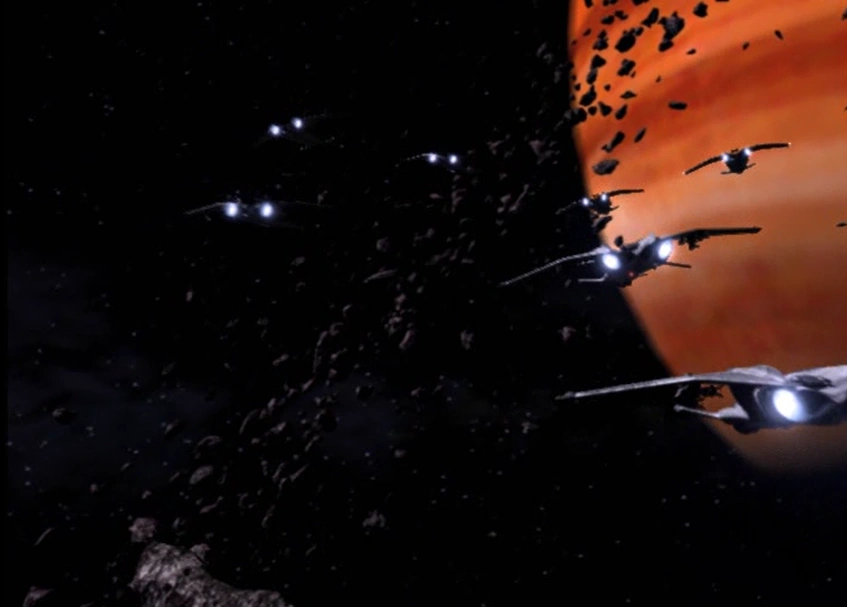
Now that we have an update to our Action Vehicular Combat, integrated the Chase rules, the Dogfighting rules and a few additional expansions, we need to test it out, with our newly revised Typhoons and Starhawks! Naturally, we need pilots, so we’ll choose our old friend Tobin Starlaw, to whom we’ll give this fancy new Ace Fighter advantage, and we’ll choose Starlet as his wingman. Starhawks are superior to Typhoons (they certainly cost more), and Tobin and Starlet are superior pilots, so they should be able to easily handle an array of mook fighters. Thus, for this battle, we’ll have the pair face off against a wing of 5 typhoons in an asteroid field (Rough, Normal terrain which starts at Distant range).

For simplicity, Tobin has Pilot 18, Gunnery/Artillery 16, Daredevil and Ace Fighter. Starlet has Skill 15 in everything pertinent. Tobin has an ally Tech-Bot with skill-18 in anything pertinent (mainly Electronics Operations, Hyperspace navigation and doing quick repairs). Starlet has some lame, run of the mill robot with no personality and skill 12. The Starhawk stats are here. What matters most is that the Starhawk has the following traits:

  • 140 HP, HT 11

  • An absolute maximum speed (for escape) of 650 (+14)

  • +4 Dodge (in high agility)

  • A best possible Chase Roll (high agility, afterburner) of +17

  • +4 accuracy on its missiles (4 missiles), with 6dx10 damage

  • -4 ECM (and a decoy launcher)

  • ROF 12 cannon (+2 to hit), with 6dx5(5) damage

  • DR 15 and force screen DR 200 which can be angled.

Our imperial pilots have skill 12. For a reference to a typhoon, see here. What matters most is that the Typhoon has the following traits:

  • 90 HP, HT 9f

  • An absolute maximum speed (for escape) of 750 (+15)

  • A best possible Chase Roll (afterburner) of +15

  • +5 dodge

  • -4 ECM (and a decoy launcher)

  • ROF 6 between two cannons (+1 to hit), with 6dx5(5) damage

  • DR 15

Wednesday, October 17, 2018

Action Vehicular Combat

These rules are based on the GURPS Action Chase rules starting on Page 31 of GURPS Action 2: Exploits; this has been substantially updated to account for dogfighting and other, heavier forms of vehicular combat.  While this was designed for Psi-Wars, most of it should work for any vehicle-heavy Action game.

Tuesday, October 16, 2018

Action Vehicular Combat - Musings

One of the reasons I wanted to step away from GURPS Spaceships is that it seems less compatible with the GURPS Action rules than I would like, and I didn’t want one rule-set for outspace and one ruleset for the ground. In principle, a repulsor-car chase and a dogfight should be essentially the same.

I’ve dug through the chase rules, and the Dogfighting rules from Pyramid and, of course, I’m already familiar with the Spaceship combat rules. My intent here was to get a feel for how things worked, and what I’d want to change if I wanted to use the rules for Psi-Wars. My core discovery is that the Chase rules are for chases, and what I really want is a vehicular combat system. The chase rules comment several times on what happens when you “Catch up” to your target: combat happens. Fortunately, the chase rules support combat, allowing the game to flow in and out of combat and chases:

Chases and combat aren’t exclusive! The chase rules support combat during a chase, and the GM is free to end a chase if both sides decide to stop running and start shooting. Similarly, if somebody bolts from a fight, the GM can switch over to the chase rules -GURPS Action 2 page 31

So if we want a more comprehensive example of what a Psi-Wars Dogfight or Tank battle looks like, what we ultimately need to do is work out how vehicular combat should work in GURPS Action, as the GURPS Action doesn’t really consider this, focusing more on cars and motorcycles than tanks and fighter jets.

Incidentally, a quick aside: one thing I’ve struggled with in GURPS Action is how to handle movement. If you’re at rifle range and you want to move to melee range, how do you do it? The answer has been staring me in the face the whole time: you trigger back into the chase rules. Duh. This actually means moving into melee is actually pretty easy.

Thursday, August 23, 2018

Dogfighting 2: Jet vs Tank


One thing I’ll need to handle if I get into fighters vs cap-ships, I need to see how high-speed craft work against slower, sea-bound craft, but I don’t have sea-bound craft that I can compare the standard TL 8 fighter to. However, I do have tanks. High-Tech has a TL 8 main battle tank, but I’m pretty sure I know how that fight will end, which is with a dead tank on turn one, because the fighter will get a missile lock, fire, and kill. The only real disadvantage is that the fighter isn’t carrying any missile that easily punches through armor, but the top of a tank is only DR 100, and the missile deals 200 damage; it wouldn’t necessarily be a one shot kill, but the tank sure wouldn’t be happy. Thus, I’d like to propose using the TL 9 “Light Battle Tank” from GURPS Ultra-Tech. It’s more advanced than the fighter, but at least it can fight back and make things interesting.

“Surely,” I hear you say, “GURPS Action doesn’t handle things like a fighter jet ‘chasing’ a tank.” Oh, but it does! It calls this mobility pursuit. The fighter is able to operate on three dimensions and can treat the tank as static. Of course, it must pursue in ways that the tank cannot compensate for. Just chasing the tank over flat ground is not mobility pursuit, but if the tank must go over rough, rocky ground that the fighter can just soar over, then it becomes a mobility pursuit. Similarly, if things go bad for our fighter, it can use a mobility escape, simply climbing beyond the range of the tank.
It should be noted that the tank and a Psi-Wars capital ship aren’t precisely the same, because a fighter can’t use superior mobility against a capital ship, as both operate in three spatial dimensions, but we have some additional ways we can simulate it in Psi-Wars, if it comes to that.

Tuesday, June 14, 2016

Fixing Scrapperlock

Every once in a while, the GURPS blogger community forms a wave of ideas.  Someone will post something, and then other people, inspired by the idea, will pile on and put in their own two cents.  This time, it was Douglas Cole on running away, which had followups from Peter on Dungeon Fantastic and Michael Eversburg over at Chainlink and Concrete.  The general context of the discussion was the fact that players will take on things too big for them and then fail to run away.  All of them offer insights into how best to run away and speculate a bit on why it's so hard, but I want to talk first about the psychology of why players don't run away.

Monday, March 21, 2016

Psi Wars: Spaceships!

Seldon Crisis: Battle by AdamBurn
You seem to want a system for whooshing space opera battles between fighters and capital ships.  GURPS Spaceships is not that system.

I've held off on dealing with Spaceships for as long as I could, not because I dislike the book, but because I knew how much work it would be, and boy was I right. This was a doozy.  Ulzgoroth, above, is not wrong. GURPS tends to trend towards the realistic and Star Wars is, to put it lightly, not realistic.  That said, GURPS Spaceships actually does address whooshy spaceships at great length, especially in  Spaceships 4: Fighers, Carriers and Mecha, but we're going to have to parse all of that, understand all of it, and then pull out all the pieces and put them back together to get the game we want.  Unsurprisingly, I can't find much material on this sort of thing.  Most people I find who actually use GURPS Spaceships use the tactical system out of Spaceships 3, because it works pretty well out of the box.  We'll take a look at that too, but by the time we're done, we'll have a combat system that's as unique to Psi-Wars as the Chase System is to Action.

I'll be posting Spaceships stuff all week. And all of next week too.  Like I said, a doozy.  Today, I'll take a look at what's wrong with the actual Star Wars paradigm and why it's so hard to model in Spaceships, and we'll take a glance at alternate GURPS models that might work better.

Thursday, February 4, 2016

Psi-Wars -- Adjusting the Templates

Now that we've adjusted the rules accepted that GURPS Action can serve as the engine for our Psi-Wars campaign, we can also revisit the templates from GURPS Space, which are pretty basic and constrained, and we can replace them with something more befitting of our particular vision of  cinematic space-opera universe.

Before we begin, though, I want to make a very important note: We don't actually need to do this. If Action 2 is mostly compatible with how we see Psi-Wars, then Action 1 is as well.  There's no reason that we can't just use Shooters and Wheelmen and Faces, with a modicum of adjustment.  In fact, any templates I create here will probably look mostly like those already.  So, if you're interested in running this now, just do it!

But say we want something a little more specific. Perhaps we want to make the Core/Rim split more pronounced by writing it right into the templates, or we feel like some of the templates don't really fit the Action templates: A bounty hunter isn't really an Investigator, nor is he an Assassin, nor is he a Big Man, but he's a little of all three. Certainly Space Knights are almost nothing like anything in Action, except possibly the Weapon Master.  Likewise, some of the Action templates really don't fit well at all in a Star-Wars inspired universe, like the Wire Rat or the Hacker.

I'm going to go ahead and make new templates, in part because of the problems noted above, but also so that you, dear reader, if  you are unfamiliar with how templates are made, can have a chance to see how I go about making them.

I prefer to open up my copy of GURPS Template Toolkits 1: Characters and use the process noted in there.  First, we would need to define our core activity (which, if you remember, we did in Iteration 1).  Then we'd need to work out niches, with suitable traits, that address those core activities ("Spying, Combat, Space"), then mix and match those niches and traits to create interesting templates ("An assassin is about the stealth and deception portions of spying mixed with a stealthy, ambush-focused combat").  We do this to make sure we don't miss anything.  The book goes into exquisite detail about how to do all of that, but the building of this pre-framework framework takes a lot of work.  Do we want to make that much of an investment? Do we need to?

Well, we've already noted that we can use GURPS Action, right? Action already has a list of "appropriate traits" and it's already divided all of its niches up and put them in a handy "build your own character" book called GURPS Action 4: Specialists. This excellent book will let you make nearly any character you want... including, say, a Bounty Hunter or a Fighter Jock or a Diplomat (for aggressive negotiations).

Of course, we want to build a template rather than a character, but Specialists can give us guide-posts on what skills might be useful.  As an example, I'm going to create the Bounty Hunter template right here in this blog post.

Thursday, January 28, 2016

Psi Wars: The Second Iteration -- Adjusting the Rules

GURPS Action!

Previously, we grabbed a few core elements from Space and Ultra-Tech and used them to rapidly prototype our campaign, and according to our playtest, it worked!  We have a pretty functional game. You can sit down and run Psi-Wars as written.

But I prefer something with a little more detail. Many aspects of the characters feel off. The space knight isn't very Jedi-like, and our heroes aren't as heroic as I would like.  Morever, I find that the ideal design for a campaign is a campaign framework.  Works like Dungeon Fantasy, Action and Monster Hunters really drill down on the rules that matter to them, build their templates and their rule-sets around that.

For the next phase, I'd like to do the same for Psi-Wars.  I want to focus on our core activity, pull out the various niches appropriate for that core activity, and then figure out how best to express that in both rules and character.  I'd want templates, focused mechanics, and unique rules.

Now, the proper way to do this would be to dig through piles of books that use the rules that we want: Martial Arts, Gun Fu and Technical Shooting for the combat rules, Mass Combat for the mass combat rules, Spaceships for the space fighter rules, Campaigns for things like dangerous planetary environments or picking locks or detecting danger.  But that would take far too long for the purposes of Psi-Wars, which is supposed to be a study in quick campaign building.  So we need something we could steal from.

What other GURPS work focuses on cinematic action involving combat, infiltration and exfiltration, espionage, military-scale combat and commando missions?  Oh, I know: GURPS Action.  There are two books GM veterans always end up recommending to people: the first is GURPS Powers, and the second is GURPS Action 2: Exploits.  In my experience, a significant portion of the gaming populace just wants to run games that resemble the action movies that they enjoy in the theater, and Star Wars is no exception.  While I don't believe that Action is ideal for running every type of game (Dungeon Fantasy and Monster Hunters are distinctly different, and a hypothetical, Star Trek-inspired Captain-and-Crew game would also feel different), but it'll certainly work for our Psi-Wars.

So, all we need to do is comb through GURP Action 2: Exploits and see where our campaign needs to differ.  I've done so below (It's after the jump.  There's a "Read more!" in case you miss it, as this is a long intro post), but I've also included a "tl;dr" for those of you who just want the results and want to get on with the game.  I would recommend reading my notes, however, if you like this approach and want to apply it to other genres. "Like Action, but with X" describes many RPG genres, including cyberpunk, post-apocalyptic works in the milieu of Mad Max, the Assassin Creed series, and hypothetical fantasy works that focus more on cinematic action than on dungeon crawling.  The differences I highlight below tend to be those based on setting assumptions and technologies, which are the same things that will differ in your version too.

The core results are this: Almost everything works exactly as described in Action.  The main technological differences are noted below:
  • Infrared Cameras (UT 60-61) replace normal cameras.
  • Ultrascanners (UT 66), usually set to automatically search for either life signs or power signatures. It may have a profile system and sound an alarm when it detects someone not on that “white list.”  These replace most of your security systems.
  • Ultrascan Portals (UT 104) replace most search procedures.
  • RF Bug Detector (UT 106) are used for bug-hunting.
  • Cuff Tape (UT 107) replaces zip-ties.
  • Electronic Cuffs (UT 107) replace cuffs.
  • Neuronic Restraints (Agony option) (UT 108) also replace cuffs and augment torture.
  • Power Dampers (UT 108) also replace cuffs for our psionic characters.
  • Verifier Software (UT 106) replace polygraphs.
  • Privacy Field (UT 106) defeat eavesdropping attempts.
  • Add Neural Disruption Field (Agony option) (UT 103), Rainbow Laser Fences (UT 101) in the “Open” configuration, and Nerve Poison and Sleep Poison (both UT 161) to the trap options.
  • Plasma charges (UT 88) replace most explosives, and are improvised using power cells and the Electrician skill
  • Mechanical locks do not exist.
  • Crediline(UT 205) replaces truth serum.
  • A generic "Tracer" device replaces all of the various bug and tracker options.
  • A EM grapnel with a balloon piton replaces most climbing technology ("Look, ma, a tow cable!")
  • Insertion happens on foot, by ship, by shuttle, by vehicle, by scuba/submarine, or by orbital insertion with drop capsule or stealth capsule (UT 232)
  • Beam Weapons replace Guns
  • Hacking rules replace most intercepts (and are mostly done by robots, so we don't have to fuss with it)
A few skills gain greater importance:
  • Ignore Forensics references. Psi-Wars isn't that subtle.
  • Favor Intelligence Analysis over Criminology
  • Favor Research over Computer Operations (which has its own role)
  • Technological challenges are more often the domain of robots than humans.
  • Engineering (Starships) is to starships what Architecture is to buildings.
  • The primary “Getting around” skills are Piloting (Contragravity or Starship), Hiking, Running, Swimming, Scuba, Parachuting and Navigation (Hyperspace)
Beyond this, almost all rules remain the same.

Note: If you want to follow this iteration, it might be useful to invest in the GURPS Action series.  I'll come back to it quite often throughout Psi-Wars.  It's also one of the best campaign frameworks out there.
Related Posts Plugin for WordPress, Blogger...